




















How Large a Home Can a 12 kW / 30 kWh All-in-One Battery System Back Up?
Oct 23, 2026
Leave a message

Key takeaways
|
what a residential backup power system should cover
A 12 kW / 30 kWh all-in-one suits a detached or semi-detached house of roughly 2,200 to 4,100 square feet (200–380 m²) consuming 35 to 55 kWh per day. Behind an 8–12 kWp array that ceiling stretches to about 4,800 square feet. Past 5,400 square feet, or in a fully electrified house with heat pump, pool, elevator, and two EV chargers, one cabinet covers 45–65 percent of the overnight load and a second unit stops being optional.
That is not a positioning statement. It falls out of two limits meeting in the middle: the power limit of 12 kW continuous AC output, and the energy limit of what 30 kWh of LFP delivers at the terminals after depth-of-discharge, round-trip efficiency, and fade. Everything below converts those limits into floor area, array size, outage hours, and dollars - which is what properly sizing a solar backup generator for home or grid-charged system actually means.
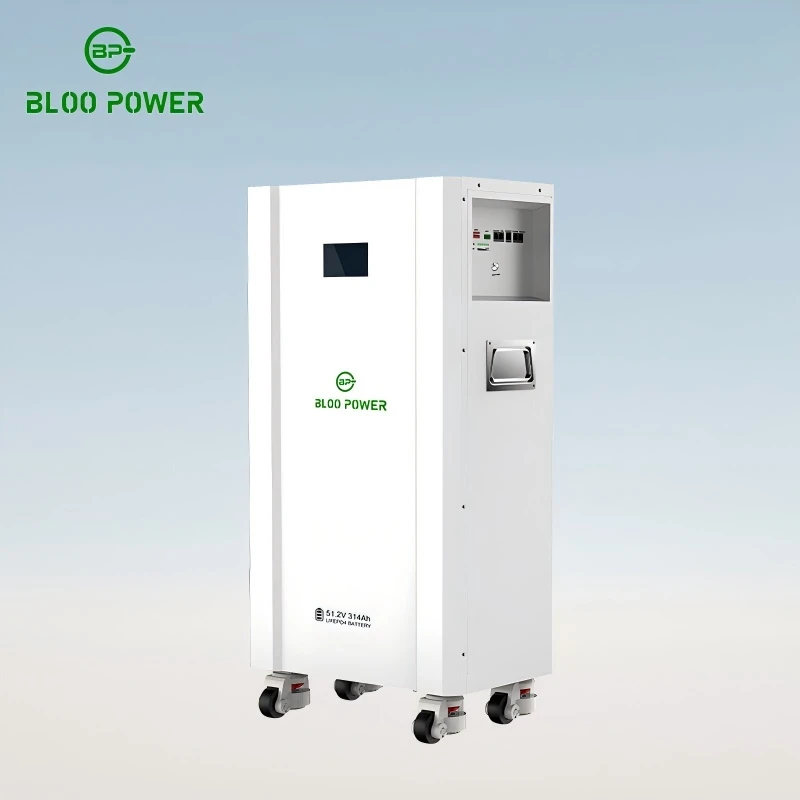
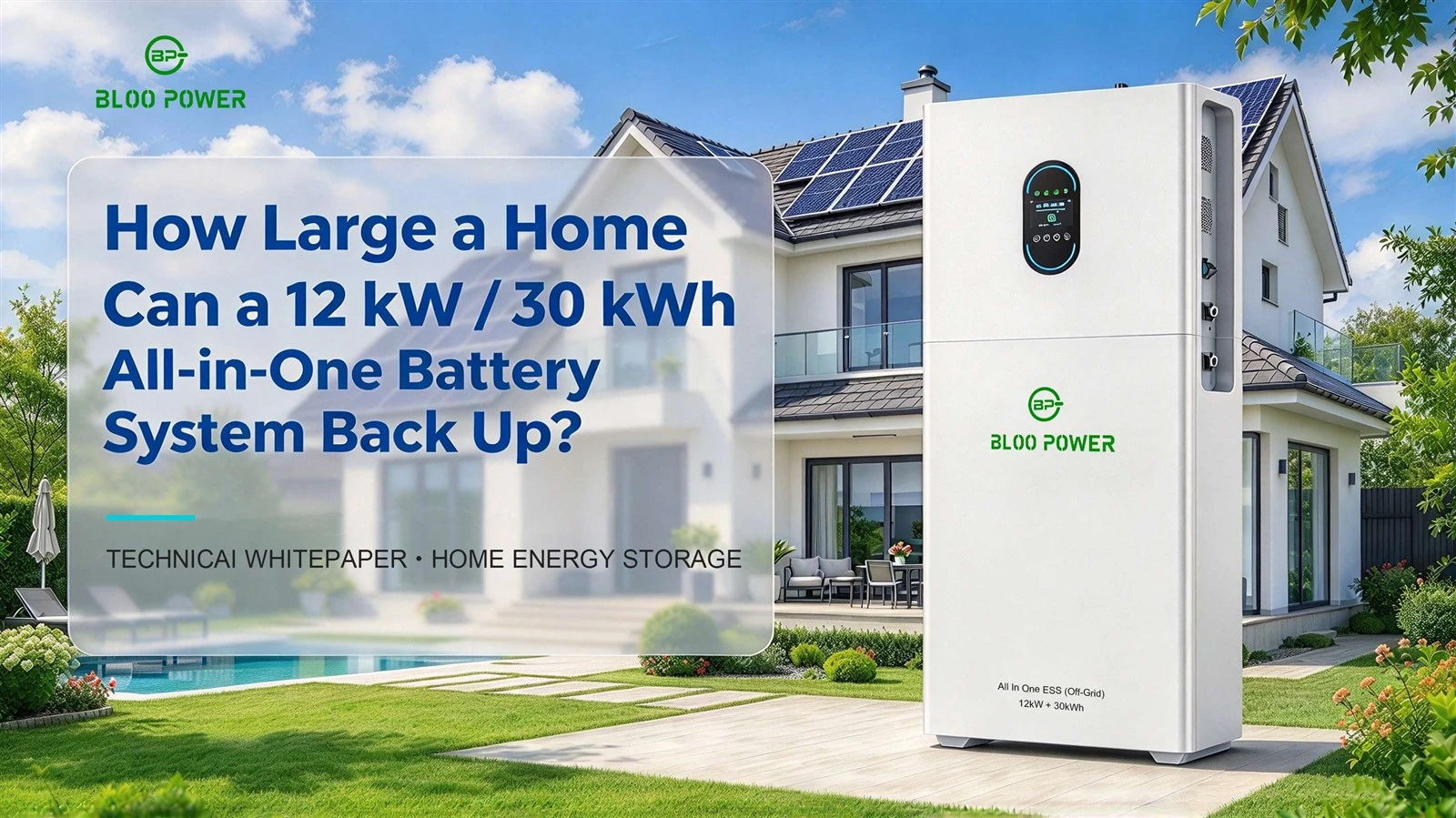
The reference hardware is the BLOO POWER BP-ALL-30KWH-A: one cabinet combining a 30 kWh LFP pack, a 12 kW single-phase inverter (120/240 V split-phase for North America, 230 V for Europe), 200 A continuous charge/discharge, and an integrated EMS. It sits on the fault line between "enough for a large house" and "not enough for an estate," which makes it a useful lens on the whole best home battery backup category, and its split-phase output is what makes it a credible solar battery backup for home candidate in North America rather than a Europe-only product.
Two definitions. Usable energy means what the inverter delivers to loads, not the nameplate figure. Overnight load means consumption between roughly 18:00 and 08:00, typically 50–60 percent of the daily total. Confusing either pair explains most bad sizing in the field - and why a residential backup power system quoted at nameplate so often disappoints in year eight.
Why floor area is the wrong input
Ask "what size house does this back up" and you have accepted a false premise: that floor area determines consumption. It correlates weakly, and the correlation collapses at the top of the market - exactly where this equipment sells.
Two houses of identical 3,200 square feet can differ threefold. The first runs mini-splits, a gas range, and a gas water heater: 30 kWh a day. The second adds a geothermal heat pump, a heated pool, resistance backup, and two EVs: 88 kWh a day. No single capacity is right for both.
What decides sufficiency is narrower: peak-coincident overnight load and peak instantaneous demand. Those are what a residential backup power system actually serves, whether the array is 12 kWp or absent, and area predicts them badly enough to be an output of the sizing exercise rather than an input.
There is a usable middle path. Building-energy research on large single-family homes converges on 5.5 to 8.4 kWh per square foot per year (60–90 kWh/m²·yr) for houses with central cooling, hydronic or forced-air heat, and domestic hot water. A 3,200 square foot house lands between 48 and 73 kWh a day - wide, but bounded, and wide in a predictable direction: the upper half is all-electric, the lower half still burns gas.
So sizing starts with twelve months of bills and one week of interval data, not a floor plan. A homeowner pursuing home battery backup without solar carries an extra constraint, because every stored kWh is bought from the grid, so marginal price rather than average price sets the value - and that is the figure that makes two best solar generator for home backup quotes comparable at all.
The 12 kW power limit: what a large house actually draws
Twelve kilowatts looks modest beside the 20 kW inverters sold into the same market. In single-phase residential service it is close to the ceiling: 12 kW at 240 V is 50 A continuous, and most detached homes sit behind a 200 A panel whose practical continuous allocation to any circuit group is well below nameplate.
The question is not what the house could draw with everything running, but the coincident peak. Decompose a 3,200 square foot house with a 4-ton variable-speed heat pump: compressor and air handler 3.5–7.1 kW; heat-pump water heater 1.5–3.0 kW; induction range plus wall oven 3.0–5.0 kW; lighting and plugs 1.0–2.0 kW; elevator 2.0–3.0 kW running, 3× at startup; pool circulation 1.5–2.5 kW; Level 2 EV charging 7.2–11.5 kW. A residential backup power system is sized against that sum after diversity, never against the panel rating.
Summed naively that is 24–44 kW, which is why naive summing produces absurd conclusions. Residential demand factors - 0.5–0.6 whole-house, 0.7–0.8 within HVAC - bring the realistic coincident peak to 12–16 kW. So 12 kW is not undersized; it sits at the lower edge of the real peak, deliberately. In grid-tied mode the utility covers any shortfall, and the inverter's job is peak shaving, self-consumption, and ride-through.
Islanded, the EMS prioritizes instead: pool pumps, EV charging, backup heat, and the elevator move to tier 2 or 3 and are shed, while refrigeration, lighting, networking, well pump, and one cooling zone hold tier 1. This is where an integrated enclosure earns its footprint - one controller runs the MPPT, the transfer logic, and the load tiers, with no third-party gateway to commission.
Table 1. Coincident peak by load scenario, and the share of it one 12 kW cabinet carries without load management.
| Load scenario | Coincident peak | 12 kW coverage | Strategy |
| Essentials: lighting, kitchen, DHW, ventilation | 6–8 kW | 100% | Full islanded operation |
| Essentials + one central AC zone | 11–13 kW | 90-100% | Inverter-driven compressor or soft start |
| Full cooling + hydronic heat + DHW | 14–18 kW | 65–85% | Grid supplements; shed off-grid |
| Above + 7.2 kW Level 2 EV charging | 18–22 kW | 55–65% | Schedule to super-off-peak |
| All-electric + pool + elevator + two EVs | 22–26 kW | 45–55% | Two units in parallel |
The last row matters because the reason to parallel is simultaneity, not capacity: two 12 kW units deliver 24 kW coincident, enough to run the pool pump and the EV charger while the heat pump is at full load. Anyone specifying a solar backup generator for home at that tier should budget the second cabinet at design time, since the subpanel and conductor sizing change - the advice most best home battery backup comparisons omit.
The 30 kWh energy limit: three derating steps
Nameplate energy is a laboratory quantity. What reaches the load passes three deductions, each with a documented basis. Getting them wrong is the difference between "covers the night" and "dies at 02:00."
Depth of discharge. Cycling LFP to 0 percent shortens life measurably, so practical systems hold a 10 percent floor and leave the BMS headroom to balance. 30 × 0.90 = 27.0 kWh - the first figure any home battery backup without solar quote should show.
Round-trip efficiency. Energy enters as DC and leaves as AC, losing to internal resistance, BMS quiescent draw, and switching. Integrated units in this class specify up to 95 percent; split architectures with an extra DC stage land at 88–92 percent. 27.0 × 0.95 = 25.65 kWh at the terminals when new - the number a solar backup generator for home datasheet usually rounds up.
Capacity fade. IEC 62619 and UL 1973 define safety, not endurance. Endurance comes from GB/T 36276-2023, which requires ≥80 percent retention after 1,000 cycles, and from MIIT storage-cell conditions requiring ≥6,000 cycles to 80 percent. The BP-ALL-30KWH-A cell is rated 8,000 cycles at 80 percent DoD, implying a twenty-year horizon at one cycle a day. On the conservative assumption of 80 percent at year ten: 25.65 × 0.80 = 20.5 kWh.
The honest figure is therefore a range: 25.6 kWh new, 20.5 kWh at year ten, 23 kWh as a design midpoint. Dividing daily load by 23 rather than 30 is what separates a defensible specification from an optimistic one.
Converted back to a house: at an overnight share of 50–60 percent, 23 kWh usable supports 38–46 kWh per day, and 25.6 kWh supports 43–51 kWh. Their union, 35 to 55 kWh daily, is where the headline recommendation comes from - materially more conservative than dividing 30 by daily consumption, and deliberately so.
Temperature is the last derate. LFP delivers roughly 90 percent of rated capacity at 0 °C and 75–80 percent at −10 °C, and the BP-ALL-30KWH-A is rated −10 to 50 °C operating - conditioned space, not an unheated garage. Site a solar battery backup for home system indoors, or discount winter runtime by 20–25 percent.
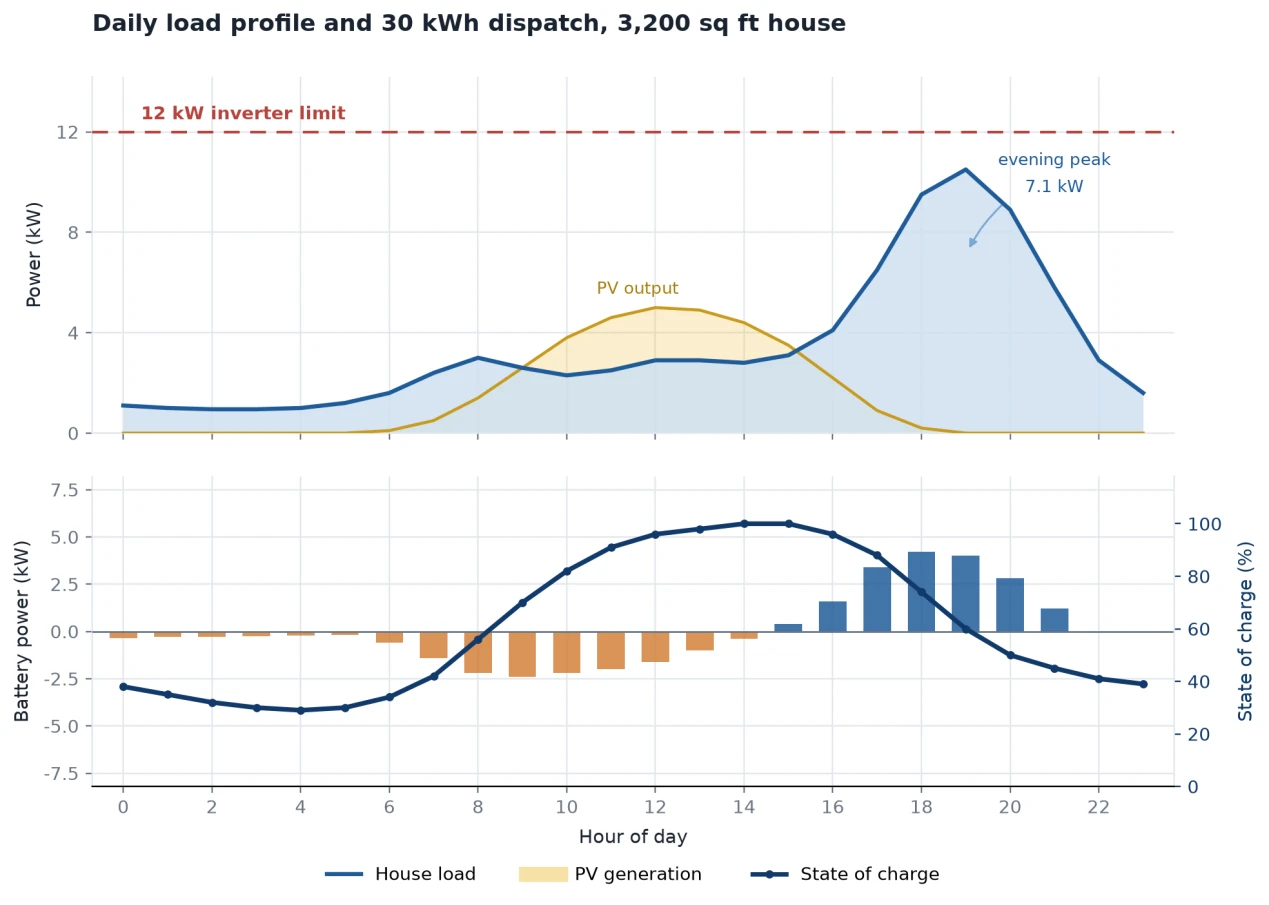
Figure 1. Summer load profile for a 3,200 sq ft house (top) against battery power and state of charge (bottom). Surplus PV charges through midday, the evening peak discharges, and the super-off-peak window tops the pack back up.
Cross-validating two sizing methods
Because area maps to consumption loosely, one method cannot carry a specification. Two run in parallel, with the cabinet itself as a third check: if they converge, the interval is real; if they diverge, the divergence names the dominant variable.
Energy-use intensity. At 5.5 kWh per square foot per year, 2,200 square feet uses 33 kWh a day and 4,300 square feet uses 65. At 8.4, the same houses land at 50 and 99. Sensitive to electrification status by 30–50 percent, so a solar battery backup for home estimate should always be run twice, once at each intensity.
Metered bills. Utility data for 2,000–3,200 square foot homes typically shows 800–1,500 kWh a month, or 26–49 kWh a day, with summer peaks above 2,000 kWh. Faithful to reality, but biased low for estates.
The methods converge most tightly between 2,200 and 3,500 square feet, at 30–50 kWh per day, against a cabinet design coverage of 38–51 kWh. That overlap is the origin of the 2,200–4,100 square foot recommendation: not a market segment someone chose, but where independent estimators intersect.
Table 2. Two independent sizing routes converge on the same floor-area answer, checked at four house sizes.
| Method | Basis | 2,200 sq ft | 3,200 sq ft | 4,300 sq ft | 5,400 sq ft |
| Intensity, low (5.5 kWh/sq ft·yr) | Area × 5.5 ÷ 365 | 33 kWh/day | 48 kWh/day | 65 kWh/day | 81 kWh/day |
| Intensity, high (8.4 kWh/sq ft·yr) | Area × 8.4 ÷ 365 | 51 kWh/day | 74 kWh/day | 99 kWh/day | 124 kWh/day |
| Metered bills | 800–1,500 kWh/month | 26–49 kWh/day | 26–49 kWh/day | 33–62 kWh/day | 41–77 kWh/day |
| 30 kWh cabinet coverage | 25.6 kWh ÷ 50–60% overnight | Full | Full | 70–85% | 50–65% |
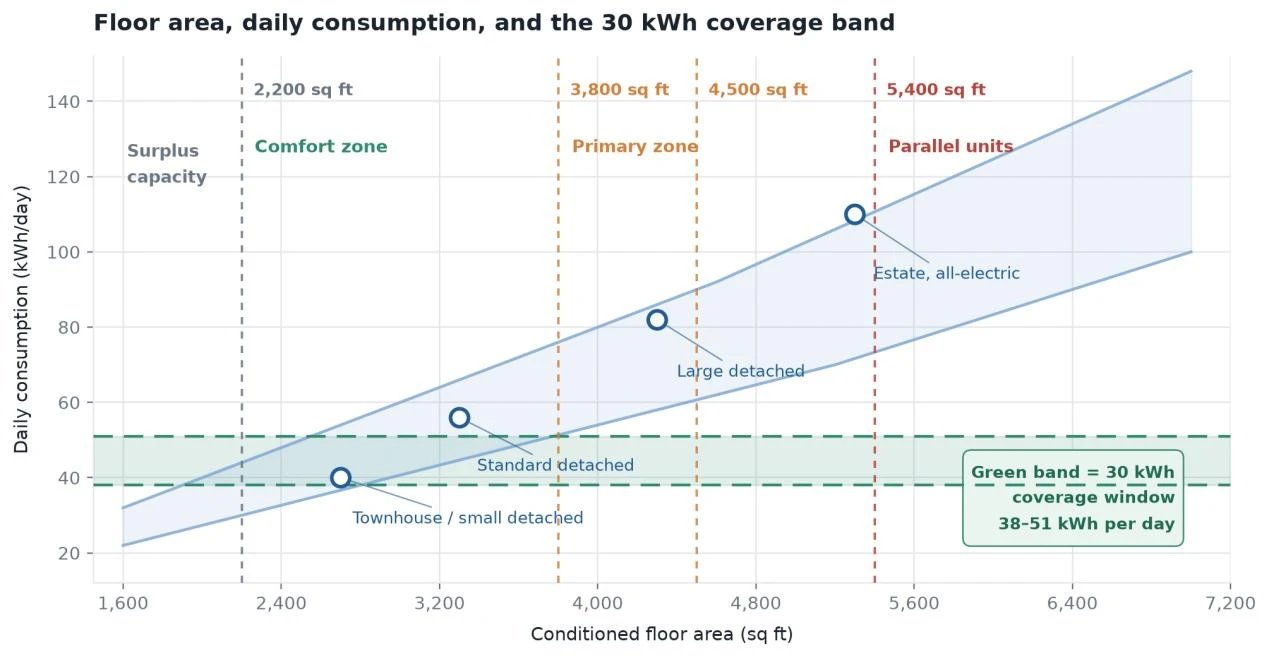
Figure 2. The empirical area-to-consumption band (blue) against the cabinet's true coverage window (green). The intersection sits near 2,200–3,800 square feet; beyond it, PV raises the ceiling and parallel units raise it further.
For whole home battery backup for a 3,000 sq ft house, the methods bracket demand at 42–58 kWh a day, half of it overnight. That is 21–29 kWh against 25.6 kWh usable - it fits, with thin margin, and the margin thins further in year nine. Hence sizing at the midpoint: the third of the range given up at commissioning is the third you want back a decade later, which is why best home battery backup shortlists belong on year-ten usable energy, not carton numbers. A solar backup generator for home shortlist deserves the same treatment.
Climate: how geography moves the ceiling
The same cabinet supports an 800 square foot larger house in Miami than in Minneapolis. The mechanism is not the equipment but the interaction between when load occurs and when the array produces.
Hot-humid (2A) - Houston, Miami, Tampa. Cooling runs eight or nine months with almost no heating load, so the profile is flat. Yield is 1,300–1,500 kWh per kWp and cooling nearly coincides with PV output, leaving the battery to cover the evening peak. Ceiling: 3,800–4,300 square feet, with hurricane resilience rather than arbitrage as the value driver - which is why this region buys more best solar generator for home backup capacity than any other.
Mixed-humid (4A) - Atlanta, New York, Philadelphia. Dual peaks raise consumption 20–30 percent above 2A, and the winter peak lands at night when PV output is zero, so a residential backup power system here charges at off-peak rates in January and the logic flips from self-consumption to time-of-use shifting. Ceiling: 3,200–3,800 square feet.
Cold (5A/6A) and very cold (7) - Boston, Chicago, Denver, Minneapolis, Montreal. A long heating season dominates, and air-source COP falls from 4.0 to 2.0–2.5 at design temperature, so the same heat needs 1.6–2× the electricity. Yield is higher at 1,150–1,350 kWh/kWp, but the winter trough coincides with the peak. Ceiling: 2,800–3,400 square feet, falling to 2,200 with resistance backup and to two cabinets where heating degree days are extreme and sub −20 °C mornings trip BMS charge protection - a spread no best solar generator for home backup sizing tool can average away.
Hot-dry (2B) - Phoenix, Las Vegas, Tucson. The best resource at 1,700–1,900 kWh/kWp, offset by the highest cooling energy per square foot: 90–120 kWh a day is normal, so the battery covers the 20:00–24:00 peak and little else. Ceiling: 3,500–4,000 square feet - peak-shaving hardware, not a best home battery backup argument for autonomy.
Table 3. Five North American climate zones, their specific yield, and the floor area one cabinet still covers.
| Zone | Market | Specific yield | 10 kWp annual | Dominant load | 30 kWh ceiling |
| Hot-humid (2A) | Houston, Miami | 1,300–1,500 kWh/kWp | 13,000–15,000 kWh | 8–9 month cooling | 3,800–4,300 sq ft |
| Mixed-humid (4A) | Atlanta, New York | 1,200–1,400 kWh/kWp | 12,000–14,000 kWh | Dual heating/cooling peaks | 3,200–3,800 sq ft |
| Cold (5A/6A) | Boston, Chicago | 1,150–1,350 kWh/kWp | 11,500–13,500 kWh | Long heating season | 2,800–3,400 sq ft |
| Very cold (7) | Minneapolis, Montreal | 1,050–1,250 kWh/kWp | 10,500–12,500 kWh | Extreme HDD, weak winter PV | 2,200–2,800 sq ft |
| Hot-dry (2B) | Phoenix, Las Vegas | 1,700–1,900 kWh/kWp | 17,000–19,000 kWh | Cooling-dominant peak | 3,500–4,000 sq ft |
The pattern worth internalizing: the ceiling is set less by annual consumption than by how much of it occurs after dark in the coldest month. A Houston house can consume more per year than a Boston house and still be served by the same battery.
This also answers the question buyers ask constantly - how long will a 30kWh battery run a house in these conditions? Section 9 gives hours rather than adjectives, but the answer moves by a factor of two between a Miami summer night and a Minneapolis January night. For a solar battery backup for home design in a cold zone, that qualifier separates a two-day outage plan from a four-hour one.
Matching array size to battery size
Battery and array are a vessel and a tap: an oversized vessel never fills, an oversized tap spills surplus onto the grid at export rates that are a fraction of retail. Two derivations, one intersection.
Fill-time. Charging 30 kWh within four effective sun hours needs 30 ÷ (4 × 0.95) ≈ 7.9 kWp. Four hours is optimistic; 3.0–3.5 equivalent hours is realistic, pushing the requirement to 9–10.5 kWp.
Balance. A 3,200 square foot house at 45 kWh a day targeting 80 percent solar coverage needs 36 kWh, which at 1,400 kWh per kWp and a 0.82 performance ratio is 36 × 365 ÷ (1,400 × 0.82) ≈ 11.4 kWp.
The two bracket 8–12 kWp: 8–10 kWp to fill the battery and cover daytime base load, 12 kWp to maximize self-consumption and suppress the top tariff tier. At 440 W per module that is 18–27 panels, or 400–600 square feet of roof.
Two details matter more than the headline. MPPT channel count: a roof with dormers, a chimney, and two orientations loses 8–15 percent of production to mismatch on a single channel, and separate trackers recover most of it. Performance ratio: 0.78–0.85 is defensible; 0.82 embeds degradation, temperature, wiring, and soiling.
Sized this way, the cabinet works as a solar backup generator for home duty rather than a grid-charging battery: an 8 kWp solar backup generator for home refills a full pack in three to four effective sun hours while carrying daytime load, where a 4 kWp array needs two clear days. That is also the practical test of whether solar battery backup for home capacity is being used or merely installed.
The economics: marginal price, not average price
The commonest modeling error in residential storage is valuing displaced kWh at the average retail rate. A house consuming 18,000–25,000 kWh a year has long since entered the upper tier, so the marginal kWh - the one a battery displaces - is priced at the top tier.
Take a representative California time-of-use schedule: peak 40–55 ¢/kWh on summer evenings, off-peak 25–33 ¢, super-off-peak 20–27 ¢, export under net billing 5–8 ¢. For a house at 22,000 kWh a year, two-thirds of consumption bills at peak or upper-tier rates, so every kWh shifted from 19:00 to 02:00 earns an 18–25 ¢ spread.
Three value streams follow. Self-consumption uplift: a 10 kWp array without storage self-consumes about 55 percent of output, with storage 85 percent, and the extra 4,500 kWh earns retail rather than export. Time-of-use arbitrage: 25.6 kWh × 330 cycles × the spread. Resilience: unmonetized in any payback calculation, and usually the largest number on the page - the three inputs that decide any best solar generator for home backup business case.
Table 4. Indicative economics by market: marginal TOU spread, annual benefit, installed cost, and simple payback.
| Market | TOU spread | Specific yield | Annual benefit | Installed cost | Simple payback |
| California (E-TOU-C) | 18–25 ¢/kWh | 1,500 kWh/kWp | ~$4,000 | ~$46,000 | ~11 years |
| Northeast (MA, NY) | 10–15 ¢/kWh | 1,250 kWh/kWp | ~$3,100 | ~$44,000 | 14–18 years with adders |
| Southwest (AZ, NV) | 10–14 ¢/kWh | 1,800 kWh/kWp | ~$2,000 | ~$40,000 | ~20 years |
| Flat-rate (TX, GA) | 0–5 ¢/kWh | 1,400 kWh/kWp | ~$900 | ~$40,000 | Not an investment case |
The last row is the honest one and the one vendor material omits. Where rates are flat and export is uncompensated, a home battery backup without solar - or with it - cannot pay for itself through arbitrage. It is a resilience purchase priced against a standby generator plus the outages avoided. That is legitimate: a 22 kW standby unit runs $6,000–$12,000 installed before fuel, needs annual service, and is audible from the property line. But it is insurance, not a return, and reading the table that way is what separates a best home battery backup purchase from a cheap one.
That reframing changes how a residential backup power system is scoped in flat-rate territory. Size for the outage you want to survive rather than maximum throughput: essentials for 24 hours is 44 kWh, one cabinet plus load discipline, at a third of the alternative. Where a home battery backup without solar is the only option because the roof is shaded or rented, the marginal price is set entirely by the spread - and the home battery backup without solar panels cost question resolves to $11,000–$16,000 installed.
Backup runtime in hours, not adjectives
Buyers talk about bill savings and think about darkness. Hours of runtime is the only honest currency, and it is a division once the load tier is fixed.
A solar battery backup for home cabinet of this class runs grid-tied, islanded, and hybrid, with transfer in the millisecond range: desktops do not reboot, routers do not drop, alarm panels stay online, and inverter-driven compressors do not trip their three-minute restart protection. That last one matters more than the other three combined on a 35 °C afternoon.
Table 5. Runtime by load tier on 25.6 kWh usable, with the scenario each tier represents.
| Load tier | Continuous load | Runtime on 25.6 kWh | Scenario |
| Essentials only | 1.85 kW | 13.8 h | Overnight storm outage; refrigeration and comms protected |
| Essentials + one 12,000 BTU mini-split | 3.05 kW | 8.4 h | Typical summer outage, one room cooled |
| Essentials + one central AC zone | 6.85 kW | 3.7 h | Short outage; median restoration is 2–4 h |
| Whole house at rated output | 12 kW | 2.1 h | Full-load island, not long-duration |
| Essentials at −10 °C | 1.85 kW | 10.4 h | Cold-weather derate of 25 percent |
The delta between the first and fourth rows is the argument for load tiers. A best solar generator for home backup claim assuming whole-house load for eight hours implies a 96 kWh battery; the same claim made honestly, with tiers, is satisfied by 30 kWh. Whether that is acceptable is a conversation about what the client wants kept alive, and it belongs before the quote, not during the first outage - the single most useful question in any best home battery backup evaluation.
For multi-day autonomy - rural well pump, winter storm corridor, wildfire shutoff zone - the arithmetic is blunt: eight hours of whole-house load is 96 kWh, four cabinets. Most buyers discover that tiering is cheaper than capacity, and that one 30 kWh unit plus a transfer switch for pool and EV charging delivers 90 percent of the perceived benefit at a quarter of the cost. That is the honest core of most best solar generator for home backup proposals, and the reason a home battery backup without solar can serve the same outage on stored off-peak energy.
Which is also the honest answer to how long will a 30kWh battery run a house: long enough for the outages that actually happen, on the circuits that actually matter, and not long enough to pretend the grid is optional. If the requirement is genuinely best solar generator for home backup autonomy over several days, the specification is capacity, not marketing.
Safety and compliance: the certifications that matter
Industrial storage can be isolated in a dedicated room with suppression and fire-rated separation. A residential backup power system puts tens of kilowatt-hours inside the living envelope, where the escape window is measured in seconds. Chemistry comes first: LFP's olivine structure decomposes above roughly 500 °C, some 150–200 °C higher than NMC, and releases no oxygen, so it cannot sustain a self-oxygenating burn. The reason to specify LFP in a house is not energy density - NMC wins that - it is the escape window.
Certification stack. Three layers, each covering a different failure mode. Cell and module: UL 1973, IEC 62619, UN 38.3. System: UL 9540, and UL 9540A, which tests whether thermal runaway propagates from one unit to the next - the test that decides whether the cabinet may sit against a house wall. Grid interface: UL 1741 SB and IEEE 1547 in North America, EN 50549-1 in Europe. NFPA 855 and NEC Article 706 then govern spacing, egress, and disconnection.
BLOO POWER's storage line carries CE, FCC, MSDS, UN 38.3, UL 1973, and IEC 62619, built under ISO 9001, 14001, and 45001 in a 15,000 m² plant with 2 GWh of annual capacity and seventeen years of ODM experience. The value to a specifier is not the logos; it is that when the installer says the cabinet can go on the utility room wall, a test report sits behind the sentence - what a solar backup generator for home specifier should demand by certificate number.
Three field details datasheets omit: 200 mm clearance on both sides, a dedicated circuit with its own overcurrent protection rather than a tap off lighting, and a grounding conductor bonded to a measured electrode, because a dry-season rod on a large lot frequently reads above the code limit. Any residential backup power system review that skips them passes inspection and still fails in service - which is as true of a home battery backup without solar install as of a PV-coupled one.
Footprint, floor loading, and the space nobody budgets for
A residential backup power system cabinet of this class is roughly 600 × 450 × 1,100 mm and 250–290 kg. Footprint is 0.27 m²; the space it actually requires is 1.5–2 m² once you add 600 mm of front working clearance, 200 mm each side, and 300 mm above.
Floor loading deserves more attention than it gets. 290 kg on 0.27 m² is about 215 lb/ft² against a live-load value near 40 lb/ft² - misleading, because this is concentrated rather than uniform, but enough to make the check structural rather than arithmetic: against a beam, column, or wall corner the load goes into structure, while mid-span it needs a spreading plate or a steel member. That is an engineer's written opinion, not an installer's judgment call.
There is also a hidden spatial cost: conductor routing. DC from the roof may traverse three or four floors to a basement mechanical room; AC to the main panel is 10 mm² copper at 12 kW. One enclosure eliminates the long DC run split architectures force, which in a retrofit can decide the project - the strongest argument for a solar battery backup for home design built around an all-in-one, and the first thing a best solar generator for home backup survey should measure.
Scalability follows. The unit parallels to 16 cabinets, 480 kWh, 192 kW over CAN and RS485, so growth is "add a cabinet," not "replace the system" - provided cell batches, state of charge, and firmware are matched, and provided busbar, fusing, and conductor sizing are recomputed rather than inherited.
Table 6. Parallel capacity: output, stored energy, and full-load runtime as cabinets are added.
| Units | Capacity | Output | Typical application | Full-load runtime |
| 1 | 30 kWh | 12 kW | 2,200–4,100 sq ft detached home | 2.1 h |
| 2 | 60 kWh | 24 kW | 4,100–6,500 sq ft, all-electric | 4.2 h |
| 3 | 90 kWh | 36 kW | Estate with pool, elevator, two EVs | 6.3 h |
| 4 | 120 kWh | 48 kW | Large estate, home workshop | 8.4 h |
| 16 (max) | 480 kWh | 192 kW | Rental cluster, microgrid, small commercial | 33.6 h |
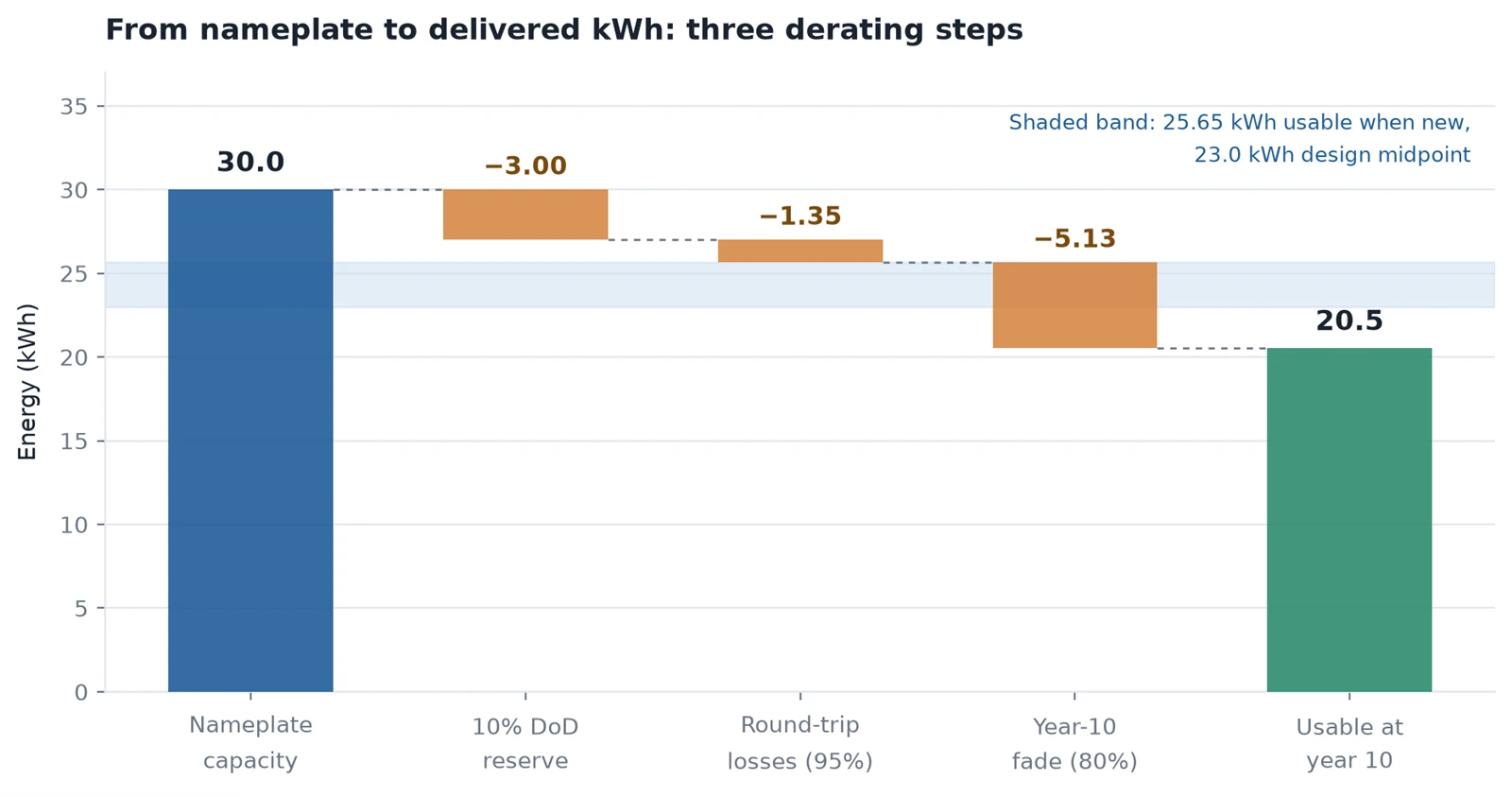
Figure 3. Where the 30 kWh goes. Charge efficiency, standby self-discharge, the depth-of-discharge floor, and inverter conversion reduce nameplate capacity to 25.6 kWh usable when new and 20.5 kWh at year ten.
Where this unit sits, and where it does not fit
A specification only makes sense in context. The 12 kW / 30 kWh cabinet is a node on a ladder, and the rungs on either side explain its ratio.
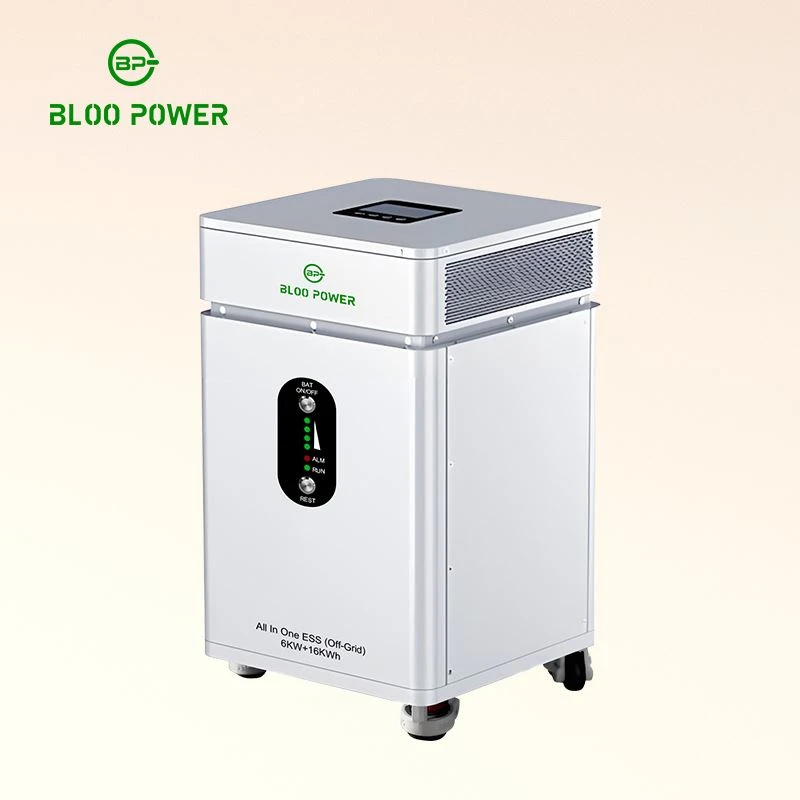
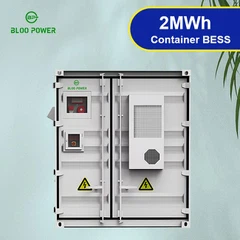
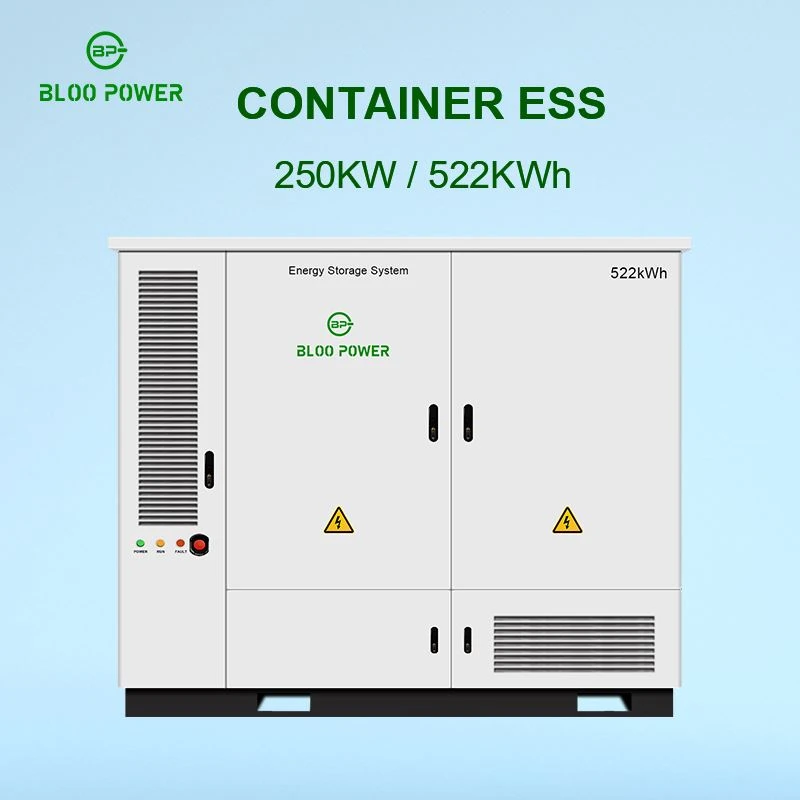
Below it sit the 6 kW / 16 kWh unit for 1,300–2,200 square foot homes and the 10 kWh wall-mount for backup-only cases - the argument that 30 kWh is the standard tier, sized for one full overnight load plus a wet, cloudy day of margin. Alongside it sit battery-only formats (15 and 30 kWh stacked, 16 kWh floor-standing, 16 kWh rack-mount) for owners who already own a hybrid inverter. Above it sit the commercial formats: 100 kWh cabinets with 50 kW PCS, 125 kW / 261 kWh liquid-cooled, 250 kW / 522 kWh, and 500 kW / 1 MWh containerized - the route for a solar backup generator for home business that outgrows residential hardware.
Five cases where solar battery backup for home money is better spent elsewhere:
Resistance-heated houses in cold climates. Baseboard or an electric boiler can push winter consumption past 100 kWh a day, of which the battery covers a quarter - no amount of home battery backup without solar capacity fixes a resistance-heat load. Fix the envelope or convert to a heat pump first.
Houses under 25 kWh a day. A seasonal property occupied two months a year leaves the pack in low cycling where calendar aging dominates, and payback stretches past twenty years - this is where a solar backup generator for home budget is better spent on a smaller unit.
Roofs under about 250 square feet of usable area. Without an array, every stored kWh is bought at off-peak rates and sold into the spread, roughly doubling payback - this is the case that turns a solar project into a home battery backup without solar project by accident.
Three-year payback expectations. Residential storage is a twenty-year asset with a 10–14 year payback in good markets and none in flat-rate ones. A residential backup power system proposal promising otherwise has inflated the tariff assumption or monetized resilience twice - common in best home battery backup marketing, and easy to check.
Commissioning checklist
- Pull 24 months of bills and one week of 15-minute interval data. Bills give annual consumption, peak share, and marginal price; the interval record, especially 18:00–22:00, decides whether 12 kW is sufficient.
- Inventory large loads by nameplate and starting method. Fixed-speed equipment draws 2–3× rated at startup, and that multiplier sizes the surge requirement.
- Measure the roof: orientation, tilt, shade at both winter sun angles, usable plane after setbacks. East-west splits lose 15–20 percent against south.
- Verify the location for footprint, clearance, ambient temperature, and floor loading, with a written structural opinion where the unit is not against a beam - the step that most often repositions a solar battery backup for home install.
- Scope the panel work explicitly. Dedicated circuits, main breaker rating, rapid shutdown, and any export-limiting device; this line is routinely underestimated by 10–15 percent of project cost.
- Run a commissioning outage test. Open the main, watch the transfer, log which circuits dropped, and confirm automatic recharge. It is the step most best home battery backup reviews skip and every homeowner should demand of any residential backup power system handover.
Send Inquiry