

















How to Select a 48V LiFePO4 Energy Storage Battery for Communication Base Stations?
Sep 10, 2026
Leave a message

Energy storage batteries for telecommunications base stations differ from standard residential energy storage batteries. Base stations typically require batteries to provide a continuous, stable DC power supply to communication equipment during power outages, weak grid conditions, diesel generator switching, or fluctuations in renewable energy input. Consequently, beyond capacity, key considerations include 48V system compatibility, LiFePO4 cell technology, the Battery Management System (BMS), cycle life, discharge rate capabilities, temperature adaptability, communication protocols, parallel expansion capabilities, safety certifications, and remote operation and maintenance (O&M) capabilities.
ITU-T L.1240 explicitly recommends prioritizing Lithium Iron Phosphate (LFP) batteries for 48V lithium-ion energy storage systems used in telecom equipment rooms or buildings. It identifies factors such as the BMS, IP protection, parallel connection capabilities, electromagnetic compatibility (EMC), fire safety, communication interfaces, thermal reliability, and mechanical reliability as critical criteria for evaluating system safety and reliability. ITU-T L.1210, released in 2025, further emphasizes that power supply systems for IMT-2020 networks must simultaneously address backup power requirements, safety, environmental conditions, remote monitoring, and energy efficiency.
Therefore, when selecting 48V LiFePO4 energy storage batteries for 4G/5G macro base stations, micro base stations, telecom equipment rooms, wireless access sites, or remote communication sites, it is recommended to conduct a systematic evaluation based on the following aspects.

Confirm whether the communication base station truly requires "48V" LiFePO4 batteries.
The first step in selecting a base station battery is not to look at capacity, but to confirm the DC bus voltage of the existing telecommunications power system. Traditional telecommunications power systems predominantly utilize a −48V DC architecture with batteries serving as backup power sources during grid anomalies or outages; therefore, a so-called "48V telecommunications battery" must actually be compatible with the operating voltage ranges of the rectifier modules, DC distribution units, and base station equipment. ITU-T documentation regarding telecommunications equipment also explicitly addresses 48V DC internal power supply and backup batteries for 48V ports. For LiFePO4 batteries, it is also necessary to verify whether the product employs a 15S or 16S cell configuration; systems composed of 3.2V LiFePO4 cells in 15S versus 16S configurations differ in nominal voltage and maximum charging voltage, meaning one cannot simply replace an existing lead-acid battery based solely on a "48V" label.
Key points to check during selection:
● Base station DC bus: −48V or another DC voltage;
● Battery nominal voltage and actual operating voltage range;
● 15S (48V) vs. 16S (51.2V) architecture;
● Rectifier charging voltage and current settings.
Comparison of common 48V and 51.2V architectures
|
item |
48V/15S LiFePO4 |
51.2V/16S LiFePO4 |
|
Nominal cell voltage |
3.2V |
3.2V |
|
Number of cells in series |
15S |
16S |
|
Nominal voltage |
48V |
51.2V |
|
Typical Applications |
Some 48V communication systems |
48V/51.2V Low-Voltage Energy Storage and Telecom Backup |
|
Key points |
Check device voltage window |
Verify rectifier and load compatibility. |
Important Note: Do not assume that the two are unconditionally interchangeable simply because the designations "48V" and "51.2V" are similar; the actual operating voltage of the communication power system and the manufacturer's compatibility test results must be the final deciding factors.
Why prioritize LiFePO4 over traditional lead-acid batteries for telecom base stations?
For telecom base stations, batteries are not merely occasional backup devices. Many sites experience frequent power outages, unstable grid conditions, peak-shaving/load-shifting requirements, diesel generator switching, and even solar charging/discharging cycles; consequently, batteries often operate in a continuous, cyclic manner. The advantages of LiFePO4 stem primarily from its superior thermal stability, longer cycle life, and higher usable energy efficiency. The ITU-T L.1240 standard specifically recommends the use of Lithium Iron Phosphate (LiFePO4) chemistry for 48V lithium energy storage systems in telecommunications applications.
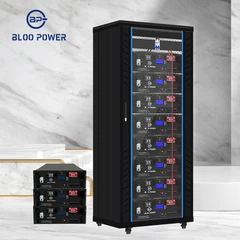
BLOO POWER currently offers 48V/51.2V LiFePO4 rack-mount batteries designed for base station environments, available in 5kWh, 7kWh, and 10kWh capacities. Their rack-mount design makes them suitable for telecom equipment rooms, base station power cabinets, and scenarios requiring modular capacity expansion. Product specifications indicate that this series utilizes LiFePO4 cells and features an intelligent BMS, RS485/CAN communication, and SNMP support.
Key reasons why LiFePO4 is suitable for telecom base stations:
● Superior thermal stability;
● Suitable for high-frequency charging and discharging;
● Cycle life is typically significantly longer than that of traditional lead-acid solutions;
● Compatible with intelligent BMS and remote monitoring systems.
Look beyond Ah capacity; calculate based on "Load Power × Backup Time"
A common mistake when selecting batteries for telecom base stations is focusing solely on the Ah rating (e.g., 100Ah, 200Ah, 300Ah) without calculating the actual required backup duration. To determine the approximate energy storage capacity, the Ah rating must be considered in conjunction with the 48V system voltage. For example: 48V × 100Ah ≈ 4.8kWh; 51.2V × 100Ah ≈ 5.12kWh. Therefore, two batteries labeled as "100Ah" may possess different theoretical energy capacities if their system voltages differ. ITU-T L.1210 outlines the design approach for backup capacity in telecommunications network power supply schemes and provides a calculation method that accounts for site peak power, power supply system efficiency, backup duration, Depth of Discharge (DoD), and a safety factor. Illustrative examples within the standard utilize a system efficiency of 0.94, a grid capacity derating factor of 0.8 or 1, and a typical lithium battery DoD of 0.85.
A simple engineering estimation formula can be expressed as follows:
Required battery capacity ≈ Base station load power × Backup duration ÷ System efficiency ÷ Usable DoD
For example:
|
Average base station load |
Target backup power duration |
Theoretically loaded energy |
Proposed Approach to Energy Storage Capacity |
|
1kW |
4h |
4kWh |
Approximately 5kWh |
|
2kW |
4h |
8kWh |
Approximately 10kWh |
|
3kW |
4h |
12kWh |
Approximately 15kWh |
|
5kW |
8h |
40kWh |
Approximately 50kWh |
For actual projects, factors such as temperature, aging, system efficiency, load fluctuations, DoD limits, and safety redundancy must also be considered; procurement cannot be based simply on theoretical values.
Focus on the BMS, rather than just the "LiFePO4" label
For telecommunication base stations, the BMS serves as the critical control center for energy storage batteries. Since base stations typically operate with little to no on-site personnel, the BMS must provide timely protection against issues such as overcharge, over-discharge, overcurrent, short circuits, over-temperature, or abnormal individual cell voltages. Without a reliable BMS, even a system using LiFePO4 cells cannot constitute a complete, carrier-grade backup battery system.
ITU-T L.1240 explicitly includes the BMS in the safety and reliability assessment criteria for 48V lithium battery systems used in telecommunications; ITU-T L.1397 further proposes an architecture for telecom battery systems featuring dedicated control and monitoring units to oversee and manage base station batteries.
Key features to verify include:
● Protection against overcharge, over-discharge, overcurrent, and short circuits;
● Monitoring of individual cell voltage and temperature;
● Estimation of SOC (State of Charge) and SOH (State of Health);
● Cell balancing functionality;
● Fault alarms and event logging.
Product specifications for BLOO POWER's 48V base station batteries indicate that their rack-mount models utilize an intelligent BMS, support SNMP for remote management, and provide RS485/CAN communication interfaces.
Communication protocols determine whether the battery can truly "integrate with the base station management system"
Telecommunication base stations generally cannot simply be made operational by connecting two power cables. If operators or telecom contractors need to remotely manage dozens, hundreds, or even thousands of sites, the batteries must be capable of transmitting data-such as SOC, SOH, voltage, current, temperature, and alarm status-to the upper-level monitoring system.
Therefore, when procuring 48V LiFePO4 telecom batteries, it is essential to verify which communication interfaces are supported and whether the communication protocols are compatible with existing power monitoring platforms. BLOO POWER's base station battery specifications confirm support for RS485, CAN, and SNMP protocols, offering practical value for remote monitoring and the management of multi-battery systems.
Recommended checks during procurement:
● Availability of RS485;
● Support for CAN;
● Support for SNMP;
● Compatibility of protocols (such as Modbus) with existing systems.
Selecting the Temperature Range Based on the Base Station Installation Environment
One of the key differences between telecommunications base station batteries and standard indoor energy storage systems is that many sites are located in outdoor cabinets, on rooftops, or in mountainous, desert, tropical, or remote areas. Prolonged exposure to high temperatures accelerates battery aging, while low temperatures can impair charging performance; therefore, one cannot rely solely on battery specifications rated for "normal room temperature."
ITU-T L.1240 has incorporated thermal and environmental reliability into the evaluation criteria for 48V lithium battery systems used in telecommunications. Similarly, ITU-T L.1210 explicitly accounts for environmental conditions in power supply solutions for next-generation telecommunications networks.
Key factors to consider during selection include:
● Charging temperature range;
● Discharging temperature range;
● Capacity degradation in high-temperature environments;
● Heat dissipation and protection for outdoor cabinets.
For projects located in high-temperature regions such as the Middle East, Africa, or Southeast Asia, suppliers should be required to provide data on cycle life, capacity retention, and BMS protection strategies specifically for high-temperature environments, rather than relying solely on laboratory data obtained at 25°C.
Focus on Cycle Life, but Pay Close Attention to Testing Conditions
Specifications such as "5,000 cycles," "6,000 cycles," or "8,000 cycles" are common in the energy storage industry, but simply comparing these numbers when purchasing base station batteries is insufficient. Cycle life figures must be evaluated in conjunction with the Depth of Discharge (DoD), charge/discharge rates, temperature, cut-off voltages, and the definition of capacity retention.
For instance, if two products both claim "6,000 cycles" but one was tested at 25°C with a 0.5C rate, 80% DoD, and an end-of-life (EOL) threshold of 80% remaining capacity, while the other was tested under shallow-cycle conditions, the practical implications differ significantly. BLOO POWER's specifications for its 48V base station products-listing ≥2,000 cycles at 100% DoD, ≥4,000 cycles at 80% DoD, and ≥8,000 cycles at 50% DoD-demonstrate the clear impact of discharge depth on service life.
Therefore, when purchasing, suppliers should be required to provide:
● Cycle testing temperature;
● DoD testing conditions;
● Charge/discharge rates;
● Definition of EOL capacity retention.
Selecting Battery Continuous Discharge Capability Based on Base Station Power
Sufficient capacity does not guarantee the battery can support the base station load. For instance, a 10kWh battery may theoretically store enough energy, but if the BMS limits the maximum continuous discharge current while the base station requires high power for startup or peak loads, the battery might still trigger a protection shutdown.
For 48V systems, the maximum output power can be roughly estimated using:
P ≈ V × I
For example, if a 48V system requires a continuous output of 4.8kW, the theoretical current is approximately 100A; however, actual design current must include a margin to account for voltage fluctuations and efficiency losses. Therefore, for high-power 5G base stations, it is essential to verify the maximum continuous discharge current, peak discharge current, and BMS current limit.
BLOO POWER offers 48V/51.2V base station rack-mount products with capacities ranging from 100Ah to 200Ah and corresponding charge/discharge current ratings; multiple units can be connected in parallel to achieve higher energy storage capacity and power output.
Prioritizing 19-inch Rack-Mount Designs to Simplify Retrofitting
Space is often severely limited in telecommunications equipment rooms and standard power cabinets, making battery dimensions a critical factor. A 19-inch rack-mount design facilitates integration with existing telecom cabinets, network equipment racks, and DC power cabinets, while also allowing for the future addition of battery modules.
The 19-inch rack-mount design has become a standard architecture for telecom lithium batteries on the market. BLOO POWER offers 3U rack-mount 48V/51.2V LiFePO4 base station batteries-available in capacities of approximately 5kWh, 7kWh, and 10kWh-that support modular expansion.
Key benefits of rack-mount batteries:
● Easier installation in standard 19-inch cabinets;
● Modular design simplifies maintenance;
● Capacity can be increased incrementally based on load requirements;
● Minimizes the need for structural modifications to the existing telecom equipment room.
Checking IP Protection Ratings and Outdoor Installation Capability
If the telecom base station is deployed outdoors, battery selection must consider not only electrochemical performance but also resistance to dust, water, humidity, salt spray, and mechanical impact. ITU-T L.1240 has designated IP protection, mechanical reliability, and environmental reliability as key evaluation criteria for 48V lithium battery systems used in telecommunications.
For batteries installed in outdoor telecom cabinets, the mere fact that the battery casing is made of metal does not automatically imply suitability for outdoor use. During procurement, it is essential to clarify whether the specified IP rating applies to the battery unit itself, the module, or the entire outdoor battery cabinet.
Key inspection points for outdoor projects include:
● IP protection ratings (e.g., IP65/IP54);
● Condensation prevention design;
● Corrosion resistance;
● Heat dissipation design for the outdoor cabinet.
If BLOO POWER products are used in outdoor base station projects, it is recommended to verify the specific model's IP rating, operating temperature range, and cabinet configuration with the manufacturer based on local environmental conditions, rather than simply applying parameters from residential products to telecom base stations.
Verification of Safety Standards and Transport Certifications
Telecom base stations are classified as critical infrastructure; consequently, safety requirements for their batteries should exceed those of standard, low-cost energy storage products. IEC 62619:2022 specifically outlines safety requirements and testing protocols for secondary lithium batteries used in industrial applications, explicitly covering scenarios such as stationary applications and telecommunications.
Additionally, IEC 63056 sets forth more specific safety requirements for secondary lithium batteries within electrochemical energy storage systems, with a scope that also includes telecommunications applications. A white paper on telecom lithium batteries published by the ITU indicates that high-quality batteries for this sector typically need to comply with standards and transport requirements such as IEC 62368-1, IEC 62485-5, IEC 62619, IEC 63056, IEC 62620, and UN 38.3.
During procurement, it is advisable to request the following:
● IEC 62619 test/certification documentation;
● IEC 63056 applicability documentation;
● UN 38.3 certification;
● Certifications required by the target market (e.g., CE, UL).
It is important to note that "compliance with a standard" is not synonymous with "holding a certification certificate for that standard." Procurement teams should require manufacturers to provide specific certificates, test reports, and details regarding applicable models.
Determining Capacity (5kWh, 10kWh, or Higher) Based on Base Station Type
For telecom base stations, a higher capacity is not necessarily better. Insufficient capacity results in inadequate backup time, while excessive capacity drives up initial investment, cabinet space requirements, and transportation costs. Therefore, a more rational approach is to select modules based on the actual load, target backup time, and capacity expansion plans.
Taking BLOO POWER's 48V/51.2V rack-mount base station batteries as an example, the product line covers capacities in the 5kWh, 7kWh, and 10kWh ranges.
A simple configuration reference
|
Base station scenario |
Recommended Approach |
Example |
|
Small and micro base stations |
Small-capacity module |
1×5kWh |
|
Standard communication site |
Medium-capacity module |
1×10kWh |
|
Requires a long backup power duration. |
Parallel connection of multiple modules |
2×10kWh |
|
High-load 5G site |
High Capacity + Redundancy |
3 × 10 kWh or higher |
|
Remote off-grid base station |
PV + Energy Storage |
10–30kWh+ |
The above is intended solely for the preliminary selection of the solution; the final capacity should be calculated based on the actual load profile and the target autonomy time.
Parallel expansion and N+1 redundancy must be considered
The load on a telecommunications base station is not static. As 5G AAUs, BBUs, transmission equipment, cooling systems, and other auxiliary devices are added, the initial battery capacity may eventually become insufficient. Therefore, a high-quality energy storage battery for telecommunications should support capacity expansion through the parallel connection of multiple modules, rather than being limited to a fixed capacity determined at the outset.
ITU-T L.1240 includes battery parallel connection capability as a criterion for evaluating 48V lithium battery systems. ITU-T L.1397 also addresses battery systems composed of multiple integrated battery units, emphasizing control and monitoring capabilities.
From an engineering perspective, the following configurations can be considered:
● Combining two 5kWh units to form a 10kWh system;
● Combining two 10kWh units to form a 20kWh system;
● Connecting multiple units in parallel to extend backup time;
● Designing for N+1 redundancy based on the site's criticality.
For critical telecommunications sites, rather than configuring a battery system with just enough capacity to meet the load, it is preferable to incorporate redundancy so that the basic communication load can still be maintained in the event of a single-module failure.
Do Not Overlook Compatibility When Replacing Old Lead-Acid Batteries
Many telecommunications base stations are not new builds but rather involve upgrading existing VRLA, AGM, or other lead-acid battery systems. Consequently, determining whether a 48V LiFePO4 battery can directly replace the existing battery is a critical aspect of the procurement process.
Replacement projects require an assessment of the existing rectifier's charging voltage, float charging logic, low-voltage protection settings, communication protocols, alarm mechanisms, and maximum charging current. It is particularly important to note that LiFePO4 and lead-acid batteries have different charging curves; one cannot simply assume that the two types are interchangeable merely because they share the same nominal voltage.
ITU-T L.1240 establishes clear criteria for evaluating 48V lithium battery systems for telecommunications, covering aspects such as charge/discharge capabilities, BMS functionality, parallel operation, communication, electrical safety, and thermal reliability. Therefore, when using rack-mounted LiFePO4 products (such as those from BLOO POWER) for site retrofitting, compatibility with the existing telecommunications power system should be verified during the project design phase.
Remote O&M capability has become a key indicator for communication base station batteries.
In the past, when faults occurred in communication batteries, engineers often had to travel to the site for inspection; for sites located in remote mountainous areas, deserts, or on islands-or for cross-border sites-on-site maintenance could require vehicles, personnel, and even specialized safety arrangements. Therefore, remote monitoring capability should be treated as a key procurement criterion when selecting energy storage batteries for communication base stations.
ITU-T L.1397 outlines specific models for battery monitoring and control in communication networks, noting that while site batteries ensure uninterrupted power supply, an integrated BMS or independent control unit enables battery status monitoring and management. ITU-T L.1384 also proposes the potential for base station energy storage systems to participate in energy dispatch and virtual power plant operations.
An ideal remote monitoring system should provide visibility into:
● SOC (State of Charge);
● SOH (State of Health);
● Individual cell voltage;
● Battery temperature;
● Charge/discharge current and fault alarms.
Selection Parameter Table for 48V LiFePO4 Telecom Base Station Batteries
|
Key Specifications |
Recommended Content to Follow |
Significance for communication base stations |
|
Voltage |
48V/51.2V and actual operating range |
Ensure compatibility with -48V systems. |
|
Chemical system |
LiFePO4 |
Safety, cycle life, and stability |
|
capacity |
50Ah/100Ah/200Ah, etc. |
Determine backup time |
|
BMS |
Smart BMS |
Over-voltage, under-voltage, over-current, and temperature protection |
|
Communications |
RS485/CAN/SNMP |
Remote monitoring and O&M |
|
Cycle life |
The DoD and test conditions must be specified. |
Assess long-term usage costs. |
|
Operating temperature |
Pay particular attention to high temperatures. |
Suitable for outdoor base stations |
|
Protection rating |
Choose according to the installation environment |
Outdoor dustproof and waterproof |
|
Safety standards |
IEC 62619, etc. |
Security for Industrial and Communication Applications |
|
structure |
19-inch rack-mount preferred |
Facilitates installation in the equipment room. |
|
Capacity expansion |
Supports parallel connection |
Accommodate future load growth |
|
Maintenance |
Modular design, remote monitoring |
Reduce operation and maintenance costs |
Why is the BLOO POWER 48V LiFePO4 base station battery worth your attention?
From the perspective of telecommunications base station applications, BLOO POWER offers 48V/51.2V LiFePO4 rack-mount batteries specifically designed for base station energy storage scenarios. These products come in 5kWh, 7kWh, and 10kWh capacities and feature a 3U rack-mount structure, allowing energy storage capacity to be configured modularly based on the base station's load requirements. Product specifications also indicate support for RS485/CAN and SNMP remote monitoring, as well as a comprehensive range of protection functions.
For telecom operators, tower companies, and overseas telecom engineering firms, the value of this modular solution lies not merely in the provision of a battery, but in the ability to establish a complete backup energy architecture-encompassing 48V DC power supply, LiFePO4 battery technology, an intelligent BMS, remote communication capabilities, and modular capacity expansion.
Key highlights of the BLOO POWER base station battery solution include:
1. 48V/51.2V low-voltage architecture-suitable for telecom DC power supply scenarios;
2. LiFePO4 cells-ideal for long-term backup and cyclic charging/discharging;
3. 3U rack-mount design-facilitates integration into standard equipment cabinets;
4. 5/7/10kWh capacity modules-allows for flexible capacity configuration;
5. RS485/CAN/SNMP support-enables convenient remote monitoring;
6. Intelligent BMS-provides multi-level battery protection;
7. Parallel expansion-suitable for increasing loads at telecom sites over time;
8. Base station-specific positioning-distinct from standard residential energy storage products.
A typical 48V energy storage architecture for a telecommunications base station
The entire system can be conceptualized as follows:
Grid/PV → Rectifier/Charging System → 48V LiFePO4 Battery → DC Power Distribution → BBU/AAU/Transmission Equipment → Communication Network
Simultaneously:
BMS → RS485/CAN/SNMP → Local Monitoring/Remote O&M Platform
The core objective of this design is not merely to increase energy storage capacity, but to ensure the base station can rapidly switch to battery power during grid anomalies while continuously monitoring battery status via the BMS.
Conclusion: Price alone should not dictate the choice of 48V LiFePO4 batteries for telecom base stations.
In summary, selecting a 48V LiFePO4 energy storage battery truly suitable for telecom base stations requires a comprehensive evaluation across multiple dimensions-rather than a simple comparison of voltage, capacity (Ah), and price. Key factors include voltage compatibility, LiFePO4 cell quality, capacity, discharge capability, BMS features, communication protocols, temperature range, cycle life, IP protection ratings, certifications, rack structure, parallel expansion capabilities, and remote O&M support.
It is particularly noteworthy that the ITU-T has established specific evaluation requirements for 48V lithium battery systems in telecommunications, covering aspects such as LFP chemistry preference, BMS functionality, IP protection, parallel operation, communication interfaces, thermal reliability, and environmental reliability. Additionally, the IEC 62619:2022 standard explicitly outlines safety requirements for lithium batteries used in stationary applications, including industrial and telecommunications sectors.
Therefore, for projects involving 5G base station upgrades, lead-acid battery replacements, backup power for remote sites, solar-powered base stations, or large-scale energy storage retrofits for communication towers, a modular 48V/51.2V LiFePO4 solution is recommended. The required energy capacity (kWh) should be calculated based on actual load profiles, followed by system configuration using products-such as those from BLOO POWER-that support smart BMS functionality, communication interfaces, and rack-based capacity expansion.
Send Inquiry