

















What Should Be Considered When Installing Residential Energy Storage Systems in 2026?
Jul 20, 2026
Leave a message

As global photovoltaic installation capacity continues to grow, an increasing number of households are installing residential energy storage systems (ESS) to achieve peak shaving and valley filling, reduce electricity costs, enhance energy independence, and provide backup power during outages.
According to standards such as NFPA 855 (*Standard for the Installation of Stationary Energy Storage Systems*), the US National Electrical Code (NEC), and the Electric Power Research Institute (EPRI) guidelines for residential energy storage installation, the installation process affects not only power generation efficiency but also-more critically-system lifespan, safety, and long-term maintenance costs.
The following sections provide a comprehensive overview of key considerations for residential energy storage system installation, covering the pre-installation, installation, and post-installation phases.

Preliminary Load Estimation and Precise Energy Storage Capacity Matching (The basis for model selection; determines system cost-effectiveness)
1. Authoritative Calculation Standards
Based on the NB/T 10128-2019 standard, the formula for calculating energy storage capacity is: Usable Energy Storage Capacity (kWh) = Average Daily Critical Load Consumption ÷ Depth of Discharge (DOD; 80% recommended for LFP) × Redundancy Factor (1.2). Industry-standard load classifications:
● Small-sized units (under 60 m²): Average daily consumption of 3–5 kWh; loads include lighting, refrigerator, TV, and one 1.5 HP air conditioner.
● Medium-sized units (80–130 m²): Average daily consumption of 6–9 kWh; loads include 2–3 air conditioners, washing machine, and high-power kitchen appliances.
● Large units/Villas (over 140 m²): Average daily consumption of 10 kWh+; loads include central air conditioning, electric water heater, and whole-house smart home systems.
2. BLOO POWER Capacity Matching Chart (Full Series)
BLOO POWER offers standardized low-voltage (51.2V) LFP energy storage units with capacities of 5.12 kWh, 10.24 kWh, 15.36 kWh, and 20.48 kWh. These units support capacity expansion via stacking and parallel connection and feature a cycle life of ≥8,000 cycles (at 80% DOD)-far exceeding the industry average of 3,500 cycles-making them suitable for a wide range of household needs.
|
Unit Types |
Average daily electricity consumption |
Recommended energy storage capacity |
BLOO POWER Compatible Models |
Compatible inverter power rating |
Self-sufficiency rate reference |
|
Small-sized units (under 60 m²) |
3~5kWh |
5kWh |
BP-51.2V100AH(5.12kWh Wall-mounted) |
3–5 kW Single-Phase Hybrid Inverter |
55%~65% |
|
Mid-sized units (80–130 m²) |
6~9kWh |
10kWh |
BP-51.2V200AH(10.24kWh Rack / Stack) |
6~8kW Single-Phase Hybrid Inverter |
70%~78% |
|
Large-format unit (140 m² / duplex) |
10~14kWh |
15kWh |
3 组 5kWh Stacking Combinations(15.36kWh) |
8~10kW Single-Phase Hybrid Inverter |
78%~85% |
|
Villa / Whole-house backup power |
15kWh+ |
20kWh |
BP-51.2V400AH(20.48kWh High-capacity unit) |
10kW Three-phase hybrid inverter |
85%~92% |
3. Key Installation Considerations
1). Avoid blindly increasing capacity based on peak appliance power ratings, as this raises equipment investment costs and charging energy losses.
2). In regions with peak-valley electricity pricing, prioritize BLOO POWER stacked energy storage systems with a capacity of 10 kWh or higher to maximize financial returns from storing low-cost off-peak electricity.
3). For off-grid backup applications, include an additional 20% capacity margin; the entire BLOO POWER product line supports seamless off-grid switching (transfer time <10ms), ensuring uninterrupted power for appliances such as refrigerators and computers.
Site Selection and Specifications for Fire Safety and Heat Dissipation Clearances (Safety First; Mandatory National Standards)
1. Areas Prohibited by National Standards (Mandatory provisions of DL/T 5903-2025)
1) Basements, semi-basements, and enclosed storage rooms without ventilation;
2) Bedrooms, children's rooms, and living rooms where people spend extended periods;
3) Kitchens and bathrooms (areas with high humidity, gas, or open flame sources);
4) Areas within 1.5m of gas pipelines, water heaters, or radiators;
5). Unshaded outdoor areas exposed to direct sunlight (ambient temperatures exceeding 40°C accelerate battery degradation).
2. Minimum Safety Clearances for Heat Dissipation (Dual standards: AS/NZS 5139 and BLOO Equipment Installation Manual)
BLOO wall-mounted, stackable, and all-in-one units strictly adhere to fire safety clearance requirements. Minimum clearances based on installation type:
● Bottom of unit to floor: ≥50mm; top clearance: ≥200mm; left/right sides: ≥100mm; front maintenance access: ≥600mm;
● For stacked/parallel BLOO POWER energy storage units: vertical gap between modules ≥10mm; horizontal spacing between units ≥300mm;
● Vertical distance from doors, windows, or emergency exits: ≥900mm; minimum safety distance from gas equipment: 1.5m.
3. Mandatory Site Environmental Parameters
1) Temperature: Long-term operating range 0°C–40°C; the entire BLOO series features a built-in low-temperature heating module, allowing normal charging at temperatures as low as -10°C;
2) Humidity: Ambient relative humidity 20%–80%, non-condensing; outdoor installations require IP65-rated models;
3) Wall Structure: Wall-mounted BLOO POWER batteries must be installed on non-combustible walls (e.g., brick-concrete, cement); installation on flammable walls (e.g., wood, drywall/gypsum board) is prohibited;
4). Ventilation: Dedicated energy storage rooms require top-to-bottom convection ventilation (air intake at the bottom, exhaust at the top); in high-temperature regions, install a small exhaust fan to maintain the internal temperature at ≤35°C.
Equipment Type Selection: Installation Differences Between Wall-Mounted, Rack-Mounted, and All-in-One Systems
BLOO POWER covers three mainstream residential energy storage solutions. Installation conditions, installation complexity, and space requirements vary significantly among the different models. The table below compares installation suitability, key installation points, and target households:
|
Device type |
BLOO POWER Corresponding Products |
Installation space requirements |
Construction difficulty |
Key Installation Notes |
Applicable Scenarios |
|
Wall-mounted split-type energy storage |
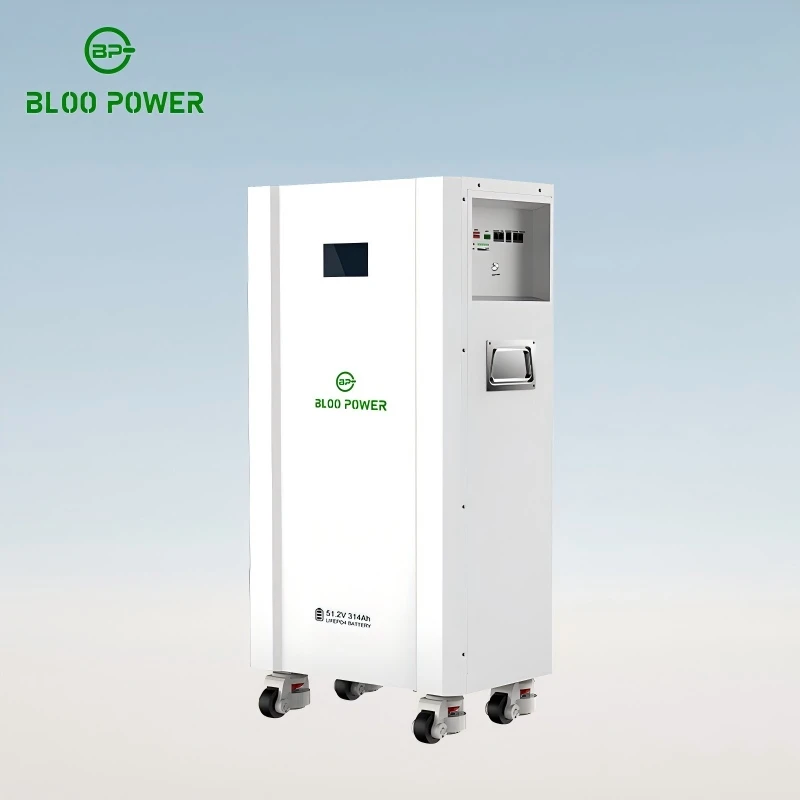
BP-WALL 5/10kWh Wall-Mounted Battery (for use with a standalone inverter) |
Clear wall width ≥ 1200 mm; load-bearing capacity of wall surface ≥ 150 kg/m². |
Medium; the battery and PCS require separate mounting. |
Wall load-bearing capacity inspection; routing DC cables through separate flame-retardant conduits; installing BMS communication cables with shielding. |
Balconies, garage interior walls, small-sized apartments |
|
Rack-mounted energy storage |
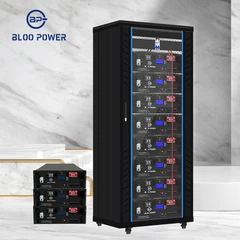
BP-RACK Modular Stackable Battery (expandable via parallel connection up to 20 kWh) |
Standalone 1.2m standard cabinet; level floor with a load-bearing capacity of ≥500 kg. |
Simple, modular assembly, plug-and-play. |
Cabinet leveling tolerance ≤5 mm; 10 mm heat dissipation gap between shelves; moisture-proof base pad. |
Equipment rooms, basement ventilation zones, and capacity expansion for large residential units. |
|
Integrated Solar-Storage Unit |
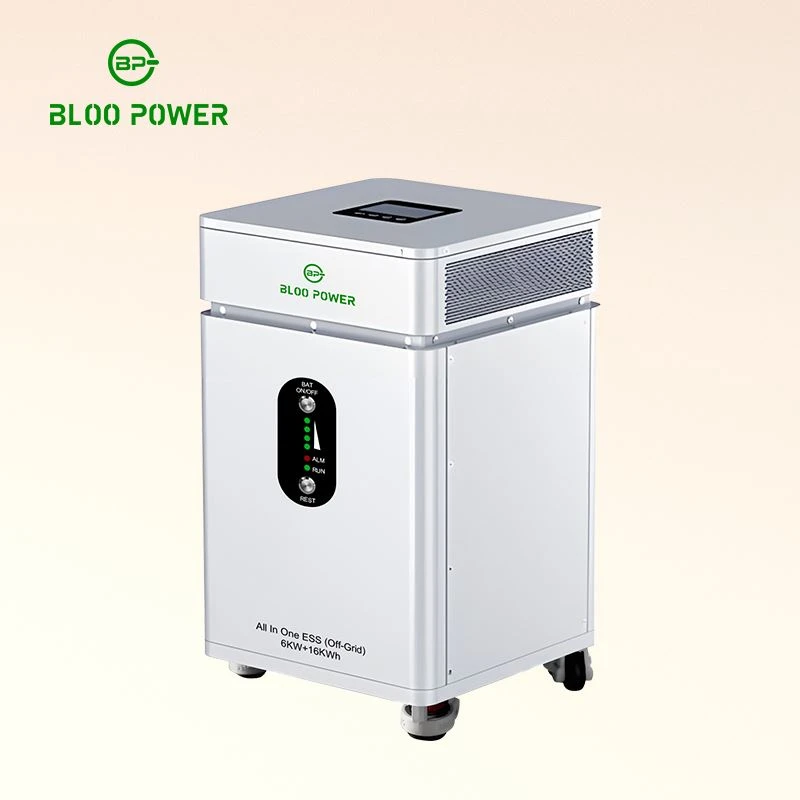
BP-ALL-IN-ONE 5/10kWh All-in-One Unit (Integrated Battery + Inverter) |
Floor-standing, occupies a footprint of 0.7 m², and requires no wall drilling. |
At a minimum, the entire unit connects to only three circuits: PV, the grid, and the load. |
Leave space around the unit for heat dissipation; do not place it directly against the wall; keep the bottom 5 cm off the ground to prevent moisture damage. |
Self-built rural houses, simple garages, and layouts without load-bearing walls. |
Key specifications: The BLOO POWER all-in-one unit achieves a conversion efficiency of 96.8%; the wall-mounted split system has a combined charge-discharge efficiency of 94.5%; and the rack-mounted expansion unit offers an efficiency of 95.7%. All meet the national standard requirement of ≥94% efficiency.
Structural Load-Bearing and Mounting Specifications (Critical Hazards Often Overlooked)
1. Wall Load-Bearing Assessment: The BLOO POWER 10kWh wall-mounted battery weighs 172.7 kg per unit; wall load capacity must be verified before installation. For brick-concrete walls, the load-bearing capacity must be ≥150 kg/m². Wall mounting is strictly prohibited on hollow brick or lightweight partition walls; floor-standing all-in-one units or rack-mounted versions must be used instead. Use M12 stainless steel expansion bolts with a minimum of 6 mounting points per battery unit and a tightening torque of 45 N·m.
2. Floor Installation Load Standards: For stacked cabinets and all-in-one units, the concrete floor must support a load of ≥500 kg/m². If installed on wooden flooring, a thickened steel base plate is required to distribute the load. Floor levelness deviation must be ≤5 mm/m to prevent equipment tilting, which could cause internal battery cells to deform under stress.
3. Outdoor Installation Foundation: When installing BLOO POWER IP65 energy storage equipment outdoors, a 15 cm thick concrete base must be poured, elevated 20 cm above ground level to prevent water immersion. The base perimeter requires a 3° drainage slope, and a sunshade canopy should be installed to prevent overheating from intense summer sunlight.
Electrical Cabling, Protection Devices, and Grounding/Lightning Protection Systems (Core Electrical Safety; Mandatory National Standards)
1. Cable Selection Specifications (GB 50217)
● DC Side (Connections between PV, battery, and inverter): Must use Class C flame-retardant copper-core DC cables with a voltage rating of ≥1000 V. For BLOO POWER 51.2 V systems, the DC cable cross-section must be ≥16 mm² for the 10 kWh model and ≥25 mm² for the 20 kWh model. Cables must be routed through separate flame-retardant PVC conduits; AC and DC cables must be laid in separate channels/conduits-routing them within the same conduit is prohibited.
● AC Side (Grid input and load circuits): Use 4–10 mm² flame-retardant copper wire with an independent circuit breaker for each circuit; the cable bending radius must be ≥10 times the cable's outer diameter. ·Communication Cable: Use double-shielded twisted-pair cables for BMS communication; keep them at least 30 cm away from high-voltage power cables to prevent signal interference that could cause false protection triggering.
2. Tiered Protection Device Configuration (DL/T 5903-2025)
All three tiers of system protection are essential. BLOO POWER equipment features an integrated BMS for Tier 1 protection; external Tier 2 and Tier 3 protection devices must be installed during setup:
1) Tier 1 (Internal): The BLOO POWER battery BMS integrates protections against overcharge, over-discharge, over-current, over-temperature, and short circuits, cutting off the circuit within 200ms of an anomaly;
2) Tier 2 (DC Side): Install a DC circuit breaker on the battery DC output line; a 10kWh system requires a 125A DC circuit breaker, while a 20kWh system requires a 200A breaker;
3) Tier 3 (AC Side): The grid-tied circuit must include an anti-islanding protection device to disconnect from the grid within 2 seconds of a power outage, complying with grid acceptance standards; install a 30mA residual current device (RCD) on the main circuit for the whole-house energy storage system.
3. Mandatory Standards for Grounding and Lightning Protection
1) Grounding Resistance: Equipotential bonding is required for the entire energy storage unit, battery cabinet, inverter, and PV mounting structure; total grounding resistance must be ≤4Ω (GB 14050);
2) Grounding Installation: Use 40×4mm hot-dip galvanized flat steel for lap joints; the lap length must be at least twice the width of the flat steel, fully welded on three sides, and the weld area treated with asphalt for corrosion protection; install two 2.5m galvanized angle steel vertical grounding electrodes, spaced 5m apart and buried 0.8m underground;
3) Lightning Protection Configuration: In areas prone to thunderstorms, install Class II Surge Protection Devices (SPDs) on both the PV DC input and the AC grid-tied side; BLOO POWER all-in-one units feature an integrated lightning protection module, whereas wall-mounted models require an additional external SPD;
4). Prohibition: The neutral line (N) must not be grounded together with the protective earth line (PE), as this will cause the residual current protection to fail.
Fire Safety Installation Requirements (Lithium battery thermal runaway prevention & fire safety standards)
In accordance with the *Fire Safety Assessment for Small-scale Distributed Lithium Iron Phosphate (LFP) Battery Energy Storage Systems*, fire safety installations for residential energy storage are categorized into three levels of protection, applicable to the entire BLOO POWER product range:
1. Basic Protection (Mandatory): Install independent smoke and heat detectors in the energy storage area, with the temperature alarm threshold set at 55°C. Prohibit the storage of combustible materials-such as cardboard boxes, fabrics, or alcohol-within a 1-meter radius of the equipment. Install fire-resistant cement boards on the walls.
2. Advanced Protection (For high-capacity systems of 10 kWh and above): For BLOO POWER 15/20 kWh stacked energy storage systems, equip the storage room with an automatic aerosol fire suppression device; the use of water-based fire extinguishers is prohibited (as contact with water can cause short circuits in lithium batteries and exacerbate thermal runaway). Maintain a clear 1.2-meter emergency evacuation path free of obstructions.
3. Temperature Control & Fire Safety Interlock: Link temperature and humidity sensors in the storage room with the ventilation system to automatically activate forced ventilation when the temperature exceeds 38°C. BLOO POWER batteries feature built-in cell temperature monitoring; the charge/discharge circuit is automatically cut off if any single cell exceeds 52°C to suppress thermal propagation.
Grid-Connection Process and Grid Acceptance Standards (Essential for legal operation; distinguishes between single-phase and three-phase systems)
1. Pre-connection Procedures
Before installation, submit an application for distributed energy storage grid connection to the local power supply bureau. Required documents include the property ownership certificate, equipment list (BLOO POWER energy storage CE, IEC, and UN38.3 certification documents), and system design drawings. The power supply authority will conduct an on-site inspection and issue a grid-connection plan.
2. Single-phase vs. Three-phase System Compatibility Standards
Domestic residential connections in China are typically 220V single-phase, while large villas and self-built houses often utilize 380V three-phase connections. BLOO POWER energy storage systems are compatible with both types of inverters; the table below compares the grid-connection installation requirements:
|
On-Grid type |
Suitable for families |
Maximum allowable access power (national standard)) |
BLOO POWER Matching inverter |
Core Requirements for On-Gridd Installation |
|
220V Single-phase on-grid |
ordinary small and medium-sized apartments |
≤8 kW (DL/T 5903 mandatory limit) |
BP-HY-5K/8K Single-phase hybrid inverter |
Connect only to the dedicated circuit upstream of the main household circuit breaker; parallel connection across multiple branch circuits is prohibited. Anti-islanding trip time ≤ 2s. |
|
380V Three-phase on-grid |
Villas, high-power whole-house loads |
8–20 kW (no upper limit) |
BP-HY-10K Three-phase hybrid inverter |
Three-phase load balance, each phase power difference ≤1.5kW; install three-phase unbalance protection device |
3. Grid-Connection Acceptance Test Items
The power utility conducts on-site testing of four key indicators; BLOO POWER equipment undergoes factory pre-calibration, significantly increasing the first-pass acceptance rate:
1). Anti-islanding protection disconnection time test;
2). AC/DC insulation resistance test (≥1 MΩ required for compliance);
3). Grounding resistance re-test (≤4 Ω);
4). Remote data communication verification (BLOO POWER supports Wi-Fi/RS485 remote monitoring, allowing the grid backend to read power generation and energy storage data).
BMS Communication and Intelligent Monitoring System Installation (Impacts system lifespan and O&M)
1. Communication Wiring Specifications: BLOO POWER battery BMS units communicate with inverters via CAN/RS485. Terminal tightening torque is 12 N·m. Communication cables must be routed through separate shielded conduits and must not run parallel to high-voltage DC power cables for distances exceeding 2 meters. For stacked battery configurations, daisy-chain (series) communication wiring is required, with a terminal resistor installed at the end of the line to prevent signal reflection faults.
2. Monitoring Equipment Installation: All-in-one units feature a built-in 7-inch local touchscreen display; wall-mounted or rack-mounted systems utilize an external monitoring panel installed at an eye-level height of 1.4–1.6 meters. Remote monitoring via mobile app supports viewing SOC (State of Charge), charge/discharge power, individual cell temperatures, and daily peak-valley tariff savings.
3. Functional Configuration and Commissioning: During installation, configure three operating modes based on household electricity usage habits:
1). Self-consumption mode: PV power supplies the load first, with excess energy stored in the battery;
2). Peak-valley arbitrage mode: Charges during off-peak (valley) hours and discharges during peak hours;
3). Off-grid backup mode: Automatically switches to battery power during grid outages, prioritizing critical loads such as refrigerators and lighting.
Professional Installation, Commissioning, and Pre-power-up Comprehensive Checks (To Prevent Power-up Failures)
All BLOO POWER energy storage systems must undergo a 7-step pre-power-up inspection; powering up without these checks may damage the BMS or battery cells:
1. Visual inspection: Ensure the battery cabinet is free of dents, cable insulation is intact, and terminals are secure;
2. Insulation test: Insulation resistance to ground must be ≥1 MΩ for both DC and AC sides;
3. Voltage verification: Static no-load voltage for the BLOO POWER 51.2V battery should be 53.2–54.8V, with a voltage difference ≤0.05V;
4. Grounding re-test: System grounding resistance ≤4Ω; verify continuity of equipotential bonding connections;
5. Protection simulation test: Manually trigger over-current and over-temperature conditions to verify the BMS automatic power-off function;
6. Communication commissioning: Ensure data synchronization between the inverter and battery BMS with no communication errors;
7. Ventilation and fire suppression system linkage test: Verify proper alarm function for temperature and smoke sensors.
Power-up commissioning sequence: Close the PV DC switch first, then the battery DC switch, and finally the AC grid-connection switch; operate at no-load for 2 hours while monitoring for a cell temperature difference ≤3°C and the absence of overheating or abnormal noise, then connect the household load for a 4-hour full-load test.
Planning for Post-Installation Maintenance and Warranty Compliance (Extending Equipment Lifespan)
1. Maintenance Clearance: Strictly adhere to the previously mentioned heat dissipation spacing standards, ensuring a 600mm unobstructed zone in front of the equipment to facilitate annual cell balancing, cable tightening, and dust cleaning; BLOO POWER modular batteries support hot-swapping of individual units without requiring a total system shutdown.
2. Environmental Maintenance Provisions: Install dehumidifiers in humid regions and provide mounting interfaces for exhaust fans in high-temperature areas; place temperature and humidity data loggers in the energy storage zone to monitor the operating environment over the long term.
3. BLOO POWER Warranty Compliance Requirements (Prerequisites for the official 10-year cell warranty and 5-year system warranty):
1). Installation must be performed by a certified electrician in accordance with the manual, with complete construction drawings and grounding test reports retained;
2). The monitoring system must remain continuously connected to the network, ensuring equipment operating data is traceable;
3). An annual on-site inspection by the manufacturer is required to tighten terminals and balance cells.
Summary of Common Installation Risks and Violations (Pitfalls to Avoid)
1. Arbitrarily reducing heat dissipation clearance or stacking debris against the wall, leading to excessive battery temperature rise and a 40% reduction in cycle life;
2. Routing AC and DC cables in the same conduit or using undersized cables, resulting in overheating and fire;
3. Lack of professional grounding or excessive grounding resistance, leading to lightning damage or electric shock hazards;
4. Installing units in enclosed basements without forced ventilation, causing combustible gas accumulation and potential explosion;
5. Connecting to the grid without authorization, violating power regulations and risking equipment damage;
6. Using non-flame-retardant cables or standard dry-powder fire extinguishers for lithium battery fires;
7. Mounting high-capacity wall-mounted batteries on lightweight hollow walls, causing the wall to fail and damage the equipment.
Conclusion
The installation of residential energy storage systems involves more than just connecting equipment; it encompasses multiple stages, including capacity planning, site selection, electrical design, safety standards, fire safety requirements, communication monitoring, future expansion planning, and professional commissioning. Adhering to NFPA 855 and local building and electrical codes-and ensuring installation by a professional team-can significantly enhance the system's safety, reliability, and long-term operational efficiency.
For users seeking a stable, efficient, and scalable home energy solution, BLOO POWER offers a diverse range of "All-in-One" LiFePO₄ home energy storage products-with capacities spanning 5kWh, 10kWh, 16kWh, and 30kWh. These systems support modular expansion and intelligent BMS management, and are compatible with hybrid inverters from various brands, effectively meeting the needs of different households across scenarios such as self-consumption, peak-valley arbitrage, and backup power during outages.
Send Inquiry