




















How to Choose a 24V or 48V Energy Storage Battery?
Aug 20, 2026
Leave a message

How to Choose a 24V or 48V Energy Storage Battery? - A Complete Selection Guide from System Power, Current, Capacity, Inverter Compatibility to Safety Certifications
With the development of residential photovoltaics, off-grid power supply, RVs, communication backup power, and small commercial energy storage systems, 24V and 48V low-voltage energy storage batteries remain two very common technologies in the market. Many users often only focus on "battery capacity in Ah" or "which is cheaper" when purchasing. However, choosing between 24V and 48V is not simply a matter of capacity selection; it involves multiple factors such as system power, current requirements, cable specifications, inverter input range, BMS continuous discharge capability, parallel system design, future expansion, safety certification, and long-term total cost.
From an electrical principle perspective, for the same output power, a higher system voltage requires less current. For example, according to P=U×I, for the same 4.8kW output power, a 24V system theoretically requires approximately 200A of current, while a 48V system requires approximately 100A. Lower current means less current stress on cables and connectors, and since conductor losses are proportional to I²R, high-power applications generally benefit more from a 48V architecture. Of course, this doesn't mean 48V is suitable for all projects: for lower-powered systems like RVs, boats, and small off-grid systems that are inherently 24V input, 24V may be more economical and easier to integrate.
This article will analyze in detail how to choose between 24V and 48V energy storage batteries from 12 core aspects, and, combined with BLOO POWER's LiFePO4 energy storage product strategy, provide a more systematic selection reference for residential users, solar installers, distributors, and project investors.

First, consider the total system power: the higher the power, the more priority should be given to 48V.
When choosing between 24V and 48V, the first step shouldn't be asking "how many Ah do I need?", but rather calculating the total load power the entire system needs to drive. This is because voltage directly determines the current the system needs to handle to achieve the same power. For low-power applications such as lighting, televisions, routers, small refrigerators, and RV equipment, a 24V system is usually sufficient. However, when the system needs to operate a larger inverter for extended periods, such as 5kW, 6kW, 8kW, or even higher power, a 48V system typically offers a more significant engineering advantage.
For example, a 4.8kW load operating ideally requires approximately 200A of current with a 24V system, while a 48V system only needs about 100A. If the load reaches 9.6kW, the theoretical current for 24V is approximately 400A, while for 48V it's approximately 200A. Actual system performance must also consider inverter efficiency, peak power, and startup surge, so the actual current may be even higher. Excessive DC current increases the design requirements for BMS, cables, fuses, busbars, connectors, and terminals. Therefore, for residential solar storage projects requiring higher continuous power output, 48V is generally more suitable than 24V.
Selection Key Points:
● Small systems and low-power loads can primarily consider 24V.
● Projects with continuous power of 5kW and above should carefully evaluate 48V solutions.
● 48V is generally more advantageous when operating high-power loads such as air conditioners, water pumps, and electric heating equipment.
● In addition to considering the inverter's rated power, peak power and startup current should also be calculated.
Calculation Formula: Current I = Power P ÷ Voltage U.
For example, with an actual load of 6,000W, ignoring losses, the theoretical current of a 24V system is 250A, while the theoretical current of a 48V system is approximately 125A. Actual selection should also include inverter efficiency, transient load, and safety margin.
Comparison of theoretical current for 24V and 48V systems with the same power.
|
Load power |
Theoretical current of 24V system |
Theoretical current of 48V system |
Selection Recommendations |
|
1,200W |
50A |
25A |
24V or 48V are both acceptable |
|
2,400W |
100A |
50A |
Select based on expansion needs |
|
4,800W |
200A |
100A |
48V is more recommended |
|
6,000W |
250A |
125A |
48V is preferred |
|
9,600W |
400A |
200A |
More suitable for 48V and higher voltage architectures |
|
12,000W |
500A |
250A |
The parallel connection capability of the 48V battery and the BMS capability need to be evaluated in detail. |
Note: The above is a simplified theoretical calculation. Actual systems need to consider inverter efficiency, inrush current, line losses, and design margins.
Key Comparison of System Current: 48V Significantly Reduces DC-Side Current Pressure in High-Power Applications
Current is one of the most crucial differences between 24V and 48V systems. Many users believe that "24V and 48V are just different voltages," but in reality, the impact of both on the entire energy storage system becomes very significant when power increases. Based on basic circuit relationships, at the same power, the current of a 48V system is approximately half that of a 24V system. With the current reduction, the continuous current that the battery BMS needs to withstand, the specifications of fuses, the current-carrying capacity of the DC bus, and the requirements for cable connections may all decrease accordingly.
Meanwhile, line heating and losses cannot be ignored. The resistive loss generated by a conductor can be approximated as P<sub>loss</sub> = I²R. This means that with the same resistance, if the current doubles, the theoretical resistive loss will increase to four times. Therefore, when energy storage systems require longer DC cable distances or higher power output, using a higher voltage can reduce copper losses and heat stress caused by current. Of course, actual losses are also affected by cable length, cross-sectional area, temperature, and connection quality, so efficiency cannot be judged solely based on voltage.
For BLOO POWER's low-voltage LiFePO4 energy storage solutions, when selecting 24V or 48V, users should comprehensively match the battery's continuous charging current, continuous discharging current, peak discharge capacity, and BMS protection parameters with the inverter's maximum DC input requirements, rather than simply comparing "how many Ah".
Key Selection Points:
● For high-power systems, prioritize calculating the maximum continuous current.
● The battery BMS rated current must meet the inverter's requirements.
● Peak load cannot be determined solely by continuous discharge parameters.
● Long-distance DC connections require additional consideration of line losses and voltage drops.
Don't Just Look at Ah; Use kWh to Compare Actual Storable Energy
Many purchasing personnel habitually ask, "Is 200Ah twice the capacity of 100Ah?" This question must be answered in conjunction with the system voltage. Ah represents the battery's charge capacity, but when truly comparing energy storage, kWh should be used. The calculation method is:
Battery Energy (Wh) = Nominal Voltage (V) × Capacity (Ah)
For example, a 24V 200Ah battery has a theoretical nominal energy storage of approximately 4.8kWh, while a 48V 100Ah battery also has approximately 4.8kWh. Therefore, it cannot be simply assumed that "200Ah is always larger than 100Ah." When comparing energy storage batteries of different voltage levels, the energy should be uniformly converted to kWh for judgment.
Taking the common LiFePO4 system as an example, the actual nominal voltage is often specified as 25.6V or 51.2V, because the nominal voltage of a single lithium iron phosphate cell is usually around 3.2V. When configuring a project, BLOO POWER can design a corresponding 25.6V or 51.2V battery system based on the inverter's DC voltage range. For residential users, it's more important to calculate "how much electricity do they actually need each day" and then work backward to determine the required energy storage capacity.
For example, if a household needs 8kWh of electricity at night, and considering system losses, reserved capacity, and long-term battery life management, then simply choosing an 8kWh nominal battery may not be sufficient; it should be appropriately increased based on the actual available capacity.
Key Selection Points:
● Batteries of different voltages must be converted to kWh for comparison.
● 24V × 200Ah ≈ 4.8kWh.
● 48V × 100Ah ≈ 4.8kWh.
● When selecting capacity, available DoD, inverter losses, and future load growth should be considered.
Example of 24V and 48V energy storage capacity conversion
|
Battery nominal specifications |
Theoretical energy |
Suitable typical applications |
|
25.6V 100Ah |
2.56kWh |
Small backup power supply, communication, small off-grid |
|
25.6V 200Ah |
5.12kWh |
RVs and small home off-grid systems |
|
25.6V 300Ah |
7.68kWh |
Medium-capacity 24V system |
|
51.2V 100Ah |
5.12kWh |
Residential energy storage, solar energy storage |
|
51.2V 200Ah |
10.24kWh |
Medium to large-sized home energy storage |
|
51.2V 280Ah |
14.34kWh |
High-capacity 48V energy storage project |
|
51.2V 314Ah |
16.08kWh |
Large-capacity residential and small-scale commercial energy storage |
The actual nominal parameters should be based on the specific product data sheet.
Inverter Input Voltage Must Be Confirmed First: Battery and Inverter Connections Cannot Be Based on "Approximate" Matches
In actual energy storage projects, the battery voltage must match the inverter's battery input range. A 24V inverter typically cannot be directly connected to a 48V battery, and a 48V inverter cannot be directly connected to a 24V battery. Therefore, before selecting a battery, the inverter's datasheet must be reviewed, including the nominal battery voltage, allowable input voltage range, maximum charging current, maximum discharging current, startup requirements, and communication protocol.
It is particularly important to note that "48V battery" does not mean that the actual operating voltage of all products is always 48.0V. For example, a 51.2V LiFePO4 battery is often classified as a 48V low-voltage energy storage system, but its actual voltage will change during charging and discharging. Therefore, users must check whether the inverter supports the full operating range of a 51.2V LiFePO4 battery, rather than simply relying on the "48V" designation.
For BLOO POWER projects, it is recommended to simultaneously confirm CAN or RS485 communication compatibility between the battery and hybrid inverter during the solution design phase. If the system supports BMS communication, the inverter can perform more coordinated charge and discharge control based on battery status; if a non-communication mode is used, charging voltage, cut-off voltage, current limits, and protection parameters must be set more strictly. UL Solutions points out that UL 9540 evaluates the entire ESS system, involving multiple aspects such as charging and discharging, protection, control, and inter-device communication; therefore, system compatibility cannot be judged solely by whether individual components can operate independently.
Selection Focus:
● Confirm whether the inverter is a 24V, 48V, or other voltage platform.
● Check the actual allowable DC input voltage range.
● Confirm the maximum charging current and maximum discharging current.
● Prioritize matching solutions that support BMS communication such as CAN/RS485.
Battery and BMS Capacity Selection: Sufficient Capacity Doesn't Guarantee Sufficient Output Power
Many users believe they've chosen the right battery after calculating the kWh capacity. However, the ability of an energy storage system to drive a load effectively also depends on the current-carrying capacity of the BMS. For example, a 10kWh battery may have a large storage capacity, but if the BMS's continuous discharge current is low, it may still be unable to support a high-power inverter operating at full load. Therefore, when selecting 24V or 48V batteries, both "how much electricity can be stored" and "how much power can be output per hour" must be calculated simultaneously.
For example, assuming a 48V battery pack has a capacity of 10kWh but a continuous discharge capacity of only 100A, its theoretical DC output power is approximately 4.8kW to 5.12kW. If the inverter is 10kW, a single battery may not be able to continuously support full-power operation. In this case, multiple batteries may need to be connected in parallel, with multiple BMSs sharing the current. A 24V system requires a higher current at the same power, therefore the current-carrying capacity requirement for a single BMS is often higher.
When designing modular energy storage solutions, BLOO POWER should match the number of battery modules to project requirements. For example, if a user needs a continuous 10kW load, the configuration cannot be based solely on "how many kWh are needed"; it's also necessary to verify whether the total continuous discharge capacity of all parallel-connected batteries can cover the 10kW operating requirement.
Key Selection Points:
● Check the continuous charging current.
● Check the continuous discharging current.
● Check the peak discharge current and duration.
● When multiple batteries are connected in parallel, confirm the total allowable number of parallel connections in the system.

Considering Cable, Fuse, and Installation Costs: The Hidden Costs of High-Current Systems Cannot Be Ignored
One of the biggest engineering challenges of 24V systems is the need for higher DC current at high power levels. Higher current typically means requiring cables, fuses, circuit breakers, busbars, and terminals with higher current-carrying capacity. While the purchase cost of 24V batteries themselves may be advantageous, as project power increases, the requirements for downstream electrical materials and installation may also increase, impacting the total cost of ownership (TCO).
For example, a 6kW inverter operating on the 24V side theoretically draws around 250A, and the actual current may be even higher considering efficiency. This requires system designers to carefully select appropriate cable cross-sectional areas and protection devices, and control the distance between the battery and the inverter. In contrast, the same 6kW system using a 48V architecture draws approximately half that current, making engineering design generally easier.
Therefore, it is recommended that purchasing personnel not only compare the "unit price of the battery," but also compare the total system cost, including:
● Battery purchase cost.
● High-current cable and copper busbar cost.
● Cost of fuses, circuit breakers, and DC protection equipment.
● Cost of installation labor, expansion, and long-term maintenance.
For small 24V systems, the 24V architecture may be simpler overall; however, for systems above 5kW or those that will continue to expand in the future, the reduced current provided by 48V may make the entire DC-side engineering more rational.
Choose Based on Actual Application Scenarios: 24V is Suitable for "Small and Flexible" Applications, 48V is Suitable for "High Power and Scalability"
Voltage selection should not be divorced from the application scenario. 24V systems are commonly used in RVs, ships, small off-grid residences, communication equipment, mobile energy storage, and small to medium-sized solar projects. These scenarios share the common characteristics of relatively small loads, relatively large equipment size requirements, or existing systems already using a 24V DC architecture. In these cases, continuing to use 24V may be more economical than upgrading to 48V to maintain compatibility with existing equipment.
48V systems, on the other hand, are more suitable for modern residential solar energy storage. Especially when paired with 5kW, 6kW, 8kW, 10kW, or even larger power hybrid inverters, 48V-class LiFePO4 systems have become a very common low-voltage energy storage solution. For BLOO POWER's wall-mounted, rack-mounted, and modular home energy storage products, 48V-class systems with capacities of 5kWh, 10kWh, 15kWh, or even larger can be configured based on the user's daily electricity consumption, and the total storage capacity and supported power can be increased through parallel connection.
24V is more commonly used for:
● Off-grid power supply for RVs and campsites.
● Marine auxiliary power.
● Small communication and UPS systems.
● Small-scale off-grid photovoltaic projects with lower power output.
48V is more commonly used for:
● Residential solar energy storage.
● Hybrid inverter systems above 5kW.
● Multi-cell parallel expansion projects.
● Medium to large-scale off-grid residential and small commercial backup power.
Consider Future Expansion: 48V typically offers better long-term upgrade potential if electricity demand is anticipated to grow.
Energy storage systems are not one-off devices; users' future electricity needs may continue to grow. For example, initially only lighting, refrigerators, and televisions might be needed, but later air conditioning, electric vehicle charging, heat pumps, water pumps, or more household appliances could be added. Therefore, load changes over the next 3-10 years must be considered when selecting a system, rather than just meeting current needs.
If a user currently installs a small 24V system but plans to upgrade to an 8kW or 10kW inverter in the future, they may need to replace the inverter, batteries, and a large number of DC-side devices later. Conversely, if the user adopts a 48V-class modular energy storage architecture from the outset, they can increase the kWh capacity by adding battery modules and improve the system's continuous discharge capability within the product's limits.
BLOO POWER's modular LiFePO4 energy storage solution allows for capacity planning based on project needs; for example, building a 10kWh system initially and then adding a second or third battery pack based on actual electricity consumption. When expanding capacity, it is crucial to confirm the consistency of battery models, firmware versions, parallel connection rules, and the relationship between new and old batteries to avoid arbitrarily mixing batteries from different batches or in different states.
● Predict whether future additions such as air conditioners, heat pumps, or EV charging will be needed.
● Confirm the future battery capacity that the inverter can support.
● Confirm the maximum number of batteries that the BMS allows for parallel connection.
● Prioritize modular and standardized energy storage architectures.
Safety Certifications and System-Level Safety Requirements Should Not Be Ignored When Choosing LiFePO4
Whether choosing 24V or 48V, battery safety cannot solely rely on the claim of "using lithium iron phosphate." Battery systems involve multiple aspects, including cells, BMS, fuse protection, contactors, cables, casing, communication, inverters, installation environment, and fire safety requirements. For stationary energy storage applications, the focus should be on whether the product and system meet the certifications and specifications required by the target market.
IEC 62619:2022 specifies the safety requirements and testing scope for secondary lithium batteries used in industrial applications, including stationary applications such as communication, UPS, and energy storage systems. IEC 63056:2020 proposes additional or specific product safety requirements for lithium batteries used in energy storage systems, explicitly covering photovoltaic systems, residential energy storage systems, and large-scale grid-connected and off-grid energy storage applications.
For the North American market, UL Solutions explains that UL 9540 is a crucial system-level safety standard for energy storage systems and equipment, covering charging, discharging, protection, control, and equipment communication, and referencing related standards such as UL 1973 and UL 1741. Residential projects in the United States may also involve local building, electrical, and fire safety regulations. Therefore, export-oriented BLOO POWER projects must confirm certification and installation plans based on the specific requirements of the country, state, or local authorities, and cannot simply assume that "a battery with one certification can be installed in all markets."
● Stationary energy storage should focus on applicable standards such as IEC 62619 and IEC 63056.
● North American projects should evaluate relevant requirements such as UL 1973 and UL 9540.
● Simultaneously confirm the certification of the inverter and the entire ESS (Energy Storage System).
● Ultimately, the regulations and certification requirements of the project location shall prevail.
Choose based on charge/discharge rate and daily operating mode, not blindly pursuing large capacity.
A larger battery capacity does not necessarily mean a better system. Purchasing an excessively large battery when the actual load is small can lead to excessively high initial investment; conversely, if the battery capacity is too small, prolonged deep charge/discharge or high-rate operation may affect user experience and lifespan. Therefore, both 24V and 48V systems should be designed based on actual daily charge/discharge requirements.
It is recommended that users first calculate the power and operating time of major loads, such as refrigerators, lighting, televisions, air conditioners, water pumps, and other equipment, to calculate the total daily power consumption. For example, if the actual daily backup power requirement is 12kWh, and considering inverter losses, line losses, and capacity reserves, the system may need to be configured with a nominal battery capacity exceeding 12kWh. The specific configuration also needs to be determined based on allowable DoD, the manufacturer's recommended operating window, and backup time.
For BLOO POWER's LiFePO4 products, the solution design should prioritize a three-step approach: "load power + daily kWh + backup time," rather than simply quoting a price based on the customer's request for "48V 200Ah." This avoids issues such as sufficient battery capacity but insufficient power, or sufficient power but insufficient backup time.
Suggested calculation steps:
1. Calculate the total daily power consumption.
2. Confirm the required backup time.
3. Calculate the maximum simultaneous operating power.
4. Determine the number of batteries based on inverter efficiency, available capacity, and design margin.
Key Focus on Parallel System Consistency: 24V and 48V Batteries Should Not Be Mixed Arbitrarily
When a single battery's capacity is insufficient, users often expand the system by connecting batteries in parallel. However, connecting multiple batteries in parallel does not guarantee long-term stable operation simply by connecting all positive and negative terminals together. Directly mixing batteries of different brands, capacities, chemical systems, service lives, and even initial SOCs can lead to inconsistent charging and discharging.
For example, connecting a new battery in parallel with a long-used battery may result in differences in their internal resistance and actual capacity. During high-current operation, some batteries may bear more current, causing frequent BMS protection trips. For 24V and 48V systems, especially high-power parallel systems, batteries of the same model, specifications, and similar production batches should be used whenever possible, and installed according to the manufacturer's specified parallel connection quantity and wiring method.
BLOO POWER can employ a unified modular solution when providing multiple wall-mounted or rack-mounted battery projects, managing battery packs through standardized communication lines and parallel architecture. However, the specific number of batteries to be connected in parallel must be based on the product manual and BMS technical specifications; unlimited expansion should not be undertaken to increase capacity.
● Use batteries of the same brand, model, and capacity whenever possible.
● Avoid long-term direct parallel connection of new and old batteries.
● Confirm the SOC and voltage status before parallel connection.
● Strictly configure communication and protection equipment according to the manufacturer's requirements.
Judging by Total Life Cycle Cost: The Cheapest 24V or 48V Solution Isn't Necessarily the Most Economical
The final selection should be based on the "total system cost" rather than the "price per battery." A 24V system may have lower initial equipment costs in small projects and is more compatible with existing 24V equipment, making it potentially very economical for RVs, small off-grid systems, and low-power applications. However, as power increases, excessive current adds complexity to cabling, protection devices, and installation, making it less cost-effective in the long run.
A 48V system may have a higher initial cost per unit, but for residential PV storage, high-power off-grid systems, and projects requiring long-term expansion, the lower current typically reduces engineering stress on the DC side and is easier to integrate with modern 5kW-10kW hybrid inverters. Therefore, the total life cycle cost of the entire project should be calculated, including procurement, transportation, installation, cabling, inverter matching, maintenance, expansion, and future replacement costs.
From a system-level perspective, safety standards also emphasize that energy storage systems cannot focus solely on individual batteries. The UL 9540 system evaluation involves multiple aspects such as charging and discharging, protection, control, and inter-device communication. Therefore, when purchasing, one should consider the "compatibility of the whole system" rather than just comparing the Ah price of a single battery.
Comprehensive Selection Comparison of 24V and 48V Energy Storage Batteries
|
Compare items |
24V energy storage system |
48V energy storage system |
|
Suitable power range |
Small to medium-sized |
Medium and large-sized, high-power |
|
Current under the same power |
Higher |
Lower |
|
Cable requirements |
Higher requirements are needed for high power. |
Usually easier to control |
|
I²R line loss pressure |
More noticeable at high currents |
Relatively lower |
|
Inverter matching |
Commonly found in low-power systems |
Commonly found in residential storage systems with a capacity of 5kW or more |
|
RV/Boat Compatibility |
Better |
Depends on the original system |
|
Home photovoltaic energy storage |
Suitable for small projects |
Generally more scalable |
|
High power expansion |
The current pressure is large |
More suitable |
|
Initial equipment costs |
Small systems may be lower |
Depending on capacity and configuration |
|
Long-term system upgrade |
Advance assessment is required. |
Modular expansion is generally more suitable. |
How to Choose Between BLOO POWER 24V and 48V Energy Storage Products?
For BLOO POWER customers, the following simple approach can be used for initial selection:
Option A: Choose a 24V LiFePO4 Energy Storage Battery
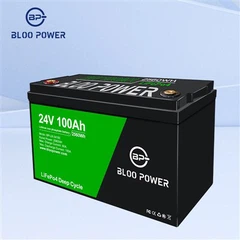
Suitable for relatively small load power, existing 24V equipment, or applications in RVs, ships, and small off-grid applications. It is recommended to focus on battery capacity, continuous discharge current, and the actual input range of the inverter. For example, if approximately 5kWh of energy storage is required, a 25.6V 200Ah LiFePO4 solution can be evaluated, but the final specifications should be based on the actual product datasheet and project load calculations.
Option B: Choose a 48V LiFePO4 Energy Storage Battery
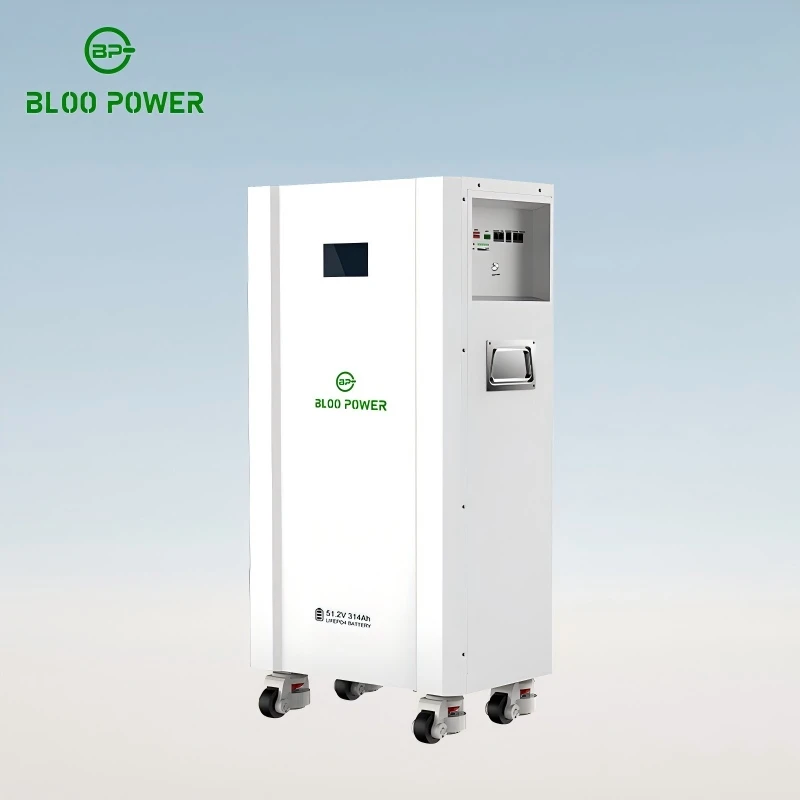
Suitable for residential solar energy storage, inverters of 5kW and above, large-capacity backup power supplies, and projects requiring future modular expansion. For example, a 51.2V 100Ah battery has a capacity of approximately 5kWh, a 51.2V 200Ah battery has a capacity of approximately 10kWh, a 51.2V 280Ah battery has a capacity of approximately 14.3kWh, and a 51.2V 314Ah battery has a capacity of approximately 16.1kWh. BLOO POWER can create energy storage solutions with capacities of 10kWh, 20kWh, 30kWh, or even larger by connecting multiple batteries in parallel, based on the customer's actual daily power consumption and peak load.
Solution C: High-Power Residential or Small Commercial Projects
If the customer requires not only large capacity but also high continuous output power, then the number of batteries must be increased or products with higher current capabilities must be selected. The fact that a battery has a capacity of 30kWh does not mean it can support inverters of any power. The total kWh capacity, the total continuous current of the BMS, and the peak power of the inverter must all be calculated during the design phase.
24V or 48V? Quick Decision Process
If your system falls into the following categories, you are more inclined to choose 24V:
● You already have a 24V inverter or 24V DC equipment.
● Your total load power is relatively low.
● Primarily used in RVs, boats, or small off-grid systems.
● You want a simple system structure and don't need large-scale capacity expansion in the future.
If your system falls into the following categories, you are more inclined to choose 48V:
● Your home requires a 5kW, 6kW, 8kW, or higher power inverter.
● You need to power multiple high-power household appliances simultaneously.
● You plan to add air conditioners, heat pumps, or other high-power loads in the future.
● You want to expand capacity by paralleling batteries.
● You prioritize reducing the cable and connection stress caused by high DC current.
Conclusion: Don't simply ask "24V or 48V is better," but rather "Which is more suitable for my system?"
There's no absolute superiority of 24V or 48V. The truly correct choice depends on the project's power output, daily power consumption, inverter specifications, BMS current capacity, future expansion plans, and installation costs. For low-power applications with an existing 24V infrastructure, 24V LiFePO4 energy storage systems still offer high practical value. However, for modern residential solar energy storage, inverters above 5kW, and projects requiring continuous future expansion, 48V systems typically alleviate DC-side design pressure by reducing current and provide a system architecture more suitable for high-power applications.
Therefore, before purchasing BLOO POWER energy storage batteries, customers are advised to provide at least the following six pieces of information: inverter model, maximum load power, daily power consumption, required standby hours, existing solar system scale, and future expansion plans. Only by simultaneously completing capacity and power calculations can you truly determine whether to choose 24V or 48V, and how many kWh of LiFePO4 energy storage batteries are needed.
Regarding safety, stationary energy storage projects should also review applicable standards in accordance with the regulations of the target market. IEC 62619 covers the safety requirements for lithium batteries in industrial applications, including stationary energy storage, while IEC 63056 further specifies safety requirements for lithium batteries in energy storage systems. North American projects may involve system-level requirements such as UL 1973, UL 9540, and local installation specifications. The final product certification and installation plan should be based on specific market regulations, local authorities, and the manufacturer's technical documentation.
Send Inquiry