












Rack-mount vs. Stacked Battery Storage: Which is Better Suited For Residential And Commercial Energy Storage?
Aug 18, 2026
Leave a message

With the increasing demand for self-consumption of solar energy, peak-valley electricity price arbitrage, residential backup power, and off-grid applications, energy storage batteries have gradually shifted from a question of "whether it's necessary to install them" to a question of "what structure should be chosen." Currently, the most common product forms in the residential and small-scale commercial and industrial energy storage market include rack-mounted batteries and stackable batteries. Both can use lithium iron phosphate (LiFePO4/LFP) cells, can be expanded through multiple battery modules, and can form complete energy storage systems with solar inverters. However, they differ significantly in terms of installation methods, space utilization, capacity expansion, ease of maintenance, system integration, and long-term economics.
Taking BLOO POWER's product portfolio as an example, its residential energy storage products cover rack-mounted, stacked, wall-mounted, integrated, and other LiFePO4 energy storage solutions. Standard residential capacities include approximately 5kWh, 10kWh, 14.34kWh, 15kWh, and 20kWh, with capacity expansion possible depending on the specific system. Some of BLOO POWER's 51.2V rack-mounted products utilize a 3U structure, such as 5.12kWh, 6.91kWh, and 10.24kWh specifications; specific cycle life, parallel connection quantity, charge/discharge current, and certification requirements should be based on the final model datasheet and project configuration.
The following section will analyze "Rack-mounted vs. Stacked Energy Storage Batteries" in detail from 12 core dimensions to help residential users, solar installers, distributors, and project developers make more informed choices.

First, let's understand the basic structures of both: What are the differences between rack-mounted and stacked batteries?
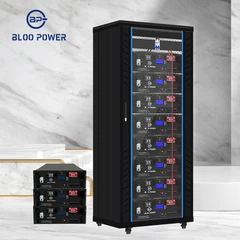
Rack-mounted energy storage batteries typically employ a standardized modular design, with each module independently installed in a rack, open battery rack, or standard battery cabinet. Users can configure multiple modules horizontally or vertically according to their needs, achieving larger capacity energy storage battery packs through battery communication systems and electrical connections. Its advantage lies in its high degree of module standardization, making it particularly suitable for homes, communication base stations, small commercial projects, and customized energy storage engineering projects that require flexible configuration based on project capacity. BLOO POWER's rack-mounted product data shows that some models use an approximately 51.2V platform and a 3U height design, offering modular options such as 5.12kWh, 6.91kWh, and 10.24kWh.
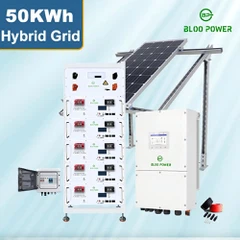
Stacked energy storage batteries, on the other hand, emphasize a product form where modules are directly stacked upwards. Each additional battery module is typically installed directly on the base or on top of the previous module, forming a complete system through dedicated connectors, communication interfaces, or internal connection structures. Its biggest advantages are its clean appearance, relatively small footprint, and ease of understanding for home users: when capacity is insufficient, modules can be added as allowed by the system. BLOO POWER defines Stackable Battery as a modular energy storage system, supporting users to expand capacity by vertically stacking identical modules.
The core difference can be summarized as: rack-mount emphasizes "standard modules + brackets/racks," while stackable emphasizes "modular vertical integration."
Key Comparisons:
● Rack-mount: Modules are installed independently, suitable for brackets, racks, and customized configurations.
● Stackable: Modules are directly combined vertically, resulting in a more integrated system appearance.
● Rack-mount: Typically more suitable for flexible capacity expansion and multi-module projects.
● Stackable: Typically more suitable for residential users seeking a simple and compact installation experience.
Comparison of rack-mounted and stacked energy storage battery basic structures
|
Compare items |
Rack-mounted energy storage battery |
Stacked energy storage batteries |
|
Basic installation method |
The module is installed in a bracket or rack. |
Battery modules are stacked vertically. |
|
Product Structure |
High degree of independent modularity |
The integrated modular combination is obvious. |
|
Capacity expansion |
Add modules according to system rules |
Typically, this is achieved by continuously adding stacked modules to expand capacity. |
|
Space utilization |
Make full use of rack and vertical space |
Mainly reduces the ground area occupied |
|
Installation complexity |
More mechanical fixing and wiring are required. |
It typically has a more intuitive modular installation method. |
|
Maintenance method |
Single-module assembly and disassembly are usually more flexible |
Disassembly and assembly may be required depending on the stacking position. |
|
Appearance |
Industrialization and specialization |
Home-oriented and tidy |
|
Typical scenarios |
Residential, Off-grid, Telecommunications, Commercial, Small BESS |
Home energy storage, villas, modular home storage |
|
System customization |
Usually higher |
Relatively more dependent on the original manufacturer's module system |
Space Utilization: Which is Better for Users with Limited Installation Space?
From a space utilization perspective, it's not a simple matter of which rack-mount or stacked configuration is "absolutely more space-saving." The key factor is the type of space the user has. Rack-mount batteries can fully utilize the vertical space within a rack. For example, some BLOO POWER 3U rack-mount battery modules are approximately 131mm high, and standardized modules can be installed in corresponding brackets or racks. If the installation location already has equipment cabinets, battery cabinets, or a technical room, rack-mount solutions can achieve high space organization efficiency by uniformly arranging multiple modules. Some BLOO POWER materials also indicate that rack-mount modules support parallel expansion of multiple units; the maximum number needs to be confirmed based on the model and system communication architecture.
Stacked products are more suitable for environments in ordinary homes where "floor space is limited, but height space allows." Examples include garage corners, storage rooms, equipment rooms, or residential energy management areas. If users do not want to add large battery cabinets, capacity modules can be added directly upwards according to the product design. BLOO POWER's product information also points out that stacked systems allow battery modules to be added vertically like building blocks, offering the main advantages of a clean appearance and simplified capacity expansion.
Therefore, rack-mount systems are often more advantageous if users have already planned for standard racks or need to manage multiple battery systems uniformly; however, if users are more concerned about floor space, home décor, and product aesthetics, stacked systems are usually more readily accepted.
When choosing a space, the following should be considered:
● Width, depth, and height of the installation location.
● Whether space needs to be reserved for future expansion.
● Whether existing racks or standard equipment brackets are available.
● Whether local electrical codes, maintenance distances, and fire safety requirements are met.
Capacity Expansion Capability: Rack-Mounted Systems More Flexible, or Stacked Systems More Convenient?
Capacity expansion is one of the most critical issues in energy storage system selection. A household might only need 10kWh today, but future additions such as electric vehicles, heat pumps, air conditioners, swimming pool equipment, or other high-power loads could render the existing capacity insufficient. One of the core advantages of rack-mounted batteries is their modular flexibility. For example, some of BLOO POWER's rack-mounted products offer single-module capacities of approximately 5.12kWh, 6.91kWh, and 10.24kWh. Some models specify support for up to 16 modules in parallel, but the actual number of modules that can be expanded depends on the BMS, inverter, cables, protection devices, and specific model requirements.
For example, assuming a project selects 5.12kWh modules:
2 units = approximately 10.24kWh
4 units = approximately 20.48kWh
6 units = approximately 30.72kWh
8 units = approximately 40.96kWh
This method is particularly convenient for solar installers because it allows for tiered pricing based on the customer's budget. Customers install the basic capacity first, and then add battery modules later based on system compatibility.
Expanding capacity with stacked energy storage is even simpler and more intuitive. Users typically add modules of the same model as specified by the manufacturer, increasing the total system storage capacity with each added module. However, stacked systems usually have limitations on the maximum number of layers, maximum capacity, base load-bearing capacity, and system structure, so expansion is not unlimited. For ordinary households, this "standardized expansion" actually makes it easier to avoid the complexities of mixing different modules.
When expanding capacity, the following must be confirmed:
● The maximum battery capacity allowed by the inverter.
● The maximum number of parallel or series modules supported by the BMS.
● Do new modules require the same model and similar production batch?
● Do cables, fuses, and circuit breakers need to be upgraded simultaneously?
Installation Difficulty Comparison: Which is More Suitable for Residential Users and Solar Installers?
Rack-mounted energy storage systems typically require more installation preparation. Installers need to confirm the load-bearing capacity of the brackets or cabinets, fix the modules according to product requirements, and complete positive and negative connections, communication line connections, grounding, and the installation of circuit breakers and protection devices. If the system contains multiple modules, it is also necessary to plan the cable length and current distribution reasonably to avoid current imbalance between modules due to unreasonable connection methods. For professional installation teams, this is not a problem; on the contrary, they can design a more flexible layout according to the site space.
BLOO POWER's rack-mounted products use an intelligent BMS and provide communication solutions such as CAN/RS485 or corresponding product configurations. Some materials claim compatibility with various off-grid or hybrid inverters on the market. However, "compatibility" does not mean that all models can be directly plugged and played. The actual project should still refer to the inverter manufacturer's battery compatibility list, communication protocol, and the technical confirmation results of both parties.
Stacked energy storage installation is usually closer to "standardized product deployment." The modules are placed in a specified order, completing the connections and communication between them, and then connected to the inverter. Therefore, for repetitive residential installation projects, stacking can reduce the workload associated with rack assembly and complex wiring. However, it's important to note that battery system installation is still part of electrical engineering; grounding, protection devices, local permits, and professional installation requirements should not be overlooked simply because the product uses a "plug-and-play" structure.
Installation Comparison Highlights:
● Rack-mounted: Requires more advanced planning.
● Stacked: Generally more standardized.
● Rack-mounted: More suitable for customized professional projects.
● Stacked: More suitable for mass-production residential projects.
Maintenance and Troubleshooting: Rack-mounted systems typically offer greater module independence.
Energy storage systems can have lifespans of several years, so not only is initial installation ease important, but future maintenance must also be considered. If a large battery system consists of multiple modules, the ability to quickly locate, remove, and replace a faulty module directly impacts system downtime.
Rack-mounted products offer significant modular advantages in maintenance. Since each battery is typically installed independently in a designated location within a rack or bracket, technicians can locate the problematic module based on BMS data, module voltage, SOC, temperature, and alarm information, and then isolate and repair it according to system safety procedures. Some BLOO POWER rack-mounted products are equipped with LCD, intelligent BMS, or remote monitoring functions; specific features vary depending on the model.
While stacked products offer a cleaner appearance, maintenance can be affected by the vertical positioning of the modules. If the bottom module needs replacement, the top modules may need to be disassembled according to the manufacturer's specifications. Therefore, when choosing a stacked system, users should specifically understand whether the manufacturer supports single-module maintenance, module disassembly and assembly procedures, and after-sales spare parts supply.
From a long-term maintenance perspective, rack-mounted systems resemble standardized industrial equipment, while stacked systems emphasize product integration. For installers and project owners with professional maintenance teams, the former is generally easier to manage at the module level.
During maintenance, it is recommended to focus on the following:
● Does it support single-module fault diagnosis?
● Can faulty modules be replaced independently?
● Does the BMS provide detailed alarms and operational data?
● Is it possible to quickly obtain original manufacturer or authorized after-sales support locally?
Heat Dissipation and Thermal Management: Don't Just Look at the Shell Structure, Consider the Entire System Design
Battery lifespan and safety are closely related to temperature. The U.S. Department of Energy points out that the safety design of battery energy storage systems involves battery management, thermal management, system integration, and testing and standards systems for risks such as thermal runaway. Therefore, users cannot judge the safety level of a system solely based on its "rack-mounted" or "stacked" appearance. Actual performance also depends on the cell chemistry, BMS control, thermal design, module spacing, and overall energy storage system certification.
Rack-mounted systems typically have sufficient installation space between modules, allowing for airflow paths based on rack design. If installed in a specialized equipment cabinet, environmental ventilation can be incorporated. For multi-module systems, this facilitates independent temperature monitoring and maintenance of different modules.
Stacked systems have more compact module spacing, therefore manufacturers usually need to specifically design the internal structure, thermally conductive materials, temperature sensors, and battery control strategies. Its advantage lies in its unified system structure, allowing for optimized thermal management solutions based on fixed module combinations. However, users should not mix modules of different heights, specifications, or manufacturers to avoid altering the system's original thermal and electrical design.
Four key points for thermal management:
● Check the allowable operating temperature range of the battery cells.
● Confirm that the BMS has high and low temperature protection.
● Avoid installing the system in direct sunlight, high temperatures, or enclosed, confined spaces.
● Ventilation and maintenance space must be reserved according to the manufacturer's specifications.
Safety Performance Comparison: Structure is Not the Only Standard; Certification and System Testing are More Important
Many users believe that "stacked systems are safer" or "rack-mounted systems are more professional, therefore safer," but this judgment is inaccurate. Energy storage safety is a system-level issue, encompassing multiple aspects including cell quality, BMS, fuse protection, contactors, communication control, thermal management, mechanical structure, inverter matching, and installation environment.
In the international market, North American energy storage projects often involve standards or testing systems such as UL 1973, UL 9540, and UL 9540A; other markets may also involve requirements such as IEC 62619, IEC 63056, and CE. The specific applicable standard depends on the product type, sales country, and application scenario. BLOO POWER's official website lists relevant certifications and documentation such as CE, FCC, MSDS, UN38.3, UL1973, and IEC62619. However, when purchasing specific products, customers should request suppliers to provide valid certificates, certification scopes, and applicable market documents for the corresponding models. Company-level certification claims should not be used as a substitute for specific system certifications.
Therefore, regardless of whether rack-mount or stacked systems are chosen, the real focus should be on whether the model meets the requirements of the project location, especially in the US, Europe, and other strictly regulated markets.
Safety Selection Recommendations:
● Confirm the specific certifications corresponding to the model, not just brand claims.
● Confirm the certification status of the entire ESS system, not just individual cells.
● Prioritize systems with complete BMS protection functions.
● Strictly comply with local installation, electrical, and fire safety regulations.
Comparison of Key Safety and Technology Selection Criteria
| item | Rack-mounted energy storage battery | Stacked energy storage batteries | Users should pay close attention to this |
| BMS | Each module is typically managed independently. | Typically managed at both the module and system levels. | Overvoltage, undervoltage, overcurrent, and temperature protection |
| Thermal Management | Related to rack and module layout | Related to overall structural design | High and low temperature operation capability |
| Mechanical stability | Relying on brackets or cabinets for fixation | Relying on base and stacking locking design | Anti-tipping and installation stability |
| Electrical protection | Multi-module connections require careful design. | Integrated connectivity is usually more | Circuit breakers, fuses, isolation measures |
| System Authentication | Module and system-level files need to be confirmed. | Module and system-level files need to be confirmed. | Applicable requirements such as UL, IEC, and CE |
| Installation Safety | High level of professionalism required for construction | Operation is more standardized but still requires professional installation | Grounding, Spacing, Environment and Standards |
Compatibility: Rack-mount batteries are generally better suited for complex inverter ecosystems
In real-world projects, ensuring proper communication between a battery and an inverter is far more complex than simply "connecting if the voltage is the same." While a 51.2V battery may be on a similar platform to some 48V low-voltage hybrid inverters from a DC voltage perspective, the BMS and inverter still need to resolve compatibility issues with CAN, RS485, or other communication protocols. If communication is incompatible, the system may not be able to accurately read SOC, maximum charging current, maximum discharging current, and temperature information.
Rack-mount batteries, due to their long-standing and widespread use in communication, server, power backup, and modular energy storage scenarios, are generally better suited for complex system integration due to their standardized communication and modular design. Some of BLOO POWER's rack-mount product specifications indicate support for RS485/CAN communication and claim compatibility with various off-grid or hybrid inverters, but final compatibility still needs to be confirmed for specific brands and models.
Stacked products, on the other hand, often employ a more closed and unified system ecosystem. For ordinary users, this is actually an advantage, as manufacturers can pre-define the operating logic between the battery module, control unit, and inverter, reducing the difficulty of user configuration.
Compatibility Checklist:
● Rated voltage and actual operating voltage range.
● CAN or RS485 communication protocol.
● Inverter's official list of compatible batteries.
● Maximum permissible charging and discharging current.
Power Output Capability: Don't just compare kWh, you must also compare kW.
Many users only focus on capacity when purchasing energy storage batteries, such as "10kWh is twice as large as 5kWh," but they ignore the system's output power. kWh indicates how much electrical energy is stored, while kW indicates how much power can be output. For example, a household installing a 10kWh battery does not necessarily mean it can consistently output 10kW; the actual continuous output capability is limited by the cells, BMS, number of modules, system voltage, and inverter capacity.
BLOO POWER's 51.2V rack-mount product datasheet shows that the maximum continuous charge/discharge capability varies depending on the module capacity. For example, some 5.12kWh, 6.91kWh, and 10.24kWh rack-mount models specify different continuous charge/discharge currents and corresponding power levels, indicating that capacity and output capability must be verified simultaneously.
One advantage of rack-mount systems is the ability to increase the total allowable charge/discharge capacity of the battery pack by adding parallel modules; however, the actual improvement is still limited by inverter and system protection design. Stacked systems can also increase system capacity with the addition of modules, but must operate within the maximum number of modules designed in the original manufacturer's specifications.
NREL's residential battery storage analysis also emphasizes that energy storage system performance involves not only capacity but also parameters such as cycle life and round-trip efficiency. NREL's 2024 ATB uses an approximately 85% round-trip efficiency assumption for representative residential battery systems, illustrating that when calculating economics at the system level, the battery's nameplate capacity cannot be simply considered as the effective amount of electricity ultimately delivered to the load.
The following must be compared before purchasing:
● Rated storage capacity: kWh.
● Available capacity: Affected by DoD and control strategies.
● Continuous output power: kW.
● Peak output power and duration.
Long-Term Lifespan and Cycle Count: Product Design Differences are Less Important Than Structural Differences
Rack-mount and stacked configurations do not inherently determine battery lifespan. The real factors affecting lifespan are the cell chemistry, DoD (Domain of Demand), charge/discharge rate, operating temperature, SOC management strategy, and actual usage frequency. Currently, LiFePO4 is widely used in the residential energy storage market due to its cycle performance and thermal stability. However, different manufacturers may have completely different cycle count testing conditions. Therefore, it's not possible to directly compare "6000 cycles" versus "8000 cycles"; the DoD, temperature, rate, and lifespan termination conditions must all be considered.
For example, some BLOO POWER rack-mount products are labeled as achieving 6500 or 8000 cycles under 80% DoD conditions. Data varies across different pages and models; therefore, the official specifications of the specific model must be consulted during project procurement.
For residential applications with approximately one complete equivalent cycle per day, theoretically, several thousand cycles could correspond to many years of use. However, actual lifespan is also affected by calendar aging. NREL's residential energy storage cost model analyzes a system lifecycle of approximately 15 years, highlighting capacity degradation and potential upgrade or replacement needs.
Therefore, when selecting a product, one should not solely focus on the highest advertised cycle count, but rather comprehensively compare warranty periods, guaranteed remaining capacity, cycle testing conditions, and actual application scenarios.
Lifecycle assessments must consider:
● The DoD (DoD) at which the cycle count was tested.
● The remaining capacity at the end of the test.
● The estimated number of cycles per day.
● The length of the manufacturer's product warranty.
Cost and Long-Term Economics: Initial Purchase Price Comparison is Inappropriate
From an initial cost perspective, rack-mount systems typically require consideration of battery modules, racks or cabinets, busbars and connection components, and installation labor. Stacked systems may integrate more structural components into the product design, resulting in faster installation, but the cost per module and the overall structure may differ. Therefore, simply comparing the "price per kWh of battery" does not determine which solution is more economical.
The real comparison should be of the total lifecycle cost of energy storage. NREL's analysis of residential battery energy storage indicates that the cost of an energy storage system includes not only the initial equipment cost but also factors such as operation and maintenance, and long-term capacity degradation. Their 2024 ATB model uses a representative round-trip efficiency of approximately 85% and conducts an economic analysis of the system's entire lifecycle.
For example, a cheap battery system with low efficiency, difficult maintenance, and limited scalability may have higher long-term operating costs. Conversely, a system with a slightly higher initial price but better modularity allows for the addition of batteries as the load increases in the future, without having to completely replace the entire system.
For BLOO POWER dealers and solar installers, different pricing structures can be designed to meet customer needs: the basic version uses fewer modules, while the upgraded version increases capacity; for professional rack projects, a rack-mount modular configuration is used; and for the high-end residential market, a more streamlined stacked solution is employed.
When calculating cost-effectiveness, it is recommended to include:
● Initial equipment price.
● Installation and auxiliary material costs.
● Energy loss due to round-trip efficiency.
● Future expansion and maintenance costs.
How should different users choose?
|
User type |
More recommended solution |
main reason |
|
Ordinary household users |
Stacking preferred |
Neat appearance, intuitive installation, and small footprint |
|
Large-capacity energy storage for villas |
Determined by capacity |
Expansion capacity, power, and installation space need to be considered simultaneously. |
|
Existing equipment room |
Rack-mounted |
Convenient for unified installation in equipment cabinets or brackets |
|
Off-grid solar projects |
Rack-mount or stackable are both available |
The key factors depend on capacity and inverter compatibility. |
|
Solar installer |
Two products deployed simultaneously |
It can cover different customer groups |
|
Distributor/OEM Customer |
Rack-mounted systems are generally more flexible |
Standard modules facilitate customization and combination. |
|
Pursuing a beautiful home |
Stacked |
Higher level of product integration |
|
Requires flexible modification later |
Rack-mounted |
Modules are usually easier to configure and maintain independently. |
|
Communication or technical equipment scenarios |
Rack-mounted |
More in line with standardized equipment installation logic |
|
Need for rapid, standardized delivery |
Stacked |
Modular installation processes are generally simpler. |
How to Choose Between BLOO POWER Rack-Mounted and Stacked Products?
For users looking to build flexible energy storage systems, BLOO POWER's rack-mounted LiFePO4 products offer strong modularity. Publicly available product data shows different rack-mount specifications such as 51.2V, approximately 5.12kWh, 6.91kWh, and 10.24kWh. Some products feature a 3U design and offer multi-module expansion capabilities. BLOO POWER also offers different types of residential energy storage products, including rack-mounted, stacked, wall-mounted, and integrated ESS (Energy Storage System), allowing for selection based on installation environment and market demand.
If the project requires installation in a standard rack or cabinet, and the customer desires flexible combinations of 10kWh, 20kWh, 30kWh, or larger capacities according to their budget, and the installer has a professional technical team, then rack-mounted products are generally more suitable. For example, multiple 5kWh or 10kWh modules can be selected to form different capacity solutions, and then configured according to inverter compatibility and maximum current requirements.
If the target customer is a typical household that desires a cleaner look, a more standardized installation process, and the ability to upgrade to fixed modules for future capacity increases, then stacked products typically offer a better user experience. Especially in the European, Australian, and other residential energy storage markets, users are increasingly focused on whether the equipment can integrate seamlessly with their living spaces, which is one of the key advantages of stacked energy storage products.
BLOO POWER's website also showcases low-voltage 48V/51.2V series and higher voltage levels of LiFePO4 residential energy storage products, listing certifications including IEC 62619 and UL 1973. For actual export or project procurement, certification documents should be verified for the target market and the final product model.
BLOO POWER Product Selection Recommendations:
● For flexible capacity combinations: Choose a rack-mount solution.
● For a home-like appearance: Prioritize stacked solutions.
● OEM/ODM customization required: Project design based on module, voltage, and capacity.
● Compatibility with specific inverters required: CAN/RS485 and official compatibility verification must be performed first.
Ultimate Recommendations for Rack-Mounted vs. Stacked Energy Storage Systems
In summary, rack-mounted energy storage systems are not necessarily more professional than stacked systems, nor are stacked systems necessarily more advanced. The two structures address different user needs.
If your core requirements are flexible capacity, standardized modules, easy rack mounting, the ability to combine more modules according to project needs in the future, and ease of professional maintenance, then rack-mounted energy storage systems are generally a better choice. For solar installers, engineering companies, off-grid projects, and users requiring larger capacities, rack-mounted solutions offer particularly high system flexibility.
If your core requirements are a clean appearance, small footprint, modular vertical expansion, simple installation process, and suitability for residential environments, then stacked energy storage systems are generally more suitable for the residential market.
Regardless of the final choice, it is recommended not to compare only "price" and "capacity," but to conduct a comprehensive evaluation based on at least the following dimensions: cell type, available capacity, DoD, continuous output power, maximum charge/discharge current, cycle life test conditions, round-trip efficiency, BMS, inverter compatibility, expansion limitations, certification documents, warranty policy, and local installation specifications.
For customers wishing to purchase LiFePO4 residential energy storage systems, rack-mounted batteries, stacked energy storage batteries, or for OEM/ODM customization, they can obtain the latest technical specifications, inverter compatibility lists, and certification documents for the corresponding models from BLOO POWER, based on their actual market conditions, grid environment, household load, and solar system scale, before making final system configurations. BLOO POWER's product portfolio covers rack-mounted, stacked, wall-mounted, and integrated residential energy storage systems, providing modular options for different capacities and installation scenarios.
Send Inquiry