












How to Match Energy Storage Batteries and Inverters?
Aug 21, 2026
Leave a message

How to match energy storage batteries and inverters? 11 key principles explained | BLOO POWER Residential Energy Storage System Selection Guide
With the development of residential photovoltaic (PV), off-grid power supply, and industrial and commercial energy storage markets, energy storage batteries and inverters have become the two most crucial components in an energy storage system. Batteries are responsible for storing and releasing electrical energy, while inverters handle DC-AC conversion, PV energy management, grid interaction, load power supply, and system control. Therefore, "sufficient battery capacity" is not the only issue in selecting an energy storage system. More importantly, the battery voltage, current capacity, inverter power, communication protocol, charging and discharging parameters, parallel expansion capabilities, and safety certifications must be truly compatible. Incorrect matching can lead to problems such as communication failures, frequent BMS protection activations, inability to discharge at full power, incomplete charging, inverter alarms, and even shortened system lifespan, even if the individual battery and inverter parameters are excellent.
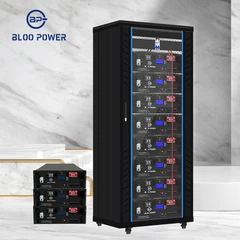
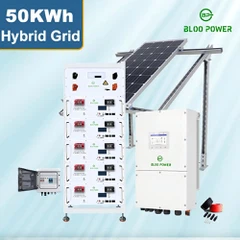
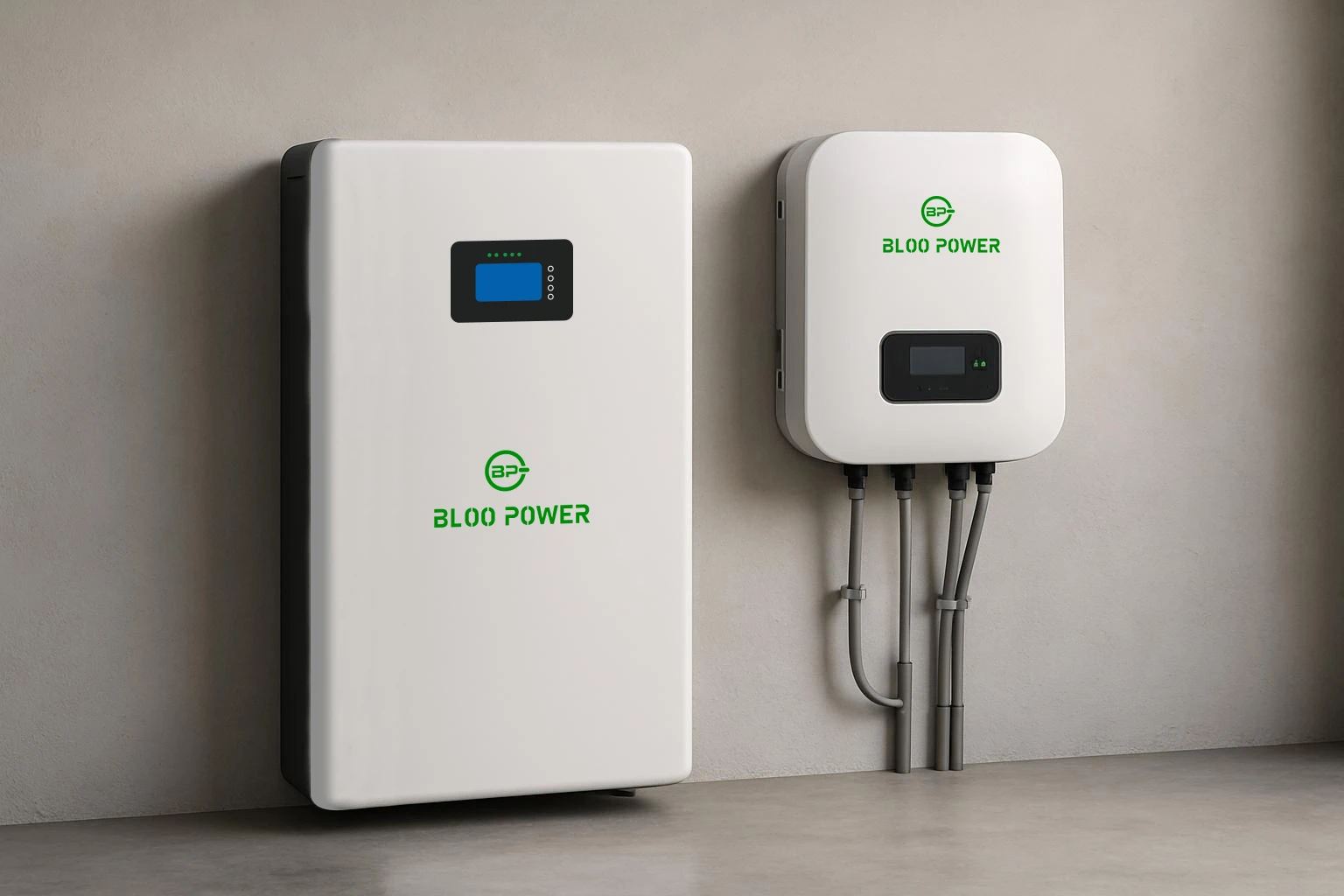
For residential users, solar installers, and energy storage dealers, the correct selection strategy should be: "First, determine your electricity needs; then, determine the inverter power; next, match the battery capacity and continuous discharge capability; and finally, verify communication and certification compatibility." Taking BLOO POWER's 48V/51.2V LiFePO4 wall-mounted, rack-mounted, stacked, and integrated energy storage products as examples, they can be modularly combined to match hybrid inverters or off-grid inverters of different power levels according to the capacity requirements of 5kWh, 10kWh, 15kWh, 16kWh, 20kWh, and larger.
First, let's clarify: What are the respective responsibilities of energy storage batteries and inverters, and why must they be matched as a whole?
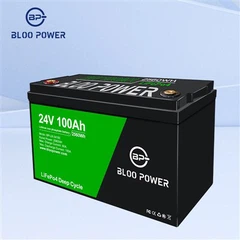
The correct matching of an energy storage system must begin with understanding the basic responsibilities of both devices. Batteries are essentially DC power sources and energy storage units, typically expressed in V (voltage), Ah (capacity), and kWh (energy storage). Inverters, on the other hand, are the "power control center" of the entire system, responsible for converting the battery's DC power into AC power for household appliances. They also handle photovoltaic charging, grid charging, grid-connected operation, off-grid power supply, and backup power switching, depending on the system type. For example, a typical 51.2V 100Ah LiFePO4 battery has a nominal energy storage of approximately 5.12kWh. However, the power output of the inverter it can supply depends not only on this 5.12kWh capacity but also on the continuous discharge current allowed by the battery's BMS (Battery Management System). For example, on a 51.2V platform, a continuous discharge of 100A theoretically corresponds to approximately 5.12kW of DC power. However, actual systems also need to consider inverter conversion losses, cable losses, ambient temperature, and battery protection strategies. Therefore, inverter selection cannot be a simple one-to-one judgment based on "10kWh battery with a 10kW inverter," but must simultaneously calculate power and current.
Key points to consider:
● The battery primarily determines the energy storage time and sustainable power supply capacity: the unit is usually kWh.
● The inverter primarily determines how many loads it can simultaneously drive: the unit is usually kW.
● The battery's maximum continuous charge/discharge current determines the actual inverter power it can support.
● A complete ESS (Energy Storage System) must simultaneously consider the battery, BMS (Battery Management System), inverter, protection devices, and communication control.
From a system safety perspective, authoritative energy storage standards also emphasize evaluating the entire system, not just checking the battery and inverter separately. UL 9540 assesses the overall safety of energy storage systems, including charging and discharging, protection, control, and communication between devices.
Choose an Inverter Based on Actual Load Power, Not Just Battery Capacity
The inverter power should first be determined by the load the user actually needs to operate simultaneously. For example, a household might have a refrigerator, lighting, television, Wi-Fi, air conditioner, water pump, and kitchen appliances, but these appliances don't necessarily all operate at full power simultaneously. Therefore, system designers need to calculate the "maximum simultaneous operating power" and consider a certain power margin. Assuming the critical household load operates at approximately 4kW simultaneously, choosing a 5kW or 6kW inverter is generally more reasonable than directly choosing a 3kW inverter; if multiple air conditioners, induction cookers, water pumps, or high-power appliances need to be supported simultaneously, an 8kW, 10kW, or even higher power system may be required. At the same time, the starting power of motor-type loads must also be considered. For example, water pumps, compressors, and some air conditioners may generate surge demands significantly higher than their rated power at startup. Therefore, in addition to continuous output power, the inverter's peak power or short-term overload capacity must also be considered.
Taking BLOO POWER's residential energy storage solution as an example, 5kWh, 10kWh, 15kWh, and 16kWh LiFePO4 batteries can be combined with hybrid or off-grid inverters of different power levels based on the actual load, rather than mechanically selecting inverters with the same power rating according to battery capacity.
Key areas to focus on:
● Calculate the maximum simultaneous power of critical loads and whole-house loads.
● Reserve a reasonable power margin for the inverter to avoid long-term full-load operation.
● Carefully check the startup surge power of equipment such as air conditioners and water pumps.
● Confirm the inverter's continuous power, peak power, and overload duration.
NREL's residential energy storage cost model also analyzes the power capacity and energy capacity of residential systems separately. For example, its model shows power capacities of 3–8kW and different E/P ratios, indicating that "battery energy storage" and "system power" are inherently two independent parameters that must be designed collaboratively.
Battery Voltage Must Be Strictly Matched to the Inverter's Battery Voltage Platform
Voltage matching is the most fundamental and potentially fatal aspect of pairing energy storage batteries with inverters. Residential energy storage systems on the market primarily utilize low-voltage platforms of 12V, 24V, and 48V/51.2V, as well as higher-voltage platforms. The inverter's battery input voltage range must match the actual operating range of the battery system. For example, a typical 48V LiFePO4 battery usually uses a nominal voltage of 51.2V, and users cannot arbitrarily connect any 48V or 51.2V battery simply because the product name includes "48V." The inverter's minimum and maximum permissible battery operating voltages, as well as charging cutoff and low-voltage protection ranges, must also be checked. The same applies to high-voltage battery storage systems, which typically require a dedicated high-voltage BMS or controller and must be connected in series according to the manufacturer's specified number of battery modules. Low-voltage 48V batteries cannot be directly connected to a high-voltage battery inverter.
BLOO POWER's product range covers low-voltage series such as 12V, 24V, 48V, and 96V, and also offers high-voltage LiFePO4 energy storage platforms such as 220V, 360V, 400V, and 512V. Therefore, for different projects, it is essential to first confirm whether the inverter is a low-voltage or high-voltage architecture before selecting the corresponding product.
Key points to consider:
● Confirm the inverter's rated battery voltage and allowable input voltage range.
● Confirm that the battery's full-charge voltage and discharge cut-off voltage are within the inverter's allowable range.
● A 48V/51.2V low-voltage system cannot directly replace a high-voltage energy storage battery system.
● The high-voltage system must be configured with battery modules and a high-voltage control unit according to the manufacturer's specifications.
Reference for Matching Inverters with Different Voltage Platforms
| Battery system platform | Common Applications | Typical inverter power range | Key points of matching |
| 12V LiFePO4 | Small RVs, lighting, portable energy storage | 0.5–2kW | High current draw limits high-power applications |
| 24V LiFePO4 | Small off-grid solar power, backup power | 1–4kW | Suitable for small to medium loads |
| 48V/51.2V LiFePO4 | Mainstream residential energy storage | 3–15kW | The key calculation focuses on BMS current and communication compatibility |
| High-pressure LiFePO4 system | Large-scale residential and commercial energy storage | ≥10kW | Dedicated high-voltage control and complete certification solutions are required. |
After determining the inverter power, it is essential to calculate the required discharge current from the battery.
This is one of the most crucial calculation steps in the actual selection of an energy storage system. The battery current can be initially estimated using "power ÷ voltage," i.e., I ≈ P ÷ V. For example, a 5kW inverter operating at full power on a 51.2V battery side theoretically has a DC-side current of approximately 97.7A; considering the inverter's own losses, the actual current drawn from the battery side is usually even higher. If a 10kW inverter is used, under the same 51.2V platform, the theoretical current is close to 195A. Therefore, if a single battery module's BMS only allows for a continuous discharge of 100A, a single battery might be suitable for supporting a load of approximately 5kW, but it cannot stably support a 10kW full-power output for extended periods. In this case, multiple battery modules typically need to be connected in parallel to share the current.
Therefore, when configuring high-power inverters with BLOO POWER's modular 48V/51.2V LiFePO4 products, designers cannot only calculate the total kWh; they also need to check the maximum continuous charge/discharge current of each battery module and determine the required number of batteries to be connected in parallel based on the inverter's maximum power.
● Calculate the theoretical current using P ÷ V, allowing for conversion loss margins.
● Check the battery's "maximum continuous discharge current," not just the peak current.
● When multiple batteries are connected in parallel, the current distribution must be considered.
● Cables, fuses, circuit breakers, and busbars must also meet the maximum continuous current requirements.
For example:
5kW ÷ 51.2V ≈ 97.7A;
10kW ÷ 51.2V ≈ 195.3A;
12kW ÷ 51.2V ≈ 234.4A.
These are only basic theoretical values; actual designs should be verified according to equipment efficiency and the manufacturer's technical documents.
Don't just look at "total capacity," you must also match the battery capacity (kWh) to the usage time.
Inverter power addresses "how much load it can simultaneously power," while battery capacity addresses "how long it can supply power." Therefore, proper system design requires calculating both power and energy storage time. For example, if a household needs an average of 2kW of power at night and wants continuous power for 5 hours, then theoretically, about 10kWh of available energy is needed. However, considering inverter losses, DoD settings, temperature, and long-term capacity degradation, the actual configuration usually requires a higher nominal capacity. Furthermore, a 5kW inverter does not necessarily mean a 5kWh battery is required, because a 5kWh battery can only theoretically sustain operation for about 1 hour at full 5kW discharge, and the actual usable time is also limited by system efficiency and available capacity. For households requiring peak shaving at night, power outage backup, or off-grid operation, a 10kWh, 15kWh, 20kWh, or a 30kWh system composed of multiple modules may be more reasonable.
According to BLOO POWER's official data, its home energy storage products offer standard capacities of 5kWh, 10kWh, 14.34kWh, 15kWh, and 20kWh, and can be expanded according to system needs. Therefore, modular configurations can be made based on the user's daily electricity consumption, nighttime load, and backup time.
● Calculate the actual daily storage requirements in kWh.
● Differentiate between nominal capacity and actual usable system capacity.
● Consider the effects of DoD, inverter efficiency, and ambient temperature.
● Allow for future load growth and natural battery capacity degradation.
Example of Inverter Power and Battery Capacity Matching
| Typical System | Inverter power | Recommended battery configuration ideas | Applicable Scenarios |
| Basic backup system | 3kW | 5–10kWh | Lighting, refrigerator, network, basic load |
| Standard Home System | 5–6kW | 10–15kWh | Ordinary household nighttime electricity use and backup power during power outages |
| High power residential system | 8–10kW | 15–30kWh | Air conditioners, water pumps, and multiple devices operating simultaneously |
| High power consumption systems | ≥10kW | ≥30kWh or high voltage system | Large residential buildings, villas, and small commercial properties |
Note: The above is a general selection reference and not a fixed ratio. The final capacity should be calculated based on the actual load curve, battery continuous current, local electricity price, and backup power time.
Communication Protocol Compatibility is More Important Than Just "Being Able to Connect"
Modern LiFePO4 energy storage systems typically connect the battery and inverter not only via positive and negative cables, but also require communication interfaces such as CAN or RS485 to allow the BMS (Battery Management System) to exchange critical data with the inverter. The communication system can transmit information to the inverter such as battery SOC (State of Charge), maximum allowable charging current, maximum allowable discharging current, temperature, fault status, and charging/discharging voltage limits. This allows the inverter to dynamically adjust its operating strategy based on real-time data from the BMS, rather than relying solely on a fixed voltage to determine battery status. If the communication protocols are incompatible, even with identical voltages, problems may arise such as battery recognition failure, abnormal SOC display, inability of the inverter to control charging correctly, and even frequent alarms between the BMS and the inverter.
Therefore, when selecting BLOO POWER batteries to pair with third-party inverters, it is essential to confirm the specific inverter model, software version, and corresponding CAN/RS485 communication protocol with the manufacturer beforehand. BLOO POWER's home energy storage product information indicates that some products offer communication interfaces such as RS232, RS485, and CAN, and are designed for compatibility with mainstream off-grid and hybrid inverters.
● Confirm that both devices support CAN, RS485, or a specified communication method.
● Confirm that the communication protocol and brand/model are on the compatibility list.
● Check the DIP address, master/slave battery, and terminating resistor settings.
● Before installation, confirm that the firmware versions of the inverter and BMS are compatible.
It is particularly important to note that "same interface" does not mean "same protocol." Two devices using RJ45 interfaces or both labeled CAN do not necessarily mean they can communicate directly.
Correctly Configure Charging and Discharging Parameters to Avoid Inverter and BMS "Mutual Protection"
Even if the battery and inverter hardware are correctly connected, improper charging and discharging parameter settings can still affect system stability. For example, if the inverter's maximum charging current exceeds the battery BMS's allowable value, the BMS may trigger overcurrent protection; if the charging cutoff voltage is set too high, the BMS may frequently trigger overvoltage protection; if the inverter's low-voltage shutdown voltage is set improperly, it may cause the battery to stop supplying power prematurely or result in abnormal SOC judgment. In systems with BMS communication capabilities, the manufacturer-recommended lithium battery communication mode should generally be used first, enabling the BMS to provide dynamic current and voltage limits to the inverter. If communication functionality is not available, manual settings must be strictly adhered to according to the charging curve, maximum current, and cutoff parameters provided by the battery manufacturer.
BLOO POWER's LiFePO4 energy storage products use a BMS to protect against overcharging, over-discharging, overcurrent, short circuits, and temperature. When configuring the system, inverter parameters should be kept away from prolonged periods approaching or repeatedly triggering these protection thresholds.
● The maximum charging current must not exceed the battery's allowable value.
● The maximum discharging current must be lower than the battery's BMS continuous discharge capacity.
● Charging cutoff and low-voltage protection parameters should be set according to the battery manufacturer's technical data.
● Prioritize BMS communication control, rather than arbitrarily applying lead-acid battery parameters.
The principle of reasonable settings is not to set the voltage and current as high as possible, but to ensure that the battery, BMS, and inverter always operate within a stable allowable range while meeting charging speed and load requirements.
Choosing AC-Coupled or DC-Coupled: Determining the System Architecture of the Battery and Inverter
For newly installed solar energy storage systems, DC-coupled systems typically offer higher system integration: the DC power generated by the photovoltaic modules can be directly managed by the hybrid inverter and stored in the battery, then converted back to AC power for household loads when needed. For users with existing traditional grid-connected photovoltaic systems, AC-coupled systems may be easier to implement because it doesn't necessarily require replacing the existing photovoltaic inverter; a separate energy storage device can be added. However, the conversion paths, installation methods, and system efficiencies of the two architectures differ. DC-coupled systems can reduce some redundant AC-DC conversions, while AC-coupled systems offer greater flexibility in retrofitting older systems.
Therefore, when configuring BLOO POWER batteries for a project, it's necessary to first determine whether the user is building a new photovoltaic + energy storage project or retrofitting an existing photovoltaic system with added batteries. Then, a decision should be made regarding whether to choose a hybrid inverter supporting DC-coupled systems or a solution suitable for AC-side energy storage retrofitting. Industry data also indicates that DC-coupled systems typically have higher energy efficiency due to reduced repeated conversions, while AC-coupled solutions are often suitable for retrofitting projects that retain existing photovoltaic (PV) equipment.
● New projects: Prioritize comparing hybrid inverters and DC-coupled solutions.
● Retrofitting existing PV systems: Focus on evaluating whether AC coupling is more economical and convenient.
● Compare actual conversion cycles, not just the efficiency of individual equipment.
● Consider installation costs, the value of retaining the original equipment, and future maintenance.
Single-phase, split-phase, and three-phase inverters must be compatible with the local power grid and load type.
While energy storage batteries provide DC power, the final AC output of the inverter must meet the requirements of the local household or project site's power grid. Different countries and regions may use different voltage systems such as 110V, 120V, 220V, 230V, and 240V, and may have single-phase, split-phase, and three-phase power supply structures. For example, some North American residences require a 120/240V split-phase system, while residential projects in Europe and many other markets may primarily use a 230V single-phase or 400V three-phase system. If the inverter output configuration is incorrect, even if the battery capacity and voltage are perfectly matched, it will not meet the actual household power distribution system's needs.
Therefore, before selecting BLOO POWER energy storage batteries, the AC voltage, frequency, number of phases, and whether grid connection certification is required for the target market should be confirmed. BLOO POWER products cover low-voltage and high-voltage LiFePO4 energy storage platforms, configurable according to different inverter architectures and project scales. However, the final AC side parameters must still be determined by the inverter and local grid specifications.
● Confirm whether the local grid is single-phase, split-phase, or three-phase.
● Confirm the rated voltage, such as 120/240V, 220V, 230V, or 400V.
● Confirm whether the grid frequency is 50Hz or 60Hz.
● Confirm the local grid connection code and inverter certification requirements.
When expanding capacity through parallel connections, both "capacity expansion" and "power expansion" must be considered simultaneously.
The biggest advantage of modular batteries is that system capacity can be increased by connecting multiple identical batteries in parallel. However, users need to understand that parallel connection not only increases kWh but may also increase the total allowable charge and discharge current of the system. For example, connecting two identical 51.2V 100Ah batteries in parallel increases the nominal system capacity to approximately 10.24kWh. Simultaneously, if each battery allows a continuous discharge of 100A, the theoretical continuous current capability of the entire system could potentially increase to approximately 200A. However, this is contingent on the product supporting this parallel connection method and the communication, busbar, cable, and protection systems being configured according to the manufacturer's requirements. It cannot be assumed that all current will be automatically and evenly distributed simply because two or three batteries have been purchased.
For BLOO POWER's modular residential energy storage solutions, 5kWh, 10kWh, and 15kWh batteries can be expanded according to project requirements. Their official product documentation also introduces the multi-unit parallel connection capability of some low-voltage products, but the actual maximum parallel connection quantity must be based on the specific model's technical specifications and project design requirements.
● Before parallel connection, confirm that the battery model, batch, and firmware meet the manufacturer's requirements.
● Calculate the total continuous charge/discharge current capability after capacity expansion.
● Use busbars, fuses, circuit breakers, and cables of the correct specifications.
● Confirm that the master-slave communication and battery address settings are correct.
Inverter and Battery Efficiency Need to be Evaluated as "Overall System Efficiency"
When purchasing energy storage equipment, users often only compare the advertised maximum efficiency of inverters or focus solely on battery cycle life. However, what truly affects how much electricity a user can ultimately utilize is the overall system efficiency. After electricity enters the system from the photovoltaic modules, it may undergo multiple stages, including MPPT conversion, battery charging, battery storage, battery discharging, inverter conversion, and AC distribution. Each stage incurs losses. Therefore, even a inverter with a high nominal efficiency may experience a decrease in overall system efficiency if the system architecture causes electricity to undergo multiple AC/DC conversions.
When selecting a system, the actual energy path of the system should be compared, and a reasonable coupling architecture and operating mode should be chosen whenever possible. NREL, in its residential energy storage modeling, also analyzes power, capacity, and battery-type inverters as independent components of system cost and performance. This demonstrates that the quality of a complete energy storage system cannot be judged solely by a single "maximum efficiency" figure.
● Compare system loop efficiency, not just inverter peak efficiency.
● Understand the number of conversions electrical energy undergoes under different modes.
● Select a suitable coupling architecture based on new or retrofit projects.
● Long-term economics should be calculated based on actual power generation and available power.
Safety certification and full compatibility verification are the last key line of defense for matching batteries and inverters.
The matching of energy storage batteries and inverters cannot ultimately stop at the level of "the same voltage, the wires can be connected, and the machine can be turned on". In particular, lithium battery energy storage systems have high energy density and large fault current capability. The system design must evaluate short circuit protection, overcurrent protection, BMS control, inverter protection capability and full system certification. UL Solutions clearly points out that the combination of individually certified components does not automatically mean that a storage system that meets the full ESS requirements is formed; the inverter also needs to be properly evaluated for battery power and its fault conditions.UL 9540 comprehensively evaluates batteries, power conversion, control, communication and protection from the perspective of a complete energy storage system.
Therefore, for BLOO POWER projects targeting North America, Europe and other different markets, it is recommended to clarify the target country, local installation specifications, inverter certification, battery certification and whether full system-level certification is required during the scheme confirmation stage. The BLOO POWER official website lists product certifications such as CE, FCC, MSDS, UN38.3, UL1973, and IEC62619, and related certification information. However, the specific certification scope should be based on the actual model, certificate, and project location requirements.
● Confirm the applicable certifications and specific model ranges for the battery and inverter.
● Confirm whether system-level certification is required for the complete system.
● Verify local grid connection and fire protection installation requirements.
● Have a qualified installer complete the protection devices, cabling, and commissioning work.
Final Matching Checklist for Energy Storage Batteries and Inverters
|
Inspection items |
Content that must be confirmed |
Problems that may result from mismatch |
|
Voltage Platform |
Low or high pressure, permissible operating range |
Failure to start, overvoltage or undervoltage protection |
|
Inverter power |
Continuous power, peak power and overload capacity |
Unable to drive high-power loads |
|
Battery continuous current |
BMS maximum continuous charge and discharge current |
BMS protection at full power |
|
Battery capacity |
kWh and backup power time requirements |
Insufficient power supply time during power outages |
|
Communication |
CAN/RS485 Protocol and Model Compatibility |
SOC error, unable to communicate |
|
Charge and discharge parameters |
Voltage, current, cutoff value |
Frequent alarms, insufficient charging, or over-protection |
|
Parallel capability |
Maximum quantity and current sharing requirements |
Abnormal current distribution |
|
AC parameters |
Single-phase/three-phase, 50/60Hz, voltage |
Unable to adapt to the local power grid |
|
Coupling method |
AC coupling or DC coupling |
Excessive renovation costs or inefficient practices |
|
Security Certification |
Battery, inverter and system-level requirements |
Installation approval and safety risks |
BLOO POWER Energy Storage Battery and Inverter Typical Pairing Recommendations
For different users, preliminary solution design can be based on the following approaches:
Solution 1: Small Home Backup Power
Suitable for basic lighting, refrigerators, internet, and small appliances. Consider a 3–5kW inverter + BLOO POWER 5–10kWh LiFePO4 battery. The key is to ensure the battery's continuous discharge current is sufficient to support the inverter at full load or anticipated critical loads, and to confirm the actual backup power time during power outages.
Solution 2: Standard Home Solar Energy Storage
Suitable for users with relatively stable household electricity demand who want to store electricity during the day and use it at night. Consider a 5–6kW hybrid inverter + 10–15kWh BLOO POWER 48V/51.2V LiFePO4 battery system. This type of solution requires careful matching of BMS communication, solar input range, and average nighttime load.
Option 3: High-Power Residential or Villa Applications
If a household uses multiple air conditioners, water pumps, electric heating devices, etc., an 8–12kW or higher power inverter + 15–30kWh or more modular batteries can be considered. Special attention should be paid to the total discharge current, as high-power low-voltage systems typically require multiple battery modules to share the current.
Option 4: High-Capacity and Commercial/Industrial Applications
For large residential, small commercial, or higher-power projects, BLOO POWER's high-voltage LiFePO4 energy storage system can be considered, depending on the inverter architecture. For high-voltage solutions, the number of battery modules, high-voltage controller, insulation and protection design, and complete compatibility with the PCS/hybrid inverter should be carefully confirmed.
In summary, the key to pairing energy storage batteries with inverters is not "the larger the capacity, the better," but rather "simultaneous matching of power, voltage, current, and communication."
The most important principle for correctly matching energy storage batteries and inverters can be summarized as follows:
First, calculate the load power to select the inverter; then, calculate the power supply time to select the battery capacity; next, verify the battery voltage, maximum continuous current, and communication protocol; finally, confirm system certifications and local installation requirements.
For BLOO POWER's residential energy storage products, users can choose from modular LiFePO4 systems with capacities of 5kWh, 10kWh, 15kWh, 20kWh, and larger, depending on project needs. These can be combined with a 48V/51.2V low-voltage or higher voltage platform to match suitable hybrid inverters, off-grid inverters, or other energy storage converters. Official product data shows that their residential energy storage products cover wall-mounted, rack-mounted, stacked, and integrated types, and offer different voltage platforms and expansion solutions.
It is particularly important to emphasize that you should not purchase equipment solely based on marketing descriptions such as "48V," "10kWh," or "compatible with mainstream inverters." For actual projects, you should confirm the specific battery model, inverter model, BMS protocol, maximum charge/discharge current, firmware version, and certification requirements. Especially for grid-connected, high-voltage, or large-capacity projects, it is recommended that the design and commissioning be completed by a professional energy storage system engineer or a qualified installer.
Send Inquiry