


















48V 100Ah, 200Ah or 300Ah? How to Choose the Right Battery Capacity for Telecom Base Stations
Sep 15, 2026
Leave a message

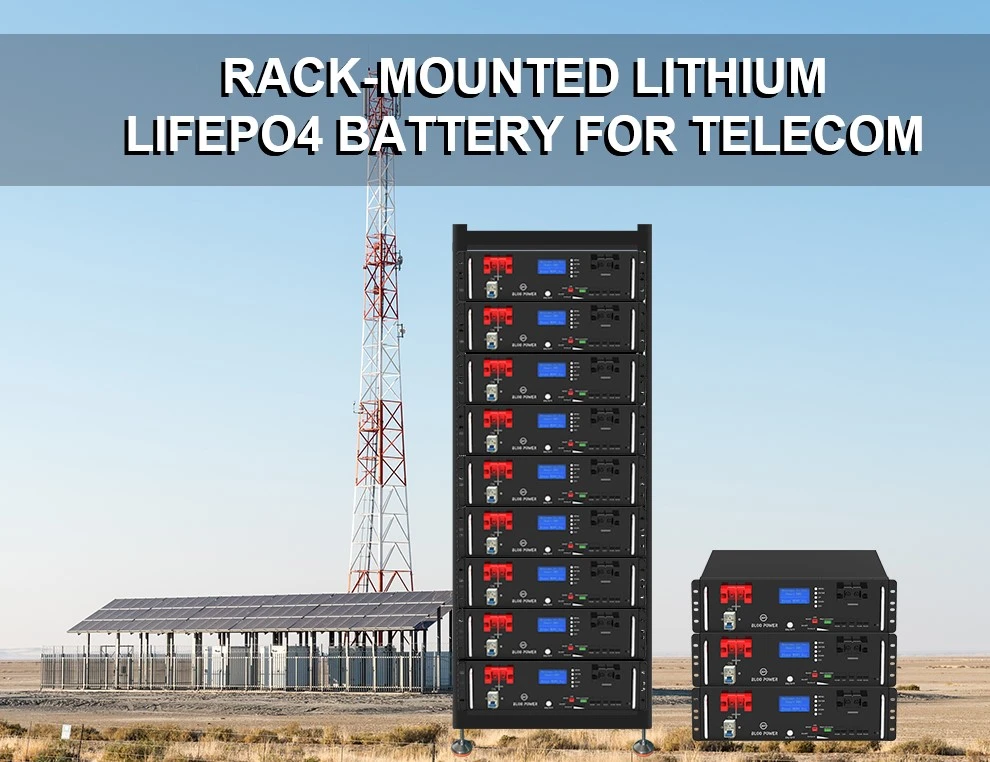
Choosing a battery for a telecom base station is not simply a matter of selecting the largest Ah rating available. A 48V 100Ah, 200Ah, or 300Ah battery can serve very different site requirements depending on the base station load, required backup duration, usable depth of discharge, power conversion efficiency, ambient temperature, battery aging, and future network expansion.
For telecom operators, EPC contractors, and system integrators, the more useful question is not "Which battery has the highest capacity?" but "How much usable energy does this site actually need?"
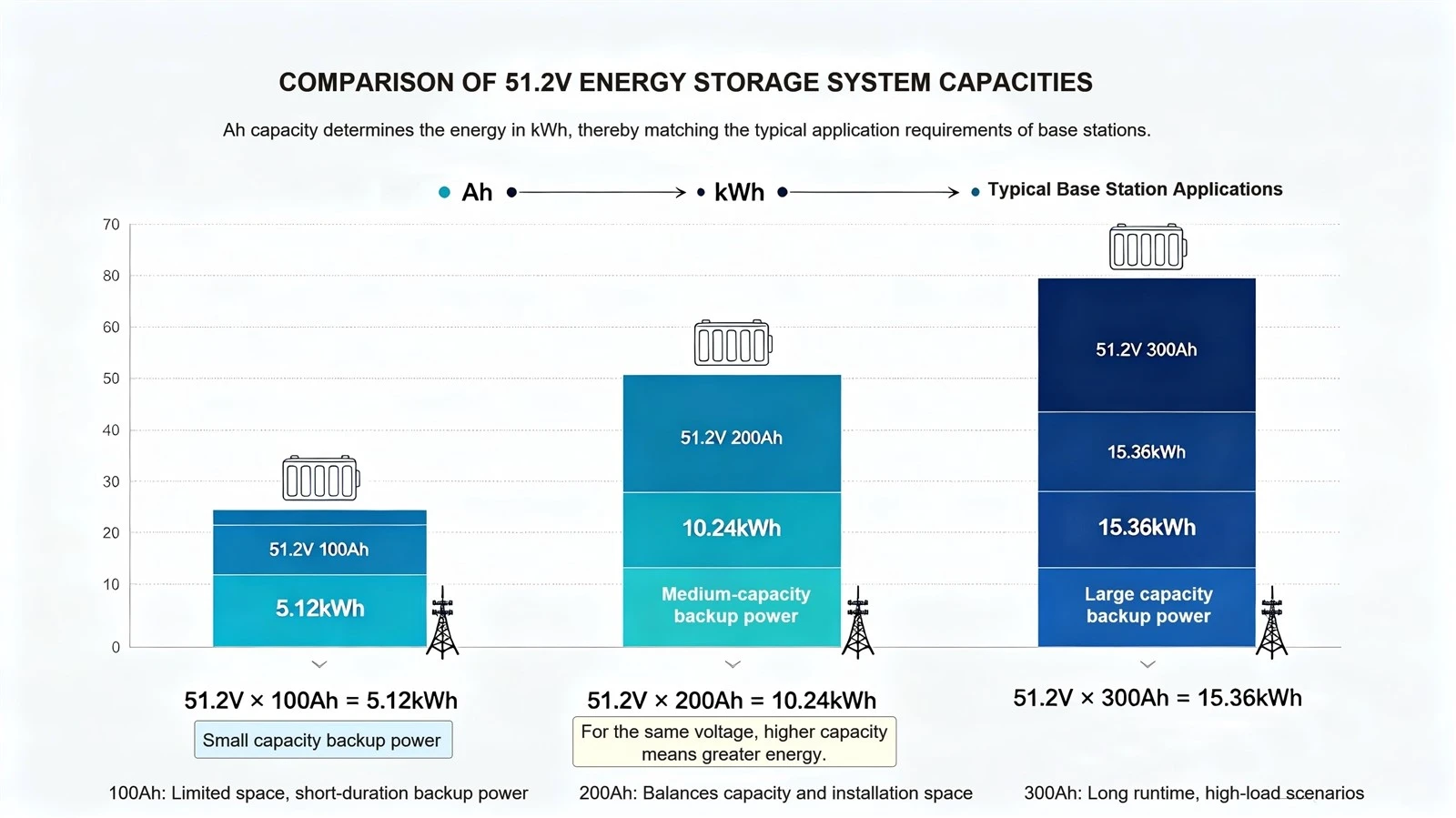
At a nominal 51.2V, which is commonly used for 16-series LiFePO4 battery systems marketed as 48V batteries, the three capacity classes represent approximately 5.12kWh, 10.24kWh, and 15.36kWh respectively.
| Battery Rating | Nominal Voltage | Nominal Energy | Typical Position |
| 48V 100Ah | 51.2V | 5.12kWh | Small / low-load sites |
| 48V 200Ah | 51.2V | 10.24kWh | Medium-load sites |
| 48V 300Ah | 51.2V | 15.36kWh | Higher-load / longer backup |
The latest ITU-T L.1210 recommendation for IMT-2020 networks recognizes the continued importance of –48V DC architectures while also highlighting higher site power demand, intelligent energy storage, lithium batteries, remote monitoring, and scalable power systems for modern telecom infrastructure.
So, should you choose 100Ah, 200Ah, or 300Ah? The answer starts with the site load-not the battery catalog.
Start With the Telecom Site Load, Not the Battery Ah Rating
Battery capacity should be calculated from the actual energy demand of the telecom equipment. A typical site may include radio equipment, BBU/RRU or AAU equipment, transmission equipment, cooling systems, monitoring equipment, and other auxiliary loads. More importantly, these loads do not necessarily remain constant throughout the day.
A site operating at 500W has a very different battery requirement from a site averaging 2.5kW. Installing a 15kWh battery at the first site may provide unnecessary capacity, while a 5kWh battery at the second site could result in an inadequate backup period.
For a commercial battery procurement project, the first step should therefore be to obtain measured or estimated load data rather than selecting a battery based on Ah alone.
Key parameters to collect:
● Average DC load
● Peak site power
● Critical and non-critical loads
● Daily load profile
● Expected future load after network upgrades
The latest ITU-T L.1210 specifically addresses changes in power requirements associated with IMT-2020 network deployment and notes that AAU, BBU and other telecom equipment can increase site power demand.
What Does 48V 100Ah Actually Mean?
The term "48V 100Ah" is widely used in the telecom and energy storage industry, but it does not directly tell you how much usable energy the battery can deliver.
The basic calculation is: Energy = Voltage × Capacity
For a nominal 48V system: 48V × 100Ah = 4.8kWh
For a 16S LiFePO4 battery with a nominal voltage of 51.2V: 51.2V × 100Ah = 5.12kWh
The same calculation gives approximately 10.24kWh for a 200Ah battery and 15.36kWh for a 300Ah battery.
This distinction matters when comparing products from different manufacturers. A telecom buyer should always check the actual nominal voltage, rated energy, usable energy, discharge limits, and BMS specifications instead of comparing the Ah figures alone.
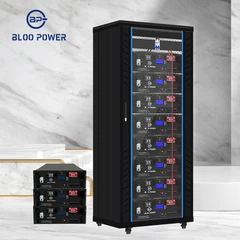
For BLOO POWER, the low-voltage battery portfolio includes 48V-class LiFePO4 products, together with rack-mounted and base-station battery configurations designed for applications where modular capacity and communication with the power system are important.
When Does a 48V 100Ah Battery Make Sense?
A 100Ah battery is usually the most practical starting point for low-load telecom sites where the required backup period is relatively short.
At 51.2V, a 100Ah LiFePO4 battery stores approximately 5.12kWh of nominal energy. A site drawing 500W would theoretically consume 2kWh over four hours, before accounting for battery usable capacity, power conversion losses, temperature effects, and aging.
That does not mean every 500W site should use a 100Ah battery. The design still needs sufficient reserve to meet the required end-of-life backup target. However, the 100Ah class can be attractive for compact installations where minimizing cabinet space, battery weight, and initial investment is important.
Typical applications include:
● Small telecom sites
● Low-power 4G/5G access sites
● Remote communication equipment
● Fiber and edge communication infrastructure
For projects with predictable low loads, a 48V 100Ah LiFePO4 Battery can be a cost-effective way to establish battery backup without oversizing the energy storage system.
Why Is 200Ah Often the Practical Middle Ground?
A 51.2V 200Ah battery provides approximately 10.24kWh of nominal energy, roughly twice the energy of a 100Ah unit at the same voltage.
That additional capacity can make a significant difference when the site has a moderate load or when the operator needs several hours of backup without increasing the number of battery modules too aggressively.
For example, a site with a continuous load of approximately 1.5kW would consume around 6kWh during four hours of operation under ideal conditions. Once system efficiency, usable DoD, temperature and aging are considered, a 10.24kWh nominal battery becomes much more realistic than a 5.12kWh unit.
This is why 200Ah can be an attractive configuration for telecom integrators looking for a balance between energy reserve, installation footprint, and system cost.
200Ah is particularly suitable when:
● The site load is around the mid-range
● Backup requirements are several hours
● Space is available for a medium-size battery
● Future equipment expansion is expected
● A single battery module should provide meaningful reserve
When Should You Consider 300Ah?
A 300Ah LiFePO4 battery provides approximately 15.36kWh at 51.2V, making it suitable for sites where backup duration and available energy are more important than minimizing battery size.
A larger battery does not automatically improve every installation. The value of 300Ah becomes clear when the base station has higher continuous consumption, longer outage requirements, limited access to backup generators, or a solar-plus-storage architecture.
For example, a 2.5kW load can consume approximately 15kWh in six hours before system losses and design margins. A 15.36kWh nominal battery therefore becomes a much more logical starting point than a 5.12kWh unit.
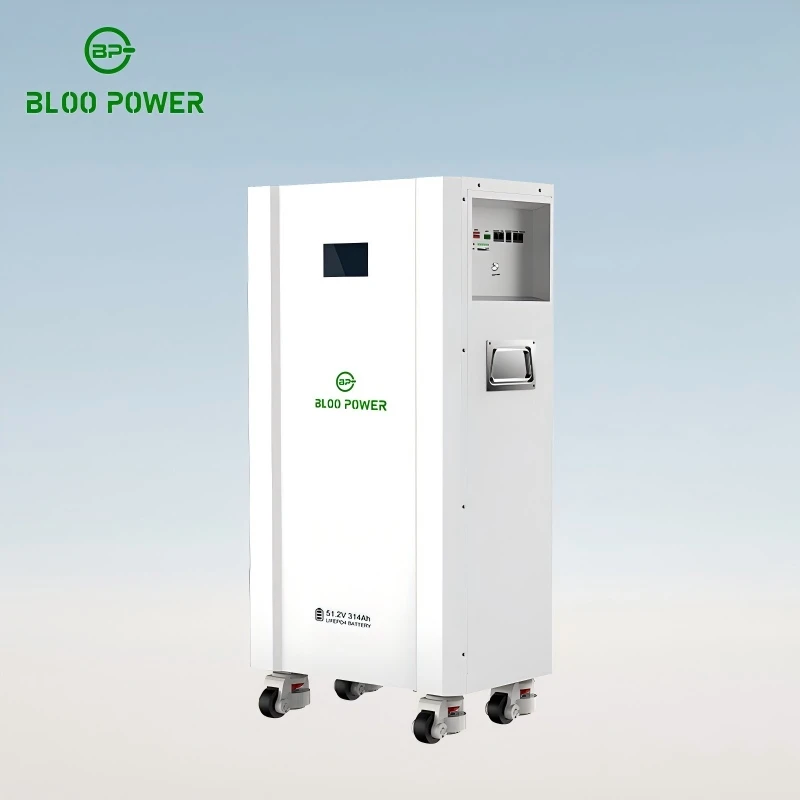
For these sites, a 51.2V 300Ah LiFePO4 Battery can reduce the number of parallel battery modules required to reach a given energy target.
Typical applications include:
● High-load 5G sites
● Remote or weak-grid telecom stations
● Solar-powered base stations
● Long-duration battery backup
● Sites where generator availability is limited
Backup Time Is the Most Important Sizing Variable
The relationship between battery size and backup time is straightforward:
Backup Time ≈ Usable Battery Energy ÷ Site Load
However, "usable battery energy" is lower than nominal battery energy.
A practical sizing calculation needs to account for:
Required battery energy ≈ Load × Backup Time ÷ System Efficiency ÷ Usable DoD × Design Margin
For example, assume a telecom site has a 1.5kW load and requires six hours of backup. The ideal energy requirement is: 1.5kW × 6h = 9kWh
If the battery is designed around 80–85% usable DoD and the overall power path has additional losses, a battery rated at only 9kWh would leave little engineering margin. A 10.24kWh 200Ah battery may therefore be close to the practical starting point, while a 15.36kWh 300Ah system provides more reserve.
ITU-T L.1210 provides a more detailed battery sizing methodology that incorporates site power, duration, efficiency, derating, DoD and a safety factor.
100Ah vs 200Ah vs 300Ah: A Practical Comparison
The following table is useful for early-stage system selection. It should not replace the final engineering calculation.
|
Parameter |
100Ah |
200Ah |
300Ah |
|
Nominal voltage |
51.2V |
51.2V |
51.2V |
|
Nominal energy |
5.12kWh |
10.24kWh |
15.36kWh |
|
Relative energy |
1× |
2× |
3× |
|
Suitable load range* |
Low |
Medium |
Medium–High |
|
Backup duration |
Short |
Medium |
Longer |
|
Initial battery cost |
Lower |
Medium |
Higher |
|
Module count for larger systems |
Higher |
Medium |
Lower |
|
Expansion flexibility |
High |
High |
Medium |
|
Typical role |
Small site backup |
General telecom backup |
High-load / long-duration backup |
*Load range depends on the required backup time, discharge rate, system efficiency and battery operating conditions.
The key takeaway is simple: Ah should never be evaluated independently from kWh and backup hours.
Modern Telecom Batteries Need More Than Energy Capacity
A telecom battery is part of a power infrastructure system. Its value depends not only on stored energy but also on how effectively the battery communicates with the rectifier, controller, monitoring platform and site management system.
Modern LiFePO4 telecom batteries can provide battery status information such as voltage, current, temperature, SOC and SOH. This becomes increasingly important for remote sites where technicians cannot routinely visit the installation.
ITU-T L.1210 specifically highlights remote battery management and monitoring, including SOC and SOH information, as part of intelligent energy storage for evolving IMT-2020 infrastructure. It also identifies LFP chemistry as the preferred lithium battery chemistry within the recommendation's telecom battery discussion.
For a commercial telecom battery, check:
● BMS protection functions
● CAN / RS485 communication
● SOC and SOH monitoring
● Remote alarms
● Battery temperature monitoring
This is where a properly engineered 48V LiFePO4 Battery becomes more than a replacement for a traditional lead-acid bank.
Why LiFePO4 Is Becoming More Relevant to Telecom Infrastructure
Telecom sites have traditionally relied heavily on lead-acid batteries. However, the increasing power requirements of modern networks, limited site space, maintenance considerations, and the need for intelligent monitoring have created stronger demand for lithium-based storage.
The latest ITU-T L.1210 recommendation specifically discusses lithium batteries as part of modern IMT-2020 power architecture. It highlights their higher energy density, parallel operation, constant-voltage characteristics and remote monitoring capabilities. The recommendation also notes that lithium battery systems can significantly reduce the footprint associated with replacing or expanding traditional lead-acid storage.
For telecom operators, the decision therefore involves more than chemistry.
It also involves:
● Available cabinet space
● Battery weight
● Required backup duration
● Maintenance strategy
● Expansion requirements
● Remote O&M capability
Do Not Oversize the Battery Without Looking at the Site
It is tempting to choose a 300Ah battery because more energy appears to provide greater reliability. In practice, oversizing can increase project cost without delivering proportional value.
A 300Ah battery may be unnecessary for a small site requiring only two or three hours of backup. The additional capacity could remain underutilized while increasing the equipment footprint and upfront investment.
The correct design target is not maximum capacity. It is sufficient usable capacity at the required end-of-life condition.
A commercial procurement team should therefore compare:
● Required backup energy
● Usable energy
● End-of-life capacity
● Installation space
● Total installed cost
This approach produces a more defensible system design than simply choosing the largest battery available.
Temperature and Installation Conditions Affect Real-World Capacity
Battery capacity is specified under defined test conditions. Telecom sites, however, are often installed outdoors or in equipment cabinets exposed to seasonal temperature changes.
Low temperatures can affect battery charging and available output, while high temperatures can accelerate aging. The battery management system may also impose operating limits under extreme conditions.
For outdoor telecom applications, the battery specification should therefore be evaluated together with the enclosure and thermal management strategy.
Procurement teams should verify:
● Operating temperature range
● Charging temperature range
● IP protection rating
● Thermal management requirements
● Installation environment
BLOO POWER's portfolio includes outdoor-capable and IP-rated LiFePO4 configurations, but the exact IP rating, temperature range and installation requirements should always be confirmed against the specific battery model selected for the telecom project.
Battery Aging Should Be Included in the Original Design
A battery system should not be sized only for its first day of operation.
Telecom infrastructure is expected to operate for years, and the battery's available capacity gradually changes with operating conditions, temperature, cycle history and calendar aging. If the original system is designed with zero reserve, the site may fail to meet its required backup duration later in the battery's service life.
This is particularly important for remote base stations where a battery replacement may involve significant labor, transportation and site-access costs.
A professional design should therefore consider:
● Initial usable capacity
● Expected degradation
● End-of-life capacity target
● Required reserve margin
For buyers, the manufacturer's warranty terms, cycle-life conditions, end-of-life capacity definition and operating assumptions should be reviewed alongside the headline capacity.
One 300Ah Battery or Multiple 100Ah / 200Ah Modules?
A 15kWh-class telecom battery system can be built in several ways.
For example:
1 × 51.2V 300Ah ≈ 15.36kWh Or 3 × 51.2V 100Ah ≈ 15.36kWh
or, depending on the system architecture: 2 × 51.2V 200Ah ≈ 20.48kWh
These configurations are not technically interchangeable in every installation. Parallel battery systems require appropriate BMS communication, current protection, cable sizing, isolation, balancing and installation procedures.
A modular architecture can make future expansion easier, while a larger single battery can reduce the number of battery modules and interconnections.
For system integrators, the better choice depends on the project's priorities.
Choose modular capacity when you need:
● Easier capacity expansion
● Standardized battery modules
● Flexible project configurations
● Simplified logistics for individual modules
Choose larger-capacity modules when you prioritize:
● Fewer battery units
● Higher energy density
● Reduced interconnection complexity
● Compact cabinet design
Solar-Powered Telecom Sites Require a Different Capacity Calculation
For off-grid and weak-grid base stations, the battery is not simply an emergency backup. It can become the central energy buffer between photovoltaic generation and telecom loads.
During the day, solar PV supplies the base station and charges the battery. At night, the battery supplies the load. During cloudy weather, the battery may need to cover several consecutive periods of low solar production.
In such systems, a 100Ah battery may be sufficient for a low-load site with strong solar resources, while a 200Ah or 300Ah configuration may be required where the site experiences longer periods without adequate PV generation.
The design should therefore consider:
● Daily energy consumption
● Solar generation
● Night-time load
● Weather and solar resource
● Required autonomy days
This is particularly relevant to remote telecom infrastructure where diesel generator use is expensive or difficult to maintain.
48V Telecom Battery Selection Should Also Consider Standards and Certification
Capacity is only one part of a professional battery procurement specification. Telecom operators and system integrators should also evaluate the battery's safety documentation, transportation compliance, testing, EMC requirements and applicable product certifications.
IEC 62619 is the international safety standard covering secondary lithium cells and batteries for industrial applications, making it relevant when evaluating stationary lithium battery systems used in industrial and infrastructure applications.
For an international telecom project, the technical documentation package may include:
● IEC 62619
● UN38.3
● CE or other market-specific conformity requirements
● MSDS / SDS
● Electrical protection specifications
● BMS communication protocol
● Factory test reports
BLOO POWER's energy storage batteries have obtained certifications such as IEC 62619, UL1973, and UN38.3; buyers may request certification documents specific to particular battery models and target markets.
How to Select the Right Battery for a 1kW, 2kW or 3kW Base Station
A simple example makes the sizing logic easier to understand.
Example A - 1kW telecom site
For a 1kW average load and four hours of required backup: 1kW × 4h = 4kWh
A 51.2V 100Ah battery provides approximately 5.12kWh nominal energy. After accounting for usable DoD and conversion losses, the available backup time will be lower than the simple 5.12-hour calculation.
For a compact site with limited backup requirements, 100Ah may be a reasonable starting point.
Example B - 2kW telecom site
For a 2kW load and four hours: 2kW × 4h = 8kWh
A 200Ah battery provides approximately 10.24kWh nominal energy at 51.2V, making it a more practical starting point.
Example C - 3kW telecom site
For a 3kW load and six hours: 3kW × 6h = 18kWh
A single 300Ah battery provides approximately 15.36kWh nominal energy, so one module may not be sufficient after accounting for usable DoD and losses. The project may require multiple 300Ah modules or another higher-capacity architecture.
This illustrates why the correct answer is not simply "300Ah is better."
A Practical Decision Guide for Telecom Battery Buyers
For an initial project assessment, the following framework can help procurement teams narrow down the battery size before detailed engineering.
|
Site Profile |
Typical Starting Point |
Why |
|
Low-load site, short backup |
100Ah |
Compact and economical |
|
Medium-load site, several-hour backup |
200Ah |
Good balance of capacity and footprint |
|
Higher-load site, longer backup |
300Ah |
More energy per battery module |
|
Solar off-grid telecom site |
200–300Ah+ |
Depends heavily on autonomy requirement |
|
High-power 5G site |
Multiple modules |
Load and backup requirements can exceed one battery |
|
Expansion-ready infrastructure |
Modular parallel system |
Easier future capacity increase |
These are starting points rather than fixed engineering rules.
The final battery configuration should be based on measured site power, required autonomy, system efficiency, battery DoD, temperature, aging and applicable telecom power architecture.
Where BLOO POWER Fits Into Telecom Battery Projects
BLOO POWER offers a range of low-voltage Lithium Iron Phosphate (LiFePO4) battery configurations suitable for energy storage applications across residential, commercial, and telecommunications sectors. The product lineup includes 48V-class lithium batteries, rack-mount units, and specialized base station batteries, enabling system integrators to select the appropriate capacity and form factor based on specific project requirements.
For telecom applications, this type of product architecture is useful when the project requires more than a standard battery pack. A professional Telecom Battery needs to integrate with the site's DC power system, battery management system, monitoring architecture and future expansion strategy.
BLOO POWER's broader product portfolio includes:
● 48V / 51.2V LiFePO4 battery systems
● Rack-mounted battery configurations
● Base station battery solutions
● Modular low-voltage battery systems
● Higher-capacity energy storage systems
For an OEM or system-integrator project, the final configuration can be specified according to required voltage, Ah capacity, communication protocol, enclosure, installation method and operating environment.
100Ah vs 200Ah vs 300Ah: Which One Should You Buy?
There is no universal "best" capacity.
A 48V 100Ah battery is a good fit when the site has relatively low power demand and the required backup duration is limited.
A 48V 200Ah battery becomes more attractive when the base station has moderate continuous consumption and several hours of battery backup are required.
A 48V 300Ah battery makes more sense for higher-load sites, longer backup periods, remote locations and solar-plus-storage applications where additional energy reserve has direct operational value.
The decision can be summarized as:
100Ah for compact, lower-load sites.
200Ah for balanced, mainstream backup applications.
300Ah for higher loads and longer autonomy.
But for a professional telecom project, the final decision should always be made in kWh and hours, not Ah alone.
Telecom Battery Sizing Formula
A practical first-stage calculation is:
Required Battery Capacity ≈ Load × Backup Time ÷ System Efficiency ÷ Usable DoD × Design Margin
For example: 1.5kW × 6h = 9kWh
After allowing for efficiency, usable DoD and design margin, a 10.24kWh or 15.36kWh battery configuration may be evaluated depending on the project's actual operating requirements.
ITU-T L.1210 provides a more detailed engineering approach. Its battery sizing example incorporates maximum site power, grid power limitations, efficiency, derating, backup duration, DoD and a safety coefficient; one example produces a required capacity of approximately 350Ah for a specific peak-shaving scenario. Importantly, the recommendation also notes that battery sizing should account for both backup requirements and peak-shaving requirements where applicable.
Final Takeaway
Choosing between a 48V 100Ah, 200Ah or 300Ah battery should never be based on Ah alone.
For telecom operators and system integrators, the correct workflow is:
Measure the site load → define backup time → calculate required kWh → account for DoD and efficiency → add aging and design margin → select Ah capacity → verify BMS and communications → confirm certifications and installation conditions.
At 51.2V nominal:
100Ah ≈ 5.12kWh
200Ah ≈ 10.24kWh
300Ah ≈ 15.36kWh
That makes the selection much easier to understand.
For a small telecom site, 100Ah may be enough. For a typical medium-load site, 200Ah often provides a practical balance between energy reserve and system cost. For higher-load or longer-duration applications, 300Ah-or multiple battery modules-can provide the additional energy required.
As 5G networks continue to increase equipment density and site power requirements, battery storage is becoming a more integrated part of telecom power architecture rather than simply an emergency backup component. ITU-T's current L.1210 recommendation reflects this shift toward scalable, intelligent, remotely monitored and increasingly renewable-integrated power systems.
For telecom battery suppliers, OEMs and system integrators, the most useful product strategy is therefore not to offer one oversized battery, but to provide a scalable 48V LiFePO4 Battery platform that can cover different load profiles, backup durations and site configurations.
The right battery is not the one with the highest Ah rating. It is the one that delivers the required usable energy, power and autonomy-within the site's space, cost and operating constraints.
Send Inquiry