

















High Voltage vs Low Voltage Home Battery: Which One Should You Choose?
Sep 14, 2026
Leave a message


Choosing the right battery voltage is one of the most important decisions when designing a Home Energy Storage System. For homeowners, installers, and solar companies, the choice between a High Voltage Home Battery and a Low Voltage Home Battery affects system power, current, inverter compatibility, installation requirements, scalability, efficiency, and total project cost.
Low-voltage residential batteries, typically based on 48V or 51.2V platforms, are widely used for solar self-consumption, backup power, off-grid applications, and small-to-medium residential energy storage. High-voltage batteries use multiple battery modules connected in series to achieve a significantly higher DC operating voltage, making them particularly suitable for higher-power residential energy storage systems.
There is no universal answer that makes high voltage better than low voltage. The right choice depends on the home's daily energy consumption, peak load, solar PV capacity, inverter architecture, backup requirements, installation environment, and future expansion plans.
The International Energy Agency's 4E programme notes that home energy storage systems are becoming increasingly important and that system-level efficiency depends on battery technology, power electronics, control strategies, operating conditions, and standby losses-not simply the battery itself.
What Is a High Voltage Home Battery?
A High Voltage Home Battery is a residential battery system designed to operate at a significantly higher DC voltage than conventional 48V or 51.2V battery systems.
Instead of using a single low-voltage battery module, a high-voltage energy storage system generally connects multiple battery modules in series. This increases the total DC voltage and allows the system to deliver the required power with lower current.

For residential applications, high-voltage battery systems are commonly paired with compatible high-voltage hybrid inverters. They are particularly attractive for large homes, high-power solar installations, EV charging, heat pumps, and other applications where the battery must support substantial continuous power.
Typical characteristics:
● High DC operating voltage
● Multiple battery modules connected in series
● Lower current at the same power level
● Suitable for high-power hybrid inverters
● Better suited to larger residential energy storage systems
What Is a Low Voltage Home Battery?
A Low Voltage Home Battery normally refers to residential battery systems operating around the 48V or 51.2V platform.
A 48V LiFePO4 Battery is one of the most established battery configurations in residential and off-grid energy storage. A 51.2V battery generally uses 16 LiFePO4 cells connected in series, with each cell having a nominal voltage of approximately 3.2V.
This architecture is widely used because it provides a practical balance between voltage, safety, power capability, product availability, and compatibility with residential hybrid inverters.

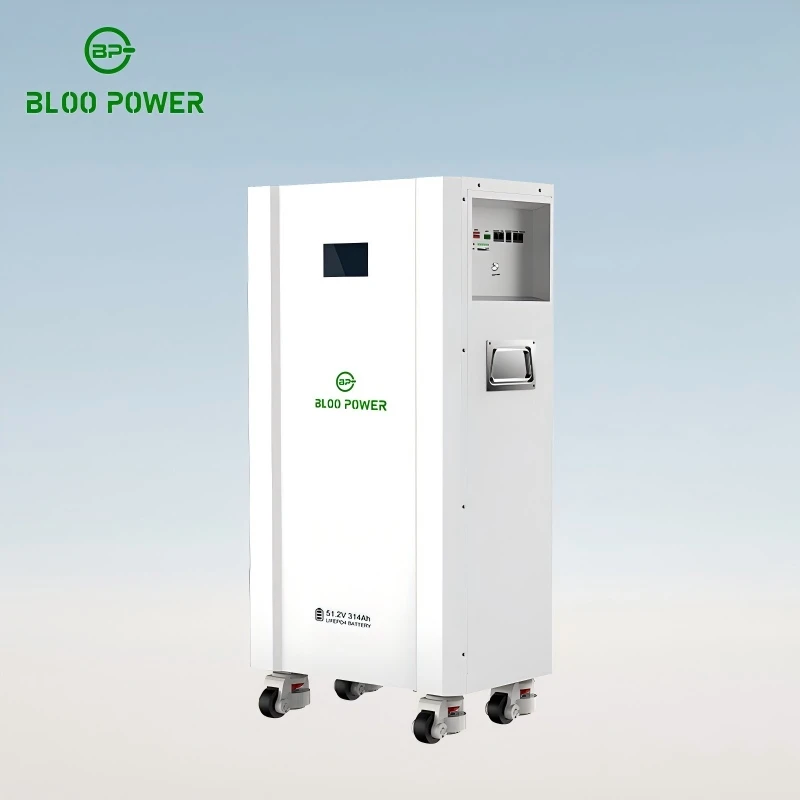
BLOO POWER's 51.2V 314Ah 16kWh Wall-Mounted LiFePO4 Battery, for example, represents this type of low-voltage residential storage architecture. It can be integrated with compatible low-voltage hybrid inverters for solar self-consumption, backup power, and residential Solar Battery Storage applications.
Common low-voltage applications:
● Residential solar storage
● Backup power
● Off-grid homes
● Small energy storage systems
● Solar self-consumption
● RV and telecom-related applications
High Voltage vs Low Voltage: What Is the Main Difference?
The fundamental difference is the DC voltage at which the battery system operates.
The relationship between electrical power, voltage, and current can be simplified as:
P = V × I
This means that when the required power remains the same, increasing voltage reduces the required current.
For example, a 10kW load operating around 51.2V would theoretically require approximately 195A before considering conversion losses and voltage variation. At 400V, the same 10kW power level would require approximately 25A.
This is one of the key reasons why high-voltage battery architectures become increasingly attractive as system power increases.
Basic comparison
|
Feature |
Low Voltage Home Battery |
High Voltage Home Battery |
|
Typical platform |
48V / 51.2V |
Several hundred volts |
|
Battery connection |
Often parallel |
Often series |
|
Current at same power |
Higher |
Lower |
|
Cable current requirement |
Higher |
Lower |
|
Typical application |
Residential / backup |
High-power residential |
|
System complexity |
Lower |
Higher |
|
Expansion |
Often modular parallel expansion |
Often series module expansion |
|
Inverter |
LV-compatible inverter |
HV-compatible inverter |
Why Does Higher Voltage Reduce Current?
The biggest electrical advantage of a high-voltage battery is reduced current at the same power level.
Consider a simple example: 10kW ÷ 51.2V ≈ 195A
Compared with:10kW ÷ 400V = 25A
The actual current in a real energy storage system varies with battery voltage, inverter efficiency, operating conditions, and peak power. However, the principle remains the same: higher voltage allows the same power to be transferred with lower current.
Lower current can help reduce conductor losses because resistive losses are related to the square of current:
Power Loss = I²R
This becomes increasingly important as battery systems move toward higher power ratings.
Key advantages include:
● Lower DC current
● Reduced resistive losses in conductors
● More manageable cable sizing at high power
● Better suitability for high-power energy storage
● Improved system architecture for larger battery systems
This is why high-voltage battery technology is particularly relevant when residential storage systems are combined with high-power solar PV, EV charging, heat pumps, or large HVAC systems.
Does High Voltage Mean Higher Battery Efficiency?
Not necessarily.
A common misconception is that a High Voltage Home Battery automatically has a higher battery efficiency than a low-voltage battery. The battery chemistry itself does not become inherently more efficient simply because the system voltage is higher.
System efficiency depends on multiple components:
● Battery cells
● BMS
● Inverter
● DC/DC conversion
● Wiring
● Cooling
● Standby consumption
● Operating strategy
The IEA 4E programme specifically highlights that the efficiency of a Home Energy Storage System can vary significantly depending on system design, operating conditions, controls, and standby losses. It also notes that residential battery systems typically remain in service for more than 10 years, meaning efficiency differences can accumulate over the system lifetime.
Therefore, homeowners should compare system-level round-trip efficiency, not simply battery voltage.
Ask manufacturers for:
● Battery efficiency
● Inverter efficiency
● AC round-trip efficiency
● DC round-trip efficiency
● Standby consumption
● Usable capacity
● Charge/discharge power
Why 48V LiFePO4 Battery Systems Remain Popular
The 48V LiFePO4 Battery platform has become one of the most widely used architectures for residential and off-grid energy storage.
One major reason is the maturity of the ecosystem. Many residential hybrid inverters, off-grid inverters, chargers, communication systems, and battery products have been developed around the 48V-class platform.
The 51.2V platform is particularly common with LiFePO4 batteries because 16 cells connected in series produce a nominal battery voltage of approximately 51.2V.
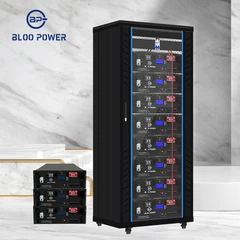
BLOO POWER's 51.2V residential battery range fits naturally into this architecture, providing options for wall-mounted, rack-mounted, and stackable Home Energy Storage System configurations.
Advantages of the 48V/51.2V platform:
● Mature residential ecosystem
● Broad inverter compatibility
● Modular system design
● Easy capacity expansion
● Suitable for many residential applications
Which Homes Are Better Suited to a Low Voltage Home Battery?
A Low Voltage Home Battery is often an excellent choice when the primary goal is solar self-consumption and backup power rather than extremely high continuous output power.
For example, a typical household may use a battery to store excess solar energy during the day and discharge it at night to power lighting, refrigeration, networking equipment, televisions, computers, air conditioning, and other household loads.
If the home's simultaneous load remains within the output capability of the battery and inverter, there may be little practical reason to move to a high-voltage architecture.
Low-voltage batteries are often suitable for:
● Small and medium-sized homes
● 5–20kWh residential storage
● Solar self-consumption
● Backup power
● Off-grid applications
● Moderate household loads
A BLOO POWER 51.2V 314Ah 16kWh Wall-Mounted LiFePO4 Battery, for example, can be considered for homes requiring around 16kWh of nominal storage capacity, provided the selected inverter and battery configuration are compatible.
Which Homes Should Consider a High Voltage Home Battery?
A High Voltage Home Battery becomes more attractive when the household has high continuous power requirements.
A large home may have several energy-intensive loads operating at the same time:
● Central air conditioning
● Heat pumps
● Electric water heaters
● EV chargers
● Pool pumps
● Large kitchen appliances
If the battery system needs to provide high output power during a grid outage, the DC current on a low-voltage architecture can become substantial.
A high-voltage battery can reduce the DC current required for the same power output, making the architecture more suitable for high-power residential energy storage.
High-voltage systems are worth evaluating for:
● Large villas
● High-power solar systems
● 20kWh+ storage
● EV charging
● Heat pump homes
● High backup-power requirements
Battery Capacity and Battery Power Are Not the Same
Another important issue is the difference between energy capacity and power output.
Battery capacity is normally expressed in kWh, while power is expressed in kW.
For example:
10kWh does not automatically mean 10kW output.
A 15kWh battery may store approximately 15kWh of nominal energy, but its maximum continuous output depends on the battery cells, C-rate, BMS, thermal design, and inverter.
This distinction is particularly important when comparing High Voltage Home Battery and Low Voltage Home Battery systems.
Homeowners should check:
● Nominal battery capacity
● Usable battery capacity
● Maximum continuous discharge power
● Maximum charge power
● Peak output power
● Inverter output rating
A larger battery is not automatically capable of running more appliances simultaneously.
High Voltage vs Low Voltage for Solar Battery Storage
For a Solar Battery Storage system, the battery should be selected together with the solar inverter.
The basic architecture is:
Solar PV → Hybrid Inverter → Battery Storage → Home Loads → Grid
The battery voltage must fall within the inverter's supported battery voltage range.
For example, a 51.2V Low Voltage Home Battery should be connected to a compatible low-voltage hybrid inverter. A high-voltage battery requires an inverter designed for the corresponding HV battery voltage range.
This means homeowners should never purchase a battery first and assume that any inverter will work with it.
Check these parameters before purchase:
● Battery voltage range
● Inverter battery voltage range
● Maximum charge current
● Maximum discharge current
● CAN/RS485 communication
● Compatible battery models
● Required certifications
The U.S. Department of Energy also emphasizes that residential solar-plus-storage projects need to consider electrical requirements, utility requirements, building codes, and applicable fire codes.
How Does Battery Expansion Differ Between Low Voltage and High Voltage?
Scalability is another major consideration.
A low-voltage battery system can often be expanded by adding compatible battery modules in parallel. For example:
51.2V 10kWh + 51.2V 10kWh +51.2V 10kWh → 30kWh Low Voltage System
However, the actual number of batteries that can be connected depends on the manufacturer's specifications.
A high-voltage system normally expands by adding compatible battery modules in series or by using predefined HV battery stacks.
Before expanding a battery system, confirm:
● Maximum number of battery modules
● Maximum parallel or series configuration
● BMS communication
● Inverter capacity range
● Battery firmware compatibility
● SOC balancing requirements
This is particularly important for homeowners who expect their energy demand to increase after installing an EV charger or heat pump.
Safety: Is a Low Voltage Home Battery Safer?
It is too simplistic to say that low voltage is always safer.
Both high-voltage and low-voltage lithium battery systems require appropriate protection and installation.
However, a high-voltage battery system presents higher DC voltage levels, which means electrical isolation, installation procedures, protective devices, connectors, and service procedures require greater attention.

The battery chemistry is also important. LFP, or lithium iron phosphate, has become a major battery chemistry in stationary storage. According to the IEA's Global Energy Review 2026, LFP batteries accounted for around 90% of battery storage deployments in 2025, reflecting their suitability for frequent cycling and stationary storage applications.
A residential battery should include:
● Reliable BMS
● Over-voltage protection
● Under-voltage protection
● Over-current protection
● Short-circuit protection
● Temperature monitoring
● Appropriate system-level protection
Battery voltage should therefore be considered together with chemistry, BMS, certification, installation, and system architecture.
The BMS Is Critical in Both High and Low Voltage Systems
The Battery Management System is responsible for monitoring and controlling critical battery parameters.
For a low-voltage battery, the BMS monitors cell voltage, current, temperature, state of charge, and abnormal operating conditions.
For a high-voltage battery system with multiple modules connected in series, the BMS architecture becomes even more important because the system must monitor multiple modules and coordinate charging, discharging, protection, and communication.
When comparing batteries, ask:
● What BMS is used?
● What is the maximum continuous current?
● Does the system provide cell balancing?
● What communication protocols are supported?
● Which inverters have been tested?
● What protection functions are included?
A high-quality BMS is not an optional feature. It is an essential part of a reliable Home Energy Storage System.
Installation Complexity: Low Voltage vs High Voltage
Low-voltage battery systems are generally easier to integrate into small residential projects because the 48V/51.2V ecosystem is mature and widely supported.
For example, a wall-mounted 51.2V LiFePO4 Battery can be installed as part of a residential solar storage system when the battery, inverter, wiring, protection devices, and mounting structure are correctly specified.
High-voltage systems usually require more specialized installation procedures because the DC voltage can be significantly higher.
The installation should therefore be performed according to local electrical codes and manufacturer requirements.
Installation considerations include:
● Battery location
● Wall or floor mounting
● Cable sizing
● DC protection
● Grounding
● Environmental temperature
● IP protection
● Local electrical regulations
Which System Is More Cost-Effective?
The answer depends on the system size.
For a relatively small residential battery system, a 48V LiFePO4 Battery can offer a practical and cost-effective architecture because of its mature supply chain and broad inverter compatibility.
For a high-power residential system, however, a low-voltage architecture may require very high DC current. This can increase requirements for cables, busbars, connectors, protection devices, and parallel battery modules.
In such cases, a High Voltage Home Battery may provide a more efficient system architecture even if the individual battery components appear more expensive.
Compare the complete system rather than battery price alone:
|
Cost Item |
Low Voltage |
High Voltage |
|
Battery cost |
Often competitive |
Often higher system complexity |
|
Inverter |
Wide selection |
HV-specific |
|
Cabling |
Higher current rating |
Lower current requirement |
|
Protection |
LV protection |
HV protection |
|
Installation |
Generally simpler |
More specialized |
|
Expansion |
Often flexible |
More structured |
|
Best value |
Small/medium systems |
High-power systems |
What About Homes With EV Chargers and Heat Pumps?
The growth of residential electrification is changing battery requirements.
The IEA 4E programme identifies EV chargers, hot water systems, heating and cooling equipment, pool equipment, solar PV, and home batteries as important components of increasingly flexible household energy systems.
A home with an EV charger and heat pump can have substantially higher peak electrical demand than a traditional household.
For example:
Solar PV + Home Battery + EV Charger + Heat Pump + Air Conditioning → Higher Peak Power Requirement → Consider High Voltage Architecture
This does not automatically mean that every EV owner needs a high-voltage battery. The correct decision still depends on the inverter rating, battery discharge power, household load profile, and backup requirements.
Which Voltage Is Better for Off-Grid Homes?
For off-grid homes, 48V-class battery systems remain very common.
An off-grid system often prioritizes:
● Reliability
● Simple system architecture
● Easy maintenance
● Modular expansion
● Inverter compatibility
● Cost control
A 48V LiFePO4 Battery can work well in these applications when the inverter and battery are correctly matched.
However, larger off-grid homes with high-power loads may benefit from a high-voltage architecture.
The important point is that off-grid does not automatically mean low voltage. System power should determine the architecture.
How Large Should Your Home Battery Be?
Before deciding between High Voltage and Low Voltage, calculate how much energy your household actually needs.
A basic starting point is:
Required Battery Capacity ≈ Daily Energy to Be Shifted ÷ Usable Depth of Discharge
For example, if a household wants to shift approximately 10kWh of electricity from daytime solar production to nighttime consumption, a battery with a nominal capacity somewhat above 10kWh may be required depending on the usable SOC range, efficiency, reserve setting, and backup requirements.
The IEA 4E research emphasizes that actual HESS performance varies significantly between systems, which means homeowners should compare usable energy and system-level performance rather than relying solely on nominal kWh.
Consider:
● Daily electricity consumption
● Solar PV production
● Nighttime load
● Backup duration
● Peak demand
● Future EV/heat-pump loads
BLOO POWER 51.2V LiFePO4 Battery for Residential Energy Storage
For homeowners looking for a mature low-voltage architecture, BLOO POWER offers residential LiFePO4 battery configurations based on the 51.2V platform.
The 51.2V 314Ah 16kWh Wall-Mounted LiFePO4 Battery is particularly relevant for residential Solar Battery Storage applications where a larger single battery module can reduce the number of individual units required.
The 16kWh-class configuration can be used for applications such as:
● Solar self-consumption
● Home backup
● Residential energy storage
● Off-grid power
● Peak-time energy shifting
BLOO POWER also develops different residential battery formats, including wall-mounted, rack-mounted, and stackable configurations, allowing installers to select a battery format according to available space, capacity requirements, and system architecture.
For homeowners, the most important consideration is not simply the product's nominal voltage, but whether the battery, BMS, inverter, communication protocol, capacity, and installation configuration work together as a complete system.
High Voltage vs Low Voltage Home Battery: Which One Should You Choose?
The following table provides a practical starting point for residential battery selection.
| Home Application | Recommended Direction | Typical Storage Range | Key Reason |
| Small home | Low Voltage | 5–10kWh | Simple and cost-effective |
| Typical family home | Low Voltage | 10–20kWh | Strong fit for solar + backup |
| Medium/large home | LV or HV | 15–30kWh | Depends on power demand |
| Large villa | High Voltage preferred | 20–40kWh+ | Higher power requirements |
| EV + heat pump | High Voltage worth considering | 20kWh+ | Higher peak loads |
| High-power solar PV | High Voltage worth considering | 20kWh+ | Lower DC current |
| Off-grid home | Low Voltage commonly used | 10–30kWh | Mature ecosystem |
High Voltage vs Low Voltage: Quick Decision Guide
The selection process can be simplified into six steps:
Step 1: Calculate daily energy consumption
Determine how many kWh your home uses each day.
Step 2: Calculate peak power
Identify the appliances that may operate simultaneously.
Step 3: Determine battery capacity
Select enough usable energy for your solar self-consumption and backup requirements.
Step 4: Select the inverter
The inverter determines the supported battery voltage range and maximum battery power.
Step 5: Choose the voltage platform
Use a 48V/51.2V Low Voltage Home Battery for many standard residential applications; consider a High Voltage Home Battery when power requirements and system scale increase.
Step 6: Plan for future expansion
Consider whether you will add:
● EV charging
● Heat pumps
● More solar PV
● Air conditioning
● Additional battery capacity
Final Conclusion: High Voltage or Low Voltage?
For most standard residential applications, there is no reason to choose a High Voltage Home Battery simply because it has a higher voltage.
A Low Voltage Home Battery, especially a 48V LiFePO4 Battery or 51.2V LiFePO4 Battery, can provide a practical and flexible solution for solar self-consumption, backup power, off-grid applications, and many 5–30kWh residential energy storage projects.
BLOO POWER's 51.2V 314Ah 16kWh Wall-Mounted LiFePO4 Battery is a representative option for homeowners and installers looking for a larger-capacity low-voltage residential battery that can be integrated with a compatible hybrid inverter.
For larger homes with high-power loads, large solar arrays, EV charging, heat pumps, or substantial backup requirements, a High Voltage Home Battery deserves closer consideration. Its primary electrical advantage is the ability to deliver the same power at a lower DC current, which can make high-power system architecture more practical.
Ultimately, the best Home Energy Storage System is not determined by voltage alone. The correct selection should consider battery capacity, usable energy, continuous power, peak power, inverter compatibility, efficiency, BMS, safety, installation requirements, expansion capability, and total system cost.
The simplest rule is:
Choose Low Voltage when simplicity, flexibility, and moderate residential power are the priority. Consider High Voltage when system power, storage capacity, and future electrification requirements become significantly larger.
For residential solar projects, the battery should always be designed as part of the complete Solar Battery Storage system rather than selected as an isolated component.
High Voltage vs Low Voltage Home Battery - Key Takeaways
|
Factor |
Low Voltage Home Battery |
High Voltage Home Battery |
|
Typical voltage |
48V / 51.2V |
Several hundred volts |
|
Current at high power |
Higher |
Lower |
|
Residential compatibility |
Excellent |
Requires compatible HV inverter |
|
Installation |
Generally simpler |
Requires more specialized installation |
|
Expansion |
Flexible in many systems |
Structured module expansion |
|
Small/medium homes |
Excellent choice |
Often unnecessary |
|
Large/high-power homes |
May require more parallel capacity |
Strong candidate |
|
EV + heat pump |
Possible |
Often worth evaluating |
|
Off-grid |
Very common |
Suitable for larger systems |
|
Main advantage |
Flexibility and mature ecosystem |
High-power architecture |
Send Inquiry