




















Off-Grid Telecom Power: How Solar-Plus-Storage Keeps Remote Base Stations Running?
Oct 01, 2026
Leave a message

What this guide answers
- Why fuel logistics and delivered electricity cost - not equipment price - are the real constraints on building a site at all;
- What solar and storage each solve, and why PV only becomes usable once storage is sized correctly;
- Why the 48 V DC bus has survived sixty years unchanged, and how it dictates the physical form of the battery;
- The complete sizing chain from load profile to parallel module count, including temperature and end-of-life derating;
- Design differences across five site archetypes: high altitude, coastal, desert, extreme cold and weak grid;
- The hybrid architecture that demotes a diesel genset to backup, with a ten-year total cost of ownership model.
Why off-grid telecom power is a system-design problem, not a procurement line
In Measuring Digital Development: Facts and Figures 2025, the International Telecommunication Union estimates that roughly 2.2 billion people were still entirely offline, overwhelmingly in low-income countries, least-developed regions and rural areas. Mobile broadband coverage has reached about 96% of the world's population - but the remaining 4% has improved by only about six percentage points in seven years. The reason is structural: that last slice sits precisely where the grid does not reach, roads are poor, and construction windows are short.
GSMA's CleanTech research sampled the energy mix of mobile sites across 91 low- and middle-income countries and found that roughly 88% of off-grid and weak-grid sites still run on diesel, producing an estimated 7 million tonnes of CO2 per year. On the same value chain, about 70% of the world's telecom towers are now owned by tower companies whose return-on-invested-capital model differs from that of the operators - which directly shapes how fast any given market adopts solar-plus-storage.
Now consider what published national-scale evidence looks like. China's Ministry of Industry and Information Technology reports that across eleven rounds of universal service deployment since 2015, the programme has supported fibre build-out to roughly 130,000 administrative villages and the construction of nearly 110,000 4G and 5G base stations in rural and remote areas; by the end of 2025 all townships and 95% of administrative villages had 5G coverage, with more than 200 million rural broadband subscribers. One figure buried in that reporting deserves attention: China Tower's Aba Prefecture subsidiary states that of 672 new base stations built there since 2015, nearly one hundred were solar-powered sites in remote pastoral areas. That single line describes everything this guide covers. At such sites, the power system is not ancillary - it determines whether the site can be built, and whether it can be kept alive afterwards.
So the right first question is not "whose battery is cheaper". It is three linked questions: what is the site's daily energy demand? How long must the system hold the load with no external supply? And what architecture organises generation, storage, consumption and backup so that the ten-year cost is lowest? The points that follow take those three questions apart.
The four costs of the diesel default
Cost one: the fuel itself, and the efficiency penalty that scales with part-load operation.
The specific fuel consumption of a diesel genset - litres burned per kWh generated - is strongly tied to load factor. At 25% load, published performance data for smaller gensets puts it at roughly 0.35–0.40 L/kWh; at 50% load, 0.28–0.34 L/kWh; at 75% load, about 0.24–0.28 L/kWh; near full load, 0.22–0.27 L/kWh. Machines in the 20–50 kW band - the sizes actually used at remote sites - do worse: at 25% load, consumption can reach 0.45–0.55 L/kWh. In other words, a site with an oversized genset running lightly loaded burns close to twice the fuel per delivered kWh than it would in its efficient band. And remote sites are almost always lightly loaded, because the genset is sized for starting inrush and for future growth, while the load is small and flat.
Cost two: logistics and security.
GSMA's West Africa market analysis records off-grid sites in Ghana consuming around 1,300 litres (≈343 US gal) of diesel per month, Nigerian off-grid sites consuming more than 1,700 litres (≈449 US gal), and some grid-connected Nigerian sites still burning around 1,500 litres because of unreliable supply. That fuel has to be driven, sometimes carried by motorcycle or on foot, up to the site. In the rainy season or after snowfall, the road may simply be impassable. Diesel is also a cash-equivalent commodity: tanks and gensets at remote sites are high-value theft and vandalism targets, and GSMA names site security explicitly as an operational challenge in its Nigeria survey.
Cost three: reliability and maintenance complexity.
A genset is rotating machinery - oil, filters, belts, coolant and a starting battery, each with its own service interval. Sustained light-load running also leads to incomplete combustion, carbon build-up and wet stacking, all of which raise the failure rate further. ISO 8528-1:2018 defines the different duty ratings (prime power, standby power and so on); specify a standby-rated machine into a continuously loaded role and both service life and fuel consumption will diverge sharply from expectation.
Cost four: emissions and tightening environmental constraints.
Non-road and stationary diesel gensets face progressively stricter emissions regulation - from US EPA Tier 4 Final to EU Stage V and various regional mandatory approvals - all of which narrow the compliant envelope for small diesel engines. GSMA's estimate of roughly 7 million tonnes of CO2 per year is what turns this from a sustainability talking point into a compliance issue. Taken together, the problem with diesel is not that it is expensive. It is that its cost structure is uncontrollable and moves every year - fuel price, exchange rate, road access and security all sit outside the operator's hands.
Three preconditions for PV to be a primary source rather than a supplement
Solar earns the primary-source position at remote sites when three conditions hold at the same time.
Precondition one: the levelised cost is already below almost every alternative. IRENA's Renewable Power Generation Costs in 2024 puts the global weighted-average levelised cost of new utility-scale solar PV at US$0.043/kWh, 41% below the cheapest new fossil-fuel option; in China it was US$0.033/kWh. In 2024, 91% of new utility-scale renewable capacity worldwide had lower generation costs than the cheapest new fossil-fuel alternative. The same report notes total installed PV plant costs have fallen to US$691/kW, with a projected decline to about US$388/kW over the next five years. Translated into a remote-site context, the implication is blunt: the modules themselves are no longer the cost driver. The cost sits in mounting, transport, installation and storage.
Precondition two: PV output and site load are offset across the day - and that offset can be bridged with storage. A base station is a textbook round-the-clock constant load, drawing from morning through the night within a fairly narrow band, whereas PV generates only in daylight and peaks at solar noon. That mismatch is both the challenge (storage becomes mandatory) and the opportunity (surplus midday energy can be shifted into the night). For telecom sites specifically, the daily cycle is far more predictable than for general commercial and industrial loads, which makes conservative, reliable design easier to justify.
Precondition three: it converts continuous logistics into a one-time installation plus low-frequency maintenance. A diesel site receives dozens of fuel deliveries a year; a solar site, once installed, needs module cleaning, structural checks and vegetation management. Where roads are poor, construction windows are short and labour is expensive, that difference often outweighs the tariff differential. It is also why China Tower's Aba Prefecture operation chose the solar route in high-altitude pastoral areas. None of this means PV works everywhere: irradiance, the number of consecutive overcast days, snow cover and dust all change its viability as a primary source - section 16 sets out the boundaries explicitly.
Storage is not an accessory - it is the precondition for PV in a telecom site
Telecom networks are engineered for four-nines availability and better. PV output is governed by weather and solar elevation: it is a generator whose fuel supply is not under anyone's control. Connect such a generator directly to a load that must run 7×24 and something in between has to buffer energy across two very different timescales - seconds and hours. That is the role of storage, and at a telecom site it does four jobs at once: moving energy from day to night and through overcast periods, smoothing power between generation and load, providing backup discharge when rectifiers fail, and shaping a variable source into a bus voltage that DC telecom equipment will actually accept.
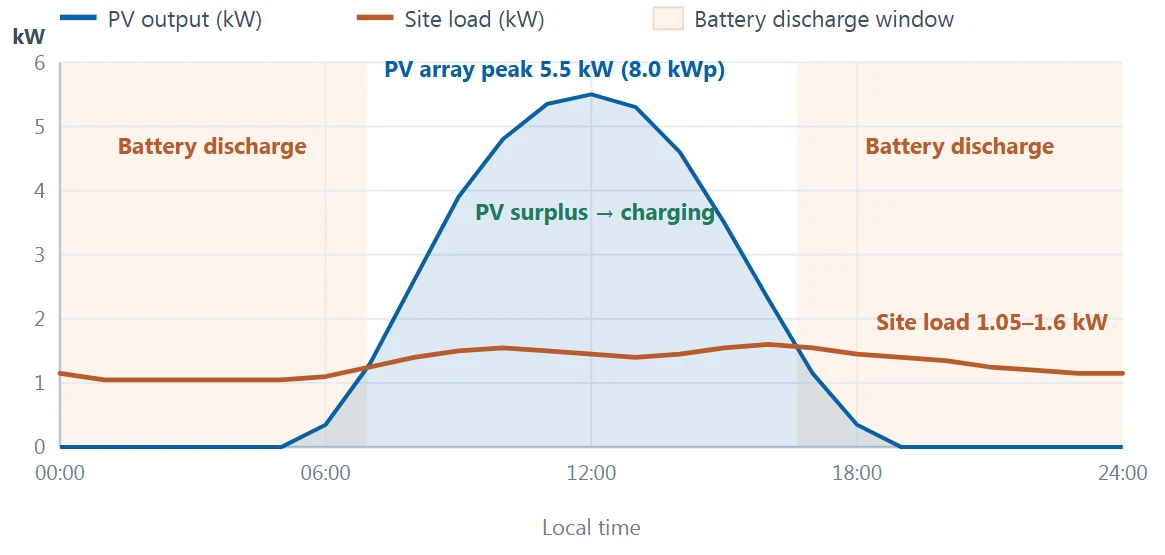
Figure 1 · The daily mismatch between PV output and site load. Worked example: an 8.0 kWp array with a peak AC output near 5.5 kW generating roughly 40 kWh per day, against an average DC site load of about 1.36 kW consuming about 32.6 kWh per day. Between roughly 00:00 and 07:00 and again after about 17:00, the battery is the only source, drawing about 15.3 kWh from storage in total. Modelled as a typical high-irradiance site (about 5.0 kWh/kWp per day) to illustrate the method - not a yield guarantee for any specific project.
ITU-T captured this logic in standards language. L.1210, Sustainable power feeding solutions for IMT-2020 networks - first published in 2019 and in force in its current edition since December 2025, twinned with ETSI ES 203 700 - requires power systems to accept multiple energy inputs and outputs, including several AC sources plus solar, with solar given priority whenever it and the grid are both available. It also calls for multi-standard outputs such as 57 V DC and 220 V AC to serve converged ICT powering. The same standard makes three judgements that shape everything downstream: lithium batteries will fully displace lead-acid, cutting footprint by more than 60%, and the core requirement is that lithium strings must not derate when paralleled. Those three sentences set the direction for every engineering detail that follows.
The 48 V DC bus: why telecom has used the same building block for sixty years
The physical basis of telecom powering is −48 V DC. ETSI EN 300 132-2 defines the DC input interface voltage range for ICT equipment, and ITU-T L.1210 lists it among current powering standards; for higher power density in data-centre-adjacent applications, ITU-T L.1200 defines DC interfaces up to 400 V. The choice of 48 V was an engineering compromise: it sits inside the safety-extra-low-voltage boundary, while keeping current - and therefore cable cross-section, voltage drop and copper loss - within acceptable limits.
This produces a key conclusion: the battery's voltage platform is not selected, it is inherited from the installed DC architecture. LiFePO4 cells have a nominal 3.2 V, so sixteen in series gives 51.2 V nominal with a working window of roughly 40–58.4 V - which lands inside both the rectifier output range and the telecom equipment input range. That is why a brownfield swap from lead-acid to lithium normally requires no change to the DC distribution architecture and no change to the equipment-side power interface, and it is the fundamental reason lithium spread so quickly through telecom networks. Conversely, on a site moving to a 400 V DC architecture - a path some C-RAN and edge data-centre designs are taking - a 51.2 V module is the wrong building block entirely and must be replaced by a high-voltage string or a containerised system.
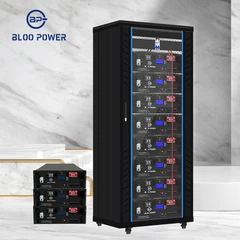
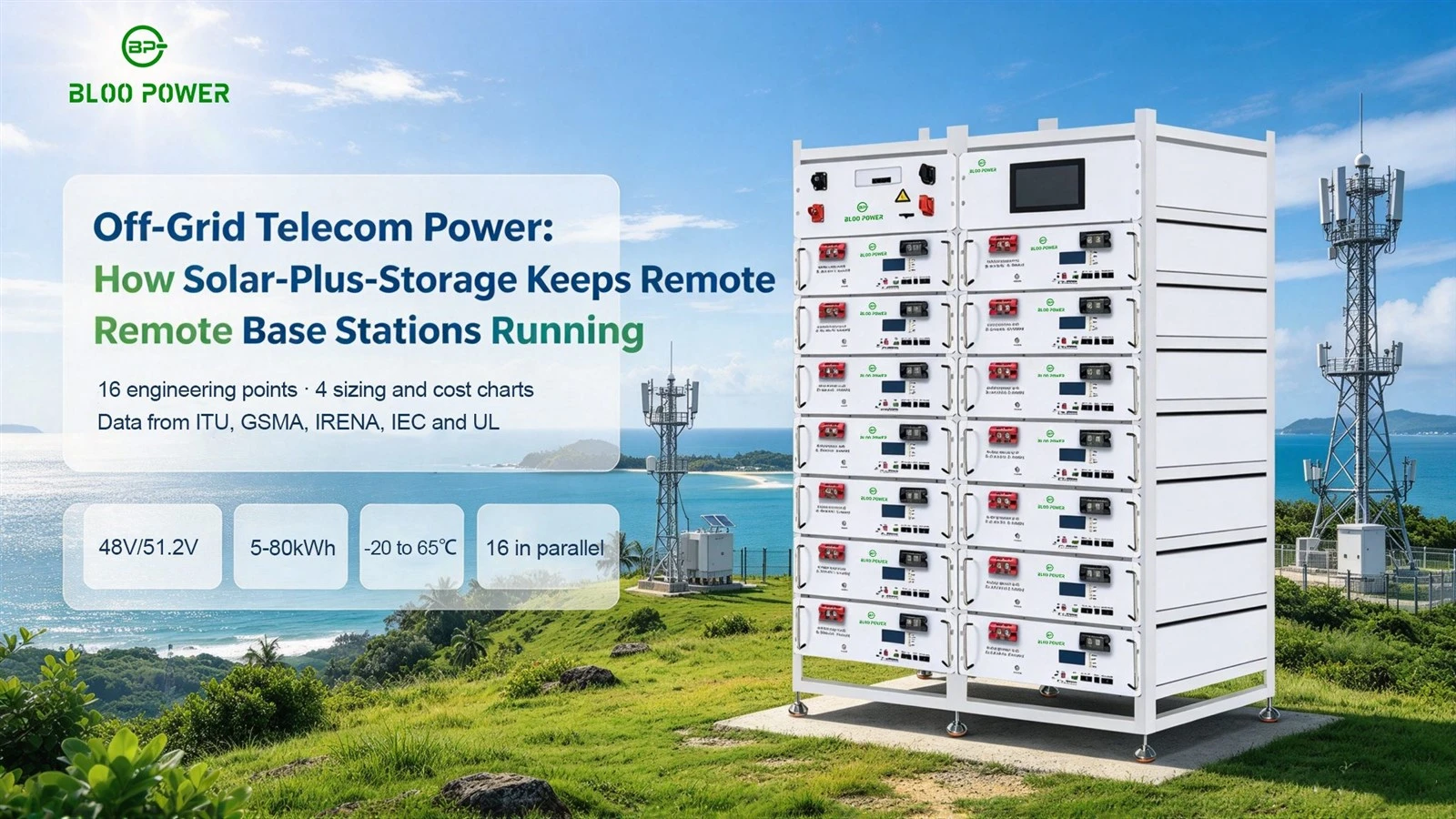
The second constraint that dictates form factor is weight and volume. A 48 V / 100 Ah class module typically weighs around 40 kg and occupies 2U or 3U of rack height; BLOO POWER's BP-BSB series 5 kWh module weighs 40 kg (88 lb) at 130 mm height, while the 10 kWh module is 65 kg (143 lb) at the same 130 mm. That dimension is not arbitrary: it means two technicians can carry and rack the unit without lifting equipment, which is a hard requirement for sites reached on foot or by cable hoist up a mountain, across to an island, or out to a tower base. The third constraint is installation space - a remote site usually has one small outdoor cabinet or a single equipment room, and the module must fit the cabinet that already exists.
The fourth constraint is scalability. BLOO POWER's base station storage modules support up to sixteen units in parallel, so one standard model scales from 5 kWh to more than 80 kWh. In practice this matters enormously at remote sites: a site may start as single-band 4G, add a second radio two years later, and be expanded again after that. Capacity can be added stepwise with load growth instead of being bought up front for a five-year forecast. Modularity also converts "string failure" into "one unit failure" - when a single module develops a cell problem, the system loses only 1/N of its capacity and the field task becomes a remove-and-replace operation rather than a project. That is the most underrated property of modularity in remote deployments: it changes availability from "no failures occur" to "service continues after a failure".
Sizing: the complete chain from load profile to parallel module count
What decides whether a system works is not nameplate capacity but the energy actually usable at the depth of discharge you are willing to run. A nominal 5.12 kWh 48 V / 100 Ah module yields about 4.6 kWh at 90% depth of discharge (DOD), and 4.1 kWh at 80%. The standard engineering estimate is:
|
Parallel modules = ⌈ critical DC load (kW) × target autonomy (h) ÷ 4.6 kWh ⌉
Here 4.6 kWh is the usable energy of one 5.12 kWh module at 90% DOD. Round the result up; where ambient temperature is sustained above 40 °C (104 °F) or below 0 °C (32 °F), the BMS derates the charge window and you should add one extra module as margin.
|
Apply that to the example site in Figure 1: average DC load about 1.36 kW, with roughly 15.3 kWh required from the battery overnight (about 17:30 to 07:00). At 90% DOD, 15.3 ÷ 4.6 ≈ 3.3, rounding up to 4 modules. Adding margin for one overcast day and for cold-weather derating, a practical specification is five 5 kWh modules - about 25 kWh of nameplate capacity. That is the difference between a capacity that was calculated and one that was guessed: the first can be reviewed by a third party, the second can only be patched after commissioning.
Table 1 · Capacity sizing by site type (basis: 4.6 kWh usable per module, 90% DOD, 25 °C / 77 °F)
|
Site type |
Typical critical DC load |
Target autonomy |
Parallel modules |
Nameplate capacity |
|
Distributed antenna / remote radio node |
200–500 W |
2–4 h |
1 |
≈5.1 kWh |
|
Small cell, smart pole, edge node |
500–1,000 W |
3–4 h |
1 |
≈5.1 kWh |
|
Urban macro, 4G-dominant |
1,000–1,800 W |
3–5 h |
2 |
≈10.2 kWh |
|
5G macro, standard configuration |
2,000–3,000 W |
3–4 h |
3–4 |
15.4–20.5 kWh |
|
5G macro, auxiliary loads at full draw |
3,800 W and above |
4 h and above |
4–5 |
20.5–25.6 kWh |
|
Remote or weak-grid site |
1,000–2,000 W |
8–10 h |
4–6 |
20.5–30.7 kWh |
|
Off-grid island / PV microgrid |
500–1,500 W |
designed on daily cycle |
4–16 |
20.5–82 kWh |
|
Transmission / core ring node |
2,000–4,000 W |
12–24 h |
8–16 |
41–82 kWh |
Note: upper limits reflect the maximum sixteen-unit parallel capability of a single model. Once capacity fades to 80% state of health, real autonomy runs about 10–20% below the table values; sub-zero operation costs a further 10–20% of usable energy. Design should increase the module count accordingly rather than adopting the table values directly.
Two correction terms are easy to overlook. The first is temperature. Usable energy falls markedly in the cold - roughly 85–90% of rated capacity at 0 °C, 75–85% at −10 °C, and 60–70% at −20 °C. Cold-climate sites must be assessed on winter capacity, never on the 25 °C nameplate figure. The second is a power check. Having enough energy does not mean having enough power. A 48 V system delivers about 4.8 kW at a continuous 100 A; if the BMS maximum continuous discharge current is set low while the load demands a larger inrush at start-up, the system will still trip into protection. So alongside cycle life and capacity, verify three more parameters: maximum continuous discharge current, peak discharge current, and the BMS current-limiting strategy.
Archetype 1: high-altitude and pastoral macro sites - best irradiance, harshest winter
The Tibetan Plateau, the western Sichuan highlands, and pastoral districts of Qinghai and Xinjiang are the archetypal fit for solar-plus-storage, for two reasons. First, irradiance is in the global top tier, with daily yields of 5.0–6.5 kWh/kWp routinely achievable. Second, extending the grid is extraordinarily expensive: running a line from the nearest substation to a ridge-top site can mean tens of kilometres of new conductor and towers, complicated by permafrost, landslides and land acquisition across grazing land. The roughly one hundred solar base stations China Tower built in Aba Prefecture's remote pastoral areas are a direct product of that arithmetic.
The engineering difficulty at altitude is not on the generation side. It is temperature and transport. First, air density and cooling capacity fall with elevation, so diesel gensets need power derating while batteries and inverters must be corrected against the manufacturer's altitude derating curve; BLOO POWER's containerised storage systems state explicit derating requirements above 3,000 m (9,800 ft). Second, extreme winter cold directly triggers lithium charge protection: most LiFePO4 modules limit charging to 0 °C and above while discharge may extend to −10 °C or lower. During the coldest stretch, that means the system can discharge but cannot charge - PV energy generated during the day is simply curtailed if the battery will not accept it. There are three routes out: house the battery in an insulated cabinet with controlled heating; select a product with integrated self-heating; or accept a shortened winter charge window and size the capacity accordingly. Third, transport sets the unit weight ceiling - at a pastoral site with no lifting gear, a 40–65 kg rack module is the realistic maximum, and anything larger must break down into man-portable units.
The recommended design logic for this archetype is: size the array against the worst winter month plus one overcast day rather than an annual average; size storage so that winter-corrected usable capacity still covers the night load; and retain a genset, demoted to extreme-weather backup with annual run hours held under 150. The output of that combination is not "zero diesel" but reducing annual fuel deliveries from dozens to single digits - which, on a mountain road closed for three months a year, is the real availability gain.
Archetype 2: islands and coastal sites - salt fog, typhoons and last-mile logistics
Island powering fails differently from high-altitude powering. Sunlight is not scarce; what is scarce is the ability to get equipment there, and the durability to leave it there. China Tower's Zhoushan operation offers a reference scale: by the end of 2025 the company and its operator partners had built 1,083 new sites in Zhejiang Province and brought 5G to 19 islands, with Zhoushan achieving 5G coverage 50 km (31 mi) out to sea serving more than 100,000 offshore users. Before that, some island communications depended on submarine cable, with weaker security and reliability.
An island power design has to confront three things head-on. The first is corrosion. High salt fog and humidity accelerate attack on metal structures, terminals, fasteners and enclosures, so material selection and surface treatment for mounting structures, combiner boxes and battery cabinets must be raised accordingly; modules should carry salt-mist corrosion certification (the IEC 61701 series), cabinets should be rated at least IP55, and terminals should be tinned copper or potted. Corrosion is a slow, hard-to-remediate failure mode - it can only be addressed at the design stage. The second is wind loading and mechanical structure. Islands face the wind directly, so mounting structures and foundations must be recalculated against local basic wind pressure, and cabinets and batteries must be restrained against displacement and overturning in extreme conditions. The third is the transport window. Island construction depends on shipping schedules and is tightly constrained by weather; miss the window and you wait for the next sailing. Two design principles follow: keep equipment modular and light to reduce dependence on heavy lift vessels, and design for "one trip ashore, then long-term operation" by moving maintainability into the design instead of leaving it for later. GSMA's observation that small sites can be delivered wholly renewable through an energy-as-a-service model points the same way - converting a one-off logistics spike into a predictable operating cost.
On capacity, island sites normally sit in the "off-grid island / PV microgrid" row of Table 1: loads of 500–1,500 W, designed on a daily cycle, requiring 4–16 modules. The critical judgement is how many consecutive overcast days to design for. Island weather turns quickly and two or three cloudy days in a row is not unusual. Designing capacity for two days without sun pushes battery cost up sharply; the practical compromise is to keep a genset or a small backup source in the architecture to cover long overcast spells, while sizing the battery for one full day-night cycle plus 50% margin. That controls battery investment while preserving availability.
Archetype 3: desert and hot-arid sites - best PV performance, worst battery environment
In the Taklamakan, the Gobi, the Middle East and the Sahel margins, PV performs about as well as anywhere on earth - while the battery faces the opposite problem. Lithium ageing is highly temperature-sensitive, and the rule of thumb used across the industry is blunt: every 10 °C rise in temperature roughly halves service life. The same rule applies in telecom power, and it is why the ITU-T standards series writes environmental conditions into battery system evaluation criteria. China Tower's Aba Prefecture experience illustrates the same tension from the other direction: in high-altitude, high-irradiance, wide-swing locations the power design has to handle "plenty of generation" and "storage under stress" simultaneously.
Hot-arid design has four practical requirements. First, treat the array and the battery as separate problems. Module output falls at high temperature (temperature coefficient typically costs about 0.3–0.4% of power per °C rise), but the modules tolerate heat; the battery must be held inside a sane thermal window, so its location should favour shade, ventilation, or semi-buried and buried options that exploit soil thermal inertia to flatten the diurnal swing. Second, take published derating thresholds at face value. BLOO POWER's containerised storage systems, for example, are rated for operation from −25 °C to 60 °C (−13 °F to 140 °F) and state explicitly that derating begins above 45 °C (113 °F), alongside an IP55 rating and a 0–95% non-condensing humidity condition. Statements like that belong directly in the design calculation, not in the marketing annex. Third, dust. Deposition reduces module yield and blocks cooling air paths, so cleaning intervals must be written into the maintenance plan, and thermal design should favour passive solutions without external fans, or forced/liquid cooling with dust-resistant construction. Fourth, thermal cycling. Desert day-night swings can exceed 20 °C, so terminals and structural parts undergo continuous expansion and contraction; mechanical fastening torque and contact resistance deserve specific attention at commissioning.
It is worth noting that hot climates are often where solar-plus-storage shows its strongest economic advantage over diesel - not because PV generates more, but because diesel reliability and maintenance costs degrade at the same time as heat, while the core component of a PV system, the module, has almost no vulnerable element in high temperature. Capacity design still follows the standard equation, but the calculation needs two extra corrections: high-temperature derating, and the parasitic load of cooling.
Archetype 4: extreme cold and high latitude - lithium plating belongs in the specification
This is the most technically demanding archetype, and the one most often glossed over during procurement. Lithium behaves in two completely different ways at low temperature, and they must be understood separately.
Cold discharge is a capacity reduction. Cold charging is permanent damage. On discharge, low temperature raises electrolyte viscosity and slows lithium-ion migration, reducing usable capacity - but the process is reversible and capacity returns as the cell warms. Typically quoted reference values are about 85–90% of rated capacity at 0 °C, 75–85% at −10 °C, and 60–70% at −20 °C. Charging is a different matter: below roughly 0 °C, charging at normal current prevents lithium ions from intercalating properly into the graphite anode, and metallic lithium plates out on the anode surface - lithium plating. Plating is irreversible and cumulative: it permanently consumes cyclable lithium, raises internal resistance, and in severe cases creates internal short-circuit risk. That is why almost every lithium cell datasheet sets the charge window lower bound near 0 °C - the EVE LF280K datasheet, for instance, specifies a charge temperature range of 0 °C to 55 °C. This is the single most common real-world failure cause for lithium in cold regions, and it is the first thing to interrogate any supplier about.
Engineering countermeasures are layered. At the BMS layer, NTC temperature sensors must be distributed across the cell busbars, with an explicit low-temperature charge cutoff (typically 0–5 °C) and a charge-resume temperature (typically 5–10 °C), with the BMS opening the charge MOSFET directly rather than relying on the inverter to behave. At the communications layer, the BMS must report that state to the inverter or rectifier over CAN or RS485 so the host system displays "charging inhibited - BMS low temperature" and redirects PV energy to load or elsewhere; if that interlock fails because of a protocol misconfiguration, the system effectively has no protection at all. At the system layer there are three options: self-heating cells (internal heating film or PTC controlled by the BMS, at a cost of roughly 3–8% of stored energy per day under sustained cold), insulation and controlled heating for the battery cabinet, or accepting a shortened winter charge window and sizing capacity and PV ratio accordingly. At the procurement layer, the specification must state the low-temperature charge threshold, the resume temperature, the heating method and its energy consumption - and the test temperature and depth of discharge behind any cycle life claim. An isolated "8,000 cycles" figure has no engineering meaning.
Taking BLOO POWER's 48 V base station modules as an example: some models are rated for a −20 °C to 65 °C operating range, others separate charge (0–55 °C) from discharge (−10 to 55 °C), and higher-cycle-life models carry an 8,000-cycle rating at 80% DOD while depth-banded models state ≥2,000 cycles at 100% DOD, ≥4,000 at 80%, and ≥8,000 at 50%. Those distinctions matter at selection time. Publishing the conditions alongside the number is itself part of a product's credibility: a supplier willing to state test conditions is usually also willing to stand behind the parameter.
Archetype 5: weak-grid sites - turning a standby asset into a peak-shaving tool
The fifth archetype differs from the first four: there is a grid, it is simply unreliable. Weak-grid sites experience voltage fluctuation, frequent short outages and long unplanned interruptions. There are far more of these sites than there are purely off-grid ones, and they are where the economics of storage show up fastest. ITU's data supplies the macro context: mobile broadband coverage has reached about 96% of the population, yet the final 4% has advanced by only some six percentage points in the seven years since 2018 - when it had already passed 90% - showing how steep the cost curve of extending coverage through new macro sites has become.
The economics here rest on a set of publicly disclosed figures. China Tower has published an estimate of 5G base station energy consumption: a single-tenant 5G site averages about 3.8 kW, more than three times a 4G site, and at an average direct-supply commercial tariff of ¥0.636/kWh that equates to roughly ¥21,000 (≈US$2,900) per site per year in electricity alone. Resold (indirect) supply averages ¥1.12/kWh, more than 1.8 times the direct tariff. Electricity has therefore become one of the largest single line items in network operating cost, with published reporting putting base station and equipment room power at more than 30% of network opex. At sites that are grid-covered but expensive or poor-quality, storage is not merely standby capacity - it becomes a mechanism to take the load off the grid during peak tariff periods. That is precisely the route China Tower describes: using lithium batteries and PV as backup sources alongside mains supply, and switching to them during peak tariffs through peak-shaving techniques. The same approach at larger scale has also been disclosed: China Tower has been approved to participate in electricity market trading in 19 provinces and municipalities, expected to save about ¥160 million (≈US$22.4 million) per year, with more than 10,000 5G sites participating in Jiangsu alone for annual savings above ¥12 million (≈US$1.68 million).

Figure 2 · Order-of-magnitude comparison of delivered electricity cost. Diesel self-generation is estimated for a typical remote-site duty: a 6 kW-class genset at roughly 23% load with specific fuel consumption near 0.50 L/kWh, and diesel at a delivered cost of ¥10/litre including remote transport, giving ¥5.00/kWh - before genset maintenance or attendance. The ¥1.12/kWh resale and ¥0.636/kWh direct tariffs are China Tower's disclosed averages. The ¥0.57/kWh solar-plus-storage figure follows IRENA's reference: a weighted-average LCOE of US$0.079/kWh across 17 operating US hybrid PV-plus-storage projects in 2024. Note that the four values come from different countries, years and accounting conventions; they demonstrate order of magnitude only and cannot be substituted for one another. Any project must be recalculated against local fuel prices, irradiance and equipment costs.
Peak-shaving revenue is a function of the site's tariff structure, not of whether a battery is installed. Where time-of-use tariffs with a wide peak-to-off-peak spread apply, the same battery follows an entirely different revenue model from pure standby duty - it may complete more than 300 shallow cycles a year, at which point surplus cycle life becomes cash flow. This is why, in weak-grid applications, products with clearly stated cycle life and depth-resolved life data have an advantage: a product that bands its life by DOD (for example ≥2,000 cycles at 100% DOD, ≥4,000 at 80%, ≥8,000 at 50%) lets an owner map a "one shallow cycle per day" operating strategy directly onto "where will this battery be in ten years".
PV-diesel hybrid: demoting the genset from primary source to last line of defence
For most remote sites the optimum is neither pure diesel nor a diesel-free solar-plus-storage system, but a three-layer structure: PV as the primary energy source, storage as the energy buffer, and a genset as the final reserve. In system topology, PV enters the DC bus through MPPT; the battery connects to the DC bus directly or through a bidirectional converter under BMS control; rectifier and inverter stages draw from the AC side (grid or genset) to charge the battery; and the load draws from the DC bus. The defining characteristic is that the genset sits on the AC side rather than in the load's mandatory path - it starts only when state of charge falls below a threshold, or when consecutive overcast days leave generation short.
That architecture changes a very specific set of operating numbers. Take a site with an average load of 1.36 kW: a diesel-only design requires a 6 kW-class machine running 24 hours a day at roughly 23% load factor, some 8,760 hours a year; in a hybrid design, the same site keeps only a 3 kW-class machine, with annual run hours compressed below 150 - and those 150 hours are spent at a far better load factor. Why does this matter so much? Because genset specific fuel consumption varies steeply with load factor, and light-load operation burns more fuel while also causing carbon build-up and wet stacking.
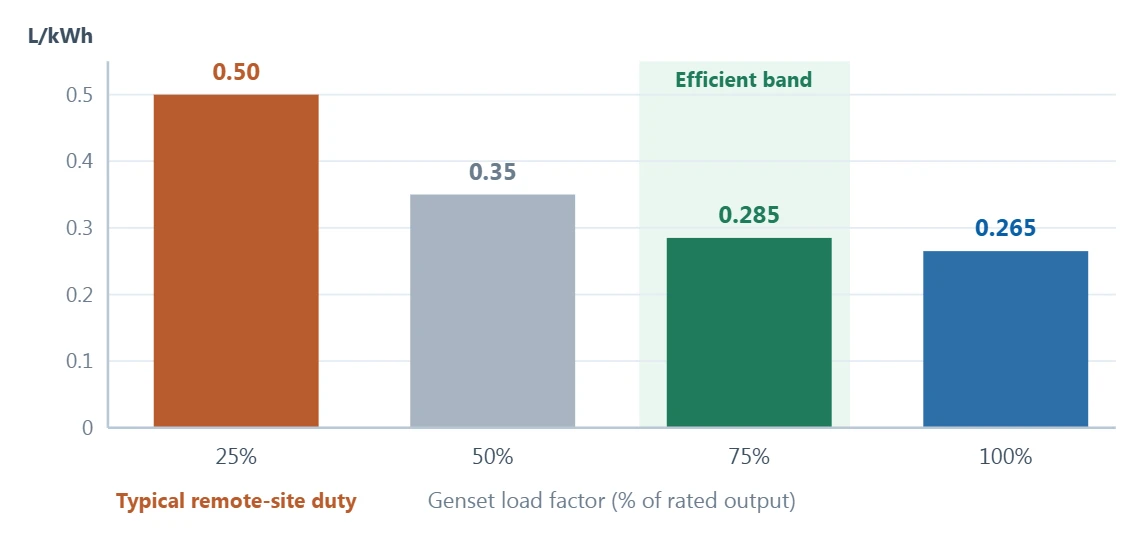
Figure 3 · Genset specific fuel consumption is tightly coupled to load factor. Values are drawn from published technical data for 20–50 kW-class machines, consistent with Cummins Power Solutions performance data, the diesel generator emission and fuel factors in US EPA AP-42 section 3.4, and the duty definitions in ISO 8528-1:2018. Consumption at 25% load is close to double that at 75% - the most expensive hidden cost of an oversized genset at a remote site, and the direct motivation for demoting the genset to backup duty in its efficient 60–80% band.
A three-layer structure buys something else as well: an additional level of redundancy. A diesel-only site depends on a single chain - fuel arrives, machine does not fail, road stays open. The hybrid splits the function across three layers: PV and storage carry normal operation, the battery covers night and short overcast spells automatically, and the genset handles extended overcast or equipment failure. No single layer failing immediately interrupts service. That aligns with ITU-T L.1210's emphasis on service availability and reliability The hybrid does introduce one detail that must be managed: a genset needs a starting battery, and that starting battery is itself a commonly forgotten failure point. After the main battery is upgraded to lithium, the starting battery still belongs on the inspection schedule.
Translating architecture into money makes the conclusion clearer. The comparison below uses the Figure 1 site as its basis - 1.36 kW average DC load, about 32.6 kWh per day, a ten-year design life, located in a remote area where diesel must be delivered. The difference between the options is not whether batteries are expensive; it is what you are still paying for in year ten.
Modelling assumptions (Figure 4 and Table 2)
- Average DC load 1.36 kW; daily consumption 32.6 kWh; ten-year horizon.
- Diesel delivered to site at ¥10/litre (≈US$1.40/L) including remote transport.
- Diesel-only: 6 kW-class genset, 24×7 operation, specific fuel consumption 0.50 L/kWh, one major overhaul during the period.
- Hybrid: 8.0 kWp PV, 25 kWh storage, genset run time under 150 h/year.
- PV-only: about 12 kWp PV and 60 kWh storage to cover multi-day autonomy.
- LiFePO4 cycled once daily on average, no full-string replacement inside ten years.
- Currency converted at ¥7.15 = US$1.00. All values are modelling outputs for illustrating cost
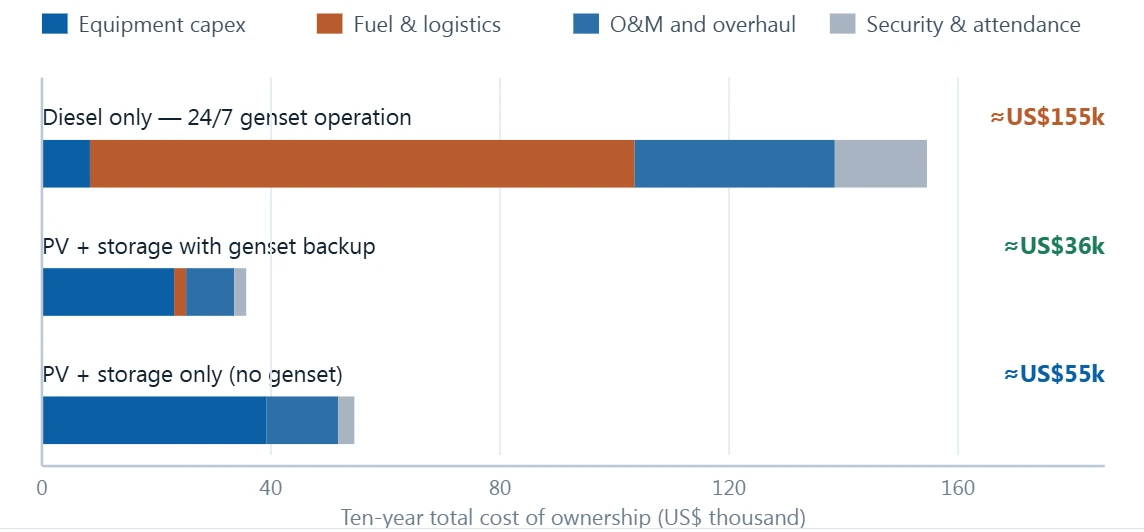
Figure 4 · The composition of ten-year cost matters more than the total. In the diesel-only case roughly 60% of spend is fuel and logistics and about 23% is continuous maintenance and attendance; in the storage-based cases, most of the spend occurs in year one as equipment capex, after which ten years of low-frequency inspection follow. Assumptions are listed above; this chart illustrates cost structure and method, and actual values must be recalculated for local fuel prices, irradiance, equipment quotations and labour rates.
Table 2 · Ten-year cost breakdown and key operating parameters for three architectures (based on the Figure 1 site)
|
Parameter |
Option 1 - Diesel only |
Option 2 - PV/storage with genset backup |
Option 3 - PV/storage only |
|
PV array |
None |
8.0 kWp |
≈12 kWp (oversized) |
|
Storage |
None (starting battery only) |
25 kWh (5 × 5 kWh) |
≈60 kWh |
|
Genset |
6 kW-class, 24×7 |
3 kW-class, <150 h/year |
None |
|
Annual diesel consumption |
≈5,950 L (1,572 US gal) |
≈100 L (26 US gal) |
0 |
|
Ten-year fuel & logistics |
≈US$95.1k |
≈US$2.1k |
US$0 |
|
Ten-year O&M and overhaul |
≈US$35.0k |
≈US$8.4k |
≈US$12.6k |
|
Ten-year security & attendance |
≈US$16.1k |
≈US$2.1k |
≈US$2.8k |
|
Equipment capex |
≈US$8.4k |
≈US$23.1k |
≈US$39.2k |
|
Ten-year total |
≈US$154.6k |
≈US$35.7k |
≈US$54.6k |
|
Principal risk |
Fuel price volatility, delivery interruption, theft, light-load carbon build-up |
Extended overcast periods depend on genset fallback |
Requires significant oversizing; risk of lost supply during long overcast spells |
Values in this table and in Figure 4 are modelling outputs used to illustrate cost structure, not quotations. Option 3 costs more than Option 2 because covering multi-day autonomy during consecutive overcast weather forces substantial oversizing of both array and battery. This is why, at most remote sites, "PV plus storage plus a small diesel backup" is more economical than "PV plus storage only" - handing the very-low-probability extreme condition to a small genset is far cheaper than covering it with battery capacity.
Chemistry selection: LiFePO4 versus VRLA, judged over ten years rather than one
In telecom energy storage the replacement of valve-regulated lead-acid (VRLA) by lithium iron phosphate (LiFePO4) is no longer a contested technical direction - ITU-T L.1210 states it as a standard requirement and notes that lithium reduces footprint by more than 60%. What needs to be explained properly is why it saves money, and on which line item. The table below places the two systems side by side, with the source and test conditions noted for every value.
Table 3 · Technical and economic comparison of LiFePO4 and VRLA at telecom sites
|
Dimension |
LiFePO4 (48 V / 51.2 V, 100 Ah class) |
VRLA |
Effect on operations |
|
Gravimetric energy density |
≈200–260 Wh/kg |
≈50–70 Wh/kg |
Roughly one third the weight for the same capacity; no structural reinforcement needed on rooftop or tower-mounted sites, and units can be carried by hand |
|
Footprint |
≈30% smaller at equal capacity; a 48 V/300 Ah class unit occupies about 59% of the lead-acid equivalent |
Index 100 |
Capacity can be expanded inside the existing cabinet, avoiding new civil works and enclosure investment |
|
Cycle life |
Telecom standard requires ≥1,000 cycles; commercial products reach 6,500–8,000 cycles at 80% DOD |
Telecom standard requires ≥400 cycles; field service typically 300–600 |
One installation spans the ten-year site life; lead-acid needs at least one full replacement |
|
Ten-year lifecycle cost |
Roughly one third of lead-acid |
Index 100 |
Selection should be driven by total cost of ownership, not unit purchase price |
|
Temperature response |
Wide operating window; some models rated −20 to 65 °C (−4 to 149 °F) |
Life roughly halves per 10 °C rise; outdoor sites need insulated cabinets |
Allows a higher cabinet temperature setpoint, cutting both battery cost and cooling energy |
|
Low-temperature charging |
Charging generally limited to above 0 °C - a genuine design constraint |
Can charge when cold, but at reduced capacity |
Cold sites must add heating, insulation, or accept a shortened winter charge window |
|
Self-discharge |
<1% per month |
Markedly higher |
Better charge retention at sites held on float without cycling |
|
Monitoring capability |
Integrated BMS with RS485/CAN; some models support SNMP |
Mostly measurable, rarely controllable |
Converts periodic site visits into continuous alarm-driven maintenance |
|
Peak-shaving capability |
Tolerates high-rate charge and discharge; depth cycling costs limited life |
Deep cycling shortens life rapidly |
Turns an idle standby asset into a productive asset that reduces energy bills |
Sources: BLOO POWER product documentation and base station storage technical papers; ITU-T L.1210 for the displacement of lead-acid by lithium and the associated footprint reduction. Cycle life and temperature entries reference commonly applied industry test conditions - suppliers should be required to state test temperature, depth of discharge, charge and discharge rate, and the capacity-retention definition used for end of life. The low-temperature charging limitation common to lithium cells must not be omitted from any comparison.
Three widespread misreadings of cycle life need correcting. First, reading the number in isolation. "8,000 cycles" says nothing about comparability unless it states the depth of discharge, temperature and C-rate at which it was measured. The same product can differ by a factor of several across depths: a product that bands its life states ≥2,000 cycles at 100% DOD, ≥4,000 at 80% and ≥8,000 at 50% simultaneously[10] - and that set of numbers is itself operating advice: holding depth of discharge between 50% and 80% multiplies service life. This directly supports the sizing approach in section 6. Slightly more capacity in exchange for a shallower cycle is often the best-value investment over a full lifecycle. Second, treating nameplate capacity as usable capacity. End of life is conventionally defined as retention of 80% of initial capacity, so a nominal 5 kWh battery may deliver only 4 kWh after ten years. Design must reserve that 20%. Third, ignoring the interaction of rate and temperature. High-rate cycling combined with high temperature accelerates fade, and charging below freezing causes permanent plating damage. A responsible specification therefore states four parameter groups together - cycle life, test conditions, low-temperature charge threshold, and maximum continuous charge/discharge current. Miss one and the engineering calculation cannot be completed.
Selection summary:
At remote telecom sites, the decisive reason LiFePO4 displaces lead-acid is not higher energy density - it is no full-bank replacement within ten years. A lead-acid solution typically needs at least one complete replacement over that horizon, and at a remote site the replacement cost far exceeds the battery price: it includes transport, lifting, outage time and labour. Once those are counted, the higher first cost of lithium is typically absorbed within two to three years.
Monitoring and O&M: replacing the truck roll with telemetry
The hardest operational problem at remote sites is not technical - it is information asymmetry. You do not know what state the battery is in, so you send someone on a fixed schedule. The cost of a site visit is not just labour; it is vehicle time, road risk and downtime. This is why ITU-T L.1210 lists remote visibility and intelligent operations among its technical requirements, and emphasises fully digital, intelligent management.
The route is to turn the battery from a dumb device into an observable one. Concretely, the BMS must export state data over standard interfaces: RS485 and CAN at the physical layer, Modbus RTU or Modbus TCP at the application layer, with some products additionally offering SNMP for integration into an existing network management platform. BLOO POWER's base station storage modules provide both RS485 and CAN, and the BP-BSB series explicitly supports SNMP with an accompanying remote monitoring and management system. This should be treated as a hard selection criterion rather than a bonus feature: if the protocols are incompatible, the fallback is either replacing the batteries or adding a data acquisition gateway, and both push cost upward.
The data points that need to be telemetered form a checklist that can go straight into a technical requirement. State of charge and state of health indicate remaining autonomy and remaining life. Total voltage and total current allow charge and discharge energy and power to be reconciled. Cell or module-level voltages reveal consistency degradation, the precursor to thermal runaway and abrupt capacity loss. Multi-point temperatures surface cooling faults or heater failure early. Alarms and event logs cover over-voltage, under-voltage, over-current, short circuit, temperature excursions and charge-inhibited states. Once this data flows continuously, the operating model changes qualitatively - from scheduled inspection to exception-driven dispatch, and from discovering a problem after an outage to replacing a module proactively as capacity approaches a threshold. For an operator running hundreds of dispersed sites, that is where O&M cost genuinely falls: not because each intervention gets cheaper, but because unnecessary interventions are eliminated.
There is a further cloud-side benefit that is often undervalued. When the same model of module from the same manufacturer runs across dozens of sites, the aggregate data can reveal regional failure patterns - for example, a batch of cells degrading in consistency faster within a particular temperature band. That kind of insight cannot be obtained from spot checks on individual sites. When evaluating suppliers, then, look beyond the datasheet: does the vendor provide a usable monitoring platform or open interface documentation, and does it support remote firmware updates?
Safety, certification and compliance: the checklist for the specification
In battery procurement, the most common trap is confusing certifications the brand holds with certifications the buyer should request. These are not the same set, and they must be listed separately.
What brands typically hold are deliverability certifications. BLOO POWER, for example, publicly lists CE, FCC, MSDS, UN38.3, UL 1973 and IEC 62619, with ISO 9001, ISO 14001 and ISO 45001 management systems and a 15-year warranty commitment. Of these, UN38.3 is the mandatory test requirement for air and sea transport of lithium batteries - covering altitude simulation, thermal cycling, vibration, shock, external short circuit, impact, overcharge and forced discharge - while MSDS is the material safety data sheet. Together they determine whether a product can legally leave the factory and be transported, which matters especially for remote-site projects where equipment often moves through several legs. CE and FCC address electromagnetic compatibility and radio equipment market access for the EU and US respectively.
What buyers should request are system-level safety certifications and test reports. These include IEC 62619 (safety requirements for industrial secondary lithium cells and batteries) and IEC 62620 (performance testing for the same) for the EU market, and UL 1973 (batteries for stationary energy storage and motive auxiliary applications) together with UL 9540A (thermal runaway propagation test methodology for battery energy storage systems) for North America. ITU-T also maintains a corresponding standards series for energy storage: L.1220 (overview), L.1221 (batteries) and L.1222 (supercapacitors), useful as citable technical clauses.
Keep these separate:
A supplier holding UN38.3, CE, FCC or RoHS demonstrates that a product can be delivered and transported compliantly. UL 1973, UL 9540A and IEC 62619/62620 are safety and performance requirements placed on the battery system itself, and generally must be requested per project as test reports or declarations. Treating the two groups as one category of "certification" is the single most common ambiguity in procurement documents in this field.
Beyond certification, four technical parameter groups must be explicit in the specification. The first is ingress protection. Outdoor cabinets and island sites normally require at least IP55, and it must be clear whether that rating applies to the complete assembly or only the cell module. The second is altitude derating. High elevation affects both cooling and insulation, so vendors generally publish a derating curve that must be applied when sizing. The third is cell-level protection and fire suppression configuration - the tiered protection logic for overcharge, over-discharge, over-current, short circuit and temperature excursion, plus whether gas or aerosol suppression is required. The fourth is mechanical and installation conditions, including dimensions, weight, mounting method (rack, wall or floor cabinet) and the minimum working space required for installation; at a remote site with only one cabinet, this is frequently the deciding feasibility factor. Finally, a no-derating commitment under parallel operation should be written into the contract, because ITU-T L.1210 already lists it among the core requirements for lithium batteries in telecom applications.
Where this stops making sense: six boundary conditions
A design note that only lists advantages is incomplete. In the six situations below, solar-plus-storage is either uneconomic or technically the wrong choice, and that should be stated at the option-study stage rather than discovered later.
One: very long autonomy requirements
If a site must run for several days with no irradiance and no fuel resupply - say three days or more of independent operation - battery capacity grows linearly and cost quickly runs away. Using the equation in section 6, 3 days × 24 h × 1.5 kW ≈ 108 kWh of usable energy, requiring more than fourteen 5 kWh modules in parallel. The better answer here is a high-voltage containerised system designed for long-duration storage (one BMS managing the whole string, reducing parallel wiring, fuse coordination and monitoring points), or retaining a suitably sized genset as the fallback.
Two: sites on a high-voltage DC architecture.
If a site is moving to 400 V DC distribution - the architecture defined by ITU-T L.1200 and adopted by some C-RAN and edge data-centre designs - then a 51.2 V module is the wrong building block and a high-voltage string or containerised system is required. Confirm the site's DC bus voltage level before selecting anything; this is the step most often skipped and the most consequential when it is.
Three: high latitudes with no effective winter irradiance.
Where winter brings two weeks or more of sustained low-irradiance weather, "PV as primary" is effectively untrue for that season, and PV's contribution to annual generation is compressed to a small share. Economics then rest on tariff arbitrage or standby value rather than diesel displacement. Sites like these also stack a low-temperature charging constraint on top, unless heating and insulation are provided, and the battery may spend the winter in a charge-in, nothing-in state.
Four: sites the grid will reach soon.
Where there is a firm grid extension plan within two to three years, waiting for connection is usually better economics than committing now to a complete off-grid system - GSMA's research notes explicitly that national grid expansion in Asia has significantly reduced the number of off-grid sites and can in turn dampen investment in renewable site power. In such cases a phased approach - install storage now to address standby and energy cost, then repurpose it for peak shaving once connected - is usually more rational than a one-step off-grid system.
Five: locations with very high equipment theft risk.
PV modules, combiner boxes and cable are stolen with some frequency in certain regions, and losing modules removes the system's entire generation capability. At sites with poor security, anti-theft design (security fasteners, non-standard mounting structures, tamper alarms) and the cost of guarding must both be priced into the option - at which point diesel's lower value density can be a hidden advantage.
Six: very high inrush or impulse loads on the DC bus.
If a site carries large motor-type loads or legacy transmission equipment in addition to telecom gear, starting inrush current may exceed what a 48 V system can sustain. The answer there is not more capacity but higher-rate cells or supercapacitor-based power compensation, which is outside the scope of a standard 100 Ah-class module.
Need an off-grid telecom power design for a real site?
Give us four inputs - average DC site load, required overnight autonomy, local minimum temperature, and local delivered diesel price - and the BLOO POWER engineering team will size an off-grid telecom power system against the equation in section 6: parallel module count, PV array ratio and hybrid architecture recommendation, with the corresponding product specifications and certification list.
Request a remote site power assessment → · info@bloopower.com
Send Inquiry