




















What Are the Advantages of a 30kWh Wheeled Energy Storage Battery?
Oct 13, 2026
Leave a message

|
What this guide answers
|
Why the 30kWh module became the building block of distributed storage
Start with the macro layer. China's National Energy Administration reports that new-type energy storage reached 136GW / 351GWh of cumulative installed capacity by the end of 2025, up 84.3% year on year, with lithium-ion chemistries accounting for 96.1% and an average discharge duration of 2.58 hours; equivalent utilisation hours rose to 1,195. On the supply side, the International Energy Agency puts global lithium-ion nameplate manufacturing capacity above 4 TWh at the end of 2025, up roughly 30%, with China holding more than 80% of both capacity and output. On cost, BloombergNEF's 2025 survey put the average lithium-ion pack at US$108/kWh, down 8% year on year and 93% below 2010, while stationary-storage packs fell to US$70/kWh - a 45% drop and the cheapest segment in the survey.
Those figures describe the utility-scale layer. What decides whether storage gets used, rather than merely built, is a different question. As capacity climbs from 5kWh to 30kWh, weight and installation requirements cross a threshold: the unit no longer belongs on a wall and no longer fits a 19-inch rack. The conventional answer is to build bigger - dedicated electrical rooms, reinforced floors, fire permits. That works inside a plant you own. It fails on leased ground, in seasonal housing, at a temporary job site, on a mine face that moves every few weeks. A wheeled chassis removes that threshold by reclassifying a 30kWh energy block from infrastructure back into equipment. The same module now also bids into wholesale grid services: the energy storage lithium batteries for frequency regulation market is one of the fastest-growing segments of the grid-services stack, because millisecond-class response is technically superior to the thermal plants it displaces.
Why 30kWh, and not 20 or 50? Three independent calculations converge on the same number:
- One day of household electricity. U.S. EIA data for 2024 show average residential consumption of 863kWh per month, about 28.4kWh per day.[1] A 28.67kWh nominal pack sits almost 1:1 against that figure.
- One night of inverter output. A 51.2V system at 200A continuous discharge delivers about 10.24kW, matching the 8–12kW band of mainstream hybrid inverters - the battery does not become the bottleneck.
- One work shift of a small genset. A 10–15kW diesel set run for two to three hours produces roughly the energy of one full 30kWh discharge, without fuel logistics, noise or exhaust.
Throughout the thirteen sections that follow, every product parameter is taken from BLOO POWER's published product pages and corporate site, and every third-party figure is attributed to its original publisher.

Capacity positioning: why 30kWh is the default size for a lithium battery pack for home energy solar storage system
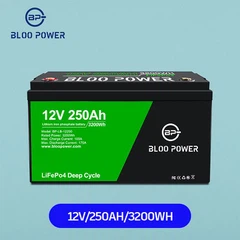
The most common sizing error in storage is treating nameplate capacity as usable capacity. On the representative model of this class, the BLOO POWER BP-HR-30KWH-B, rated energy is 28.67kWh - but delivery depends on a three-stage conversion: nominal energy → depth of discharge → inverter efficiency. Published depth of discharge is 80%, so one full cycle releases about 28.67 × 0.8 = 22.94kWh. Apply the roughly 94% efficiency of a modern hybrid inverter and usable AC energy is about 21.6kWh.
Against the U.S. average of 28.4kWh per household per day, that is about 76% - which looks insufficient until you account for daylight generation from a PV array. What the battery must cover is the post-sunset load plus critical-load backup: on a typical U.S. residential curve, the 18:00 to 06:00 window is 40–50% of daily consumption. A 21.6kWh reservoir covers that window in a detached house and still leaves roughly 30% of headroom for an air conditioner or heat pump. That ratio is the practical reason a lithium battery pack for home energy solar storage system settles on this class rather than a 5kWh wall unit or a 50kWh cabinet.
A cross-technology comparison shows the scale of the difference. To reach the same 22.94kWh of discharge with lead-acid, the chemistry's recommended 50–60% depth of discharge (deeper cycling shortens its 300–800 cycle life) forces a nominal bank of about 46kWh. At a typical 40Wh/kg for an assembled lead-acid bank, the batteries alone weigh close to 1,150 kg / 2,535 lb before ventilation, acid containment and equalisation equipment. The BP-HR-30KWH-B weighs 230 kg / 507 lb in a 740 × 450 × 680 mm envelope. Same usable energy, one-fifth the mass: a change of form factor, not an incremental improvement.
|
Engineering note: compare systems on usable AC energy - nominal energy × depth of discharge × inverter efficiency. Comparing nameplate capacity flatters every chemistry equally and hides a real gap that frequently exceeds 40%. Consistent home solar storage battery pack sizing starts from the load profile, not the label.
|
The wheeled chassis: turning 230 kg into movable capital
"On wheels" sounds secondary. In the 30kWh class it is the variable that decides whether a project exists, because capacity and mass move together: the BLOO POWER wheeled series traces 150 kg at 20.48kWh, 190 kg at 23.35kWh and 230 kg at 28.67kWh. Without a mobility strategy, a 230kg object means rigging, a forklift, a dedicated pad, and a permanent location it will never leave.
Mobility delivers three quantifiable returns:
- Asset utilisation. Rented housing, holiday homes and seasonal premises share one trait: demand moves with the season. A fixed pack may log only 150 effective cycles a year; a wheeled unit can be pushed into the occupied room, stored indoors over winter, or redeployed to another property, lifting the same asset above 300 cycles - doubling the denominator in the levelised-cost model.
- Site flexibility. On construction sites, at mine faces, for irrigation and at temporary events, the point of consumption moves within weeks. A wheeled unit follows the load instead of requiring a fixed system at every location.
- Avoiding cold-weather damage. Charging a lithium cell below 0 °C / 32 °F plates metallic lithium on the anode and causes irreversible capacity loss. A fixed installation in an unheated plant room depends entirely on electric heating; a wheeled unit can simply be pushed indoors.
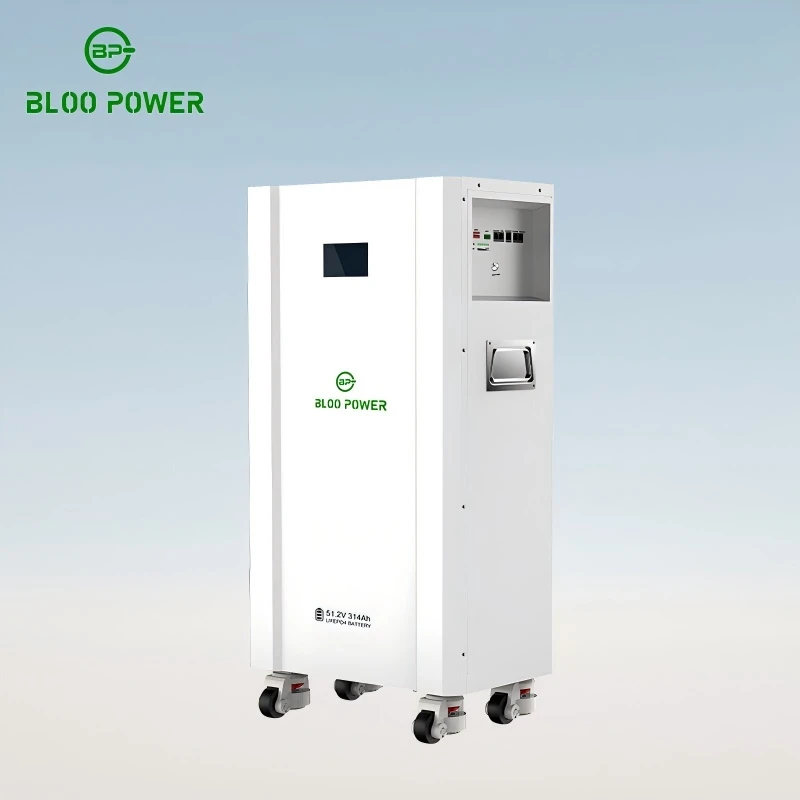
On hardware, the series uses a four-wheel base, a perforated metal enclosure and an LCD status display. Competing products make the same trade-off: Solvic Power's 32kWh wheel-stand unit weighs 290 kg, uses industrial castors and is documented as movable over gravel, dirt and uneven ground. Wheels have evolved from a selling point into a shared engineering vocabulary for a distinct category - though Section 13 sets out the floor-loading constraint that decides where a 230kg unit may stand.
LFP chemistry, a 16S2P architecture and the fire-hazard assessment question
A 30kWh pack sits indoors, close to a dwelling or inside a manned site cabin, which narrows the acceptable chemistry considerably. The entire BLOO POWER wheeled range uses LiFePO4 (LFP) cells in a 16S2P configuration - two decisions addressing two independent lines of defence: chemical safety and engineering redundancy.
The first line is intrinsic. A credible fire hazard assessment of lithium ion battery energy storage systems begins with the cathode, not the suppression system. LFP's thermal runaway onset is generally cited at 200–270 °C / 392–518 °F against 150–210 °C / 302–410 °F for nickel-rich NMC, and it releases less heat and gas per unit of energy, with no cobalt and no nickel in the cathode.The market has priced that in: the IEA reports LFP packs more than 40% cheaper per kWh than NMC and dominant in stationary storage,[18] and BloombergNEF records LFP at US$81/kWh against US$128/kWh for NMC, a 37% gap.
The second line is the architecture. 16S2P means sixteen cells in series and two branches in parallel: the series string stacks 3.2V cells to a 51.2V bus, while the parallel pair forms a 560Ah branch from two 280Ah cells. The value is fault dispersion. If one branch is isolated by the BMS after an anomalous cell, the system continues at half capacity instead of tripping the cabinet. Where the battery is the only source of power, degraded operation beats a clean shutdown.
Cell sourcing runs through a lithium battery energy storage factory with a documented quality system. BLOO POWER states that cells and purchased components come from tier-one suppliers including CATL, BYD, EVE and Gotion using original-manufacturer A-grade prismatic cells, and that the company has more than 17 years of battery engineering and production experience, a 2GWh annual production capacity, a 15,000 m² production base, more than 90,000 customers worldwide and ISO 9001 / ISO 14001 / ISO 45001 certification.
|
Caution: "A-grade cell" is a supplier's self-description, not a verifiable standard term. Convert it into something checkable at the lithium battery energy storage factory: require the cell model, batch traceability records, and factory test reports covering capacity, internal resistance and K-value. A claim that cannot be audited is not a specification. |
6,500 cycles: converting the pack from consumable into asset
Cycle count is the single most important metric in a storage battery because it is the denominator of every cost calculation. The wheeled range is rated at 6,500 cycles at 80% DOD, and that figure needs to sit on two axes.
The first is regulatory. China's GB/T 36276-2023 took effect on 1 July 2024 and requires 1,000 cycles at 45 °C with at least 80% capacity retention, plus a module cycle life no less than 90% of the cells it contains. In other words, 1,000 cycles is a market-entry floor, not an industry expectation. Mainstream LFP projects specify 6,000 cycles or more to 80% retention, and independent technical references put LFP capability at 6,000–10,000+ cycles to 70–80% capacity with a design calendar life of 15–20 years.
The second axis is economic. Converting the rating into lifetime throughput: 22.94kWh per cycle × 6,500 = about 149MWh. Against an indicative installed cost in the low thousands of US dollars for the pack plus an 8–12kW hybrid inverter - BloombergNEF's 2024 benchmarks were US$101/kWh turnkey in China, US$236/kWh in the United States and US$275/kWh in Europe - lifetime levelised cost lands near US$0.03/kWh at full throughput, or about US$0.06/kWh on the conservative assumption that only 3,000 cycles complete inside the warranty period. Diesel generation fuel cost, by comparison, typically runs US$0.21–0.28/kWh, and the peak band of China's five-segment tariff in Shandong reaches about US$0.17/kWh.
Cell prices keep falling, which improves every model built on them. BloombergNEF's 2025 survey records an average pack price of US$108/kWh, down 8% year on year and 93% below the roughly US$1,474/kWh of 2010 in constant 2025 dollars. Stationary-storage packs reached US$70/kWh, a 45% year-on-year reduction and for the first time the cheapest application in the survey; China posted the lowest regional average at US$84/kWh, with North America 44% higher and Europe 56% higher. The IEA records the same direction, with average battery prices down about 8% in 2025.
Table 1 | BLOO POWER wheeled storage series: core parameters (BP-HR-20KWH-B / 25KWH-B / 30KWH-B)
|
Parameter |
BP-HR-20KWH-B |
BP-HR-25KWH-B |
BP-HR-30KWH-B |
|
Nominal voltage |
51.2V |
51.2V |
51.2V |
|
Cell configuration |
16S2P |
16S2P |
16S2P |
|
Nominal capacity |
400Ah |
456Ah |
560Ah |
|
Nominal energy |
20.48kWh |
23.35kWh |
28.67kWh |
|
Voltage range |
40–58.4V |
40–58.4V |
40–58.4V |
|
Cycle life |
6,500 |
6,500 |
6,500 |
|
Test depth of discharge |
80% DOD |
80% DOD |
80% DOD |
|
Continuous charge / discharge current |
40A / 40A |
56A / 140A |
56A / 140A |
|
Max continuous charge / discharge current |
160A / 200A |
200A / 200A |
200A / 200A |
|
Net weight |
150kg / 331lb |
190kg / 419lb |
230kg / 507lb |
|
Dimensions (L × W × H) |
720×450×600mm |
740×450×650mm |
740×450×680mm |
|
Form factor |
Wheeled, four-wheel base |
Wheeled, four-wheel base |
Wheeled, four-wheel base |
|
Operating temperature |
Charge 0–55 °C / 32–131 °F; discharge −10–55 °C / 14–131 °F |
||
|
Storage temperature |
0–55 °C / 32–131 °F |
||
|
Cell chemistry |
LiFePO4 (lithium iron phosphate) |
||
|
Maintenance |
Maintenance free |
||
|
Maximum parallel units |
16 (approx. 458.7kWh) |
||
|
Communication |
RS485 / RS232, parallel communication supported |
||
|
Warranty |
10 years (see note) |
||
Source: BLOO POWER official roller/wheeled lithium-ion battery product pages; the 20kWh, 25kWh and 30kWh models share one specification table. Warranty note: the product page states a 10-year warranty while some corporate pages state 15 years or "15-year service life". Because the two statements differ, the contract should govern - specify cycle count, annual throughput cap, operating temperature band and a capacity-retention degradation table rather than accepting a headline term in years.

Figure 1 | The long decline in lithium-ion pack prices, 2010–2025 (logarithmic axis). Source: BloombergNEF, 2025 Lithium-Ion Battery Price Survey. Pack prices are 93% below their 2010 level; the stationary-storage segment reached US$70/kWh in 2025, down 45% year on year and for the first time the cheapest segment in the survey. This is the cost basis behind the claim that a battery has become an asset rather than a consumable.
BMS and CAN/RS485: from a dumb energy block to a grid-capable node
A 30kWh pack without a battery management system that can hold a conversation is, inside a system, a dumb block of energy. It cannot report state of charge, acceptable current or cell temperature, so the inverter falls back on guessing from terminal voltage - producing spurious shutdowns, incomplete charging and premature discharge protection. On a wheeled unit that changes location, inverter and wiring topology several times a year, that becomes unworkable.
The series addresses this with RS485 and RS232 ports for parallel communication and inverter handshaking, an intelligent BMS covering overcharge, over-discharge, overcurrent, short circuit and over-temperature protection plus cell balancing, and an on-board LCD. The published specification states compatibility with most available off-grid and hybrid inverters and charge controllers, and rates each unit for a 12kW hybrid inverter. Peer products normally add a CAN bus port and list Growatt, Deye, GoodWe, Victron, Solis, SOFAR and SRNE among compatible 48V/51.2V platforms - but request the written protocol compatibility list including firmware version, not a general claim of "wide inverter compatibility".
Why does this matter more at 30kWh than at 5kWh? Because a 51.2V bus at 200A continuous is about 10.24kW, and at that current every contact resistance, line loss and SOC estimation error is amplified. Across parallel units, differences in branch resistance skew current sharing, one unit trips on overcurrent, and the group never fully discharges. Parallel current-sharing strategy and master-slave communication exist to solve exactly that.
There is a second, larger reason. In the energy storage lithium batteries for frequency regulation market, the product being sold is latency. Modo Energy's PJM benchmark shows operational batteries averaging about US$24/kW-month (US$288/kW-year) through September 2025, with Regulation the leading revenue source, and Regulation clearing prices averaging US$61/MW-h in November 2025 - 36% above the energy market, after October 2025 spikes near US$1,800/MW-h following PJM's Regulation redesign. That revenue depends on state-of-charge accuracy and dispatch discipline, which are BMS and EMS functions, not cell functions. Any BESS frequency regulation revenue per MW figure must also be read against saturation: in CAISO, annualised market revenue for batteries fell from about US$78,000/MW-year in 2023 to US$51,000/MW-year in 2024.
Two regulatory anchors set who may bid. FERC Order No. 841 (2018) required RTOs and ISOs to build participation models recognising storage's physical characteristics, with a minimum size threshold no greater than 100kW; Order No. 2222 extended the logic to aggregated distributed resources. A single 30kWh unit is therefore below the direct-entry threshold almost everywhere - which is exactly why aggregation platforms exist.
Parallel expansion: 28.67kWh to 458.7kWh without redesign
The published parameter table allows a maximum of 16 parallel or module-connected units. On the 30kWh model that is 16 × 28.67 = 458.7kWh at one point of connection, with nominal discharge capability around 163.8kW. One product therefore spans "one household through one night" to "a small microgrid" without an architectural change.
Unit-based expansion has three advantages over building a large cabinet in one step:
- Staged capital. Install two modules for today's load and add two more in two years, avoiding the most common failure pattern in storage: over-investing up front and then running at 40% utilisation.
- Space and floor loading scale with demand. A 458kWh cabinet needs a dedicated electrical room, structural engineering and a fire permit. Two wheeled modules occupy about 0.67 m², can be physically separated to limit the consequences of a single thermal event, and need no permit.
- Transferable assets. A standardised 28.67kWh module can be serialised, independently valued and moved between projects. A fixed cabinet retains almost no residual value outside its own site.
|
Parallel-operation constraints (write these into the method statement): identical model, batch and firmware across the group; equalise voltage before closing (±0.5V or per manual); keep branch cable type, cross-section and length identical; set a unique master-slave BMS address on every unit. Mixing batches, voltages or firmware is the most frequent cause of on-site failure. |
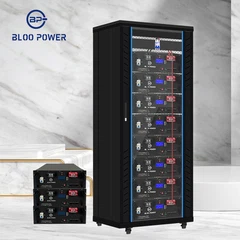
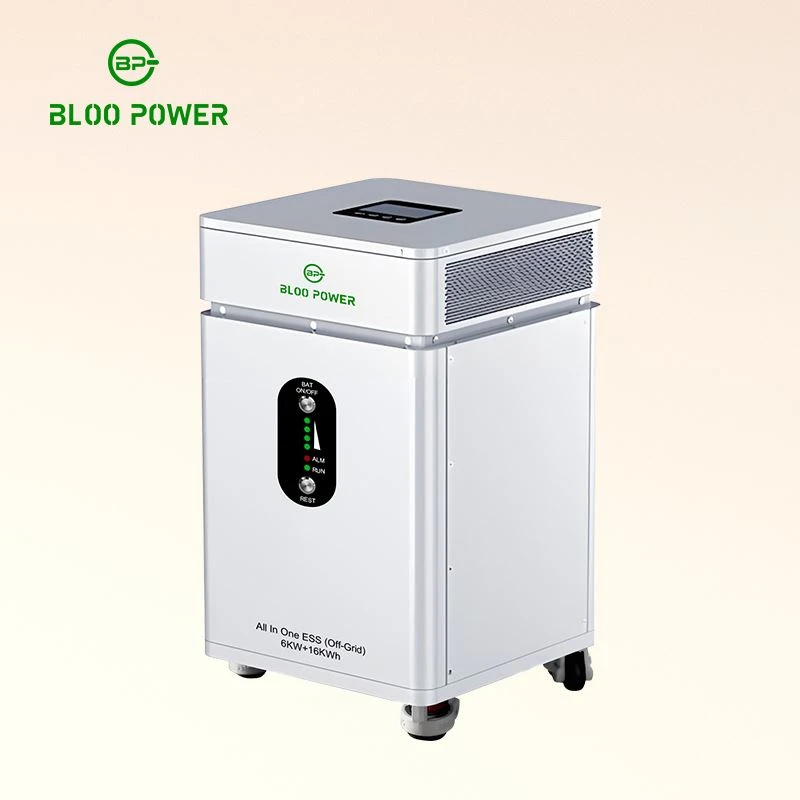
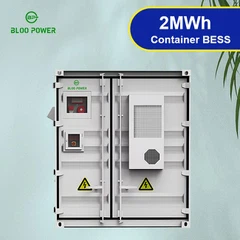
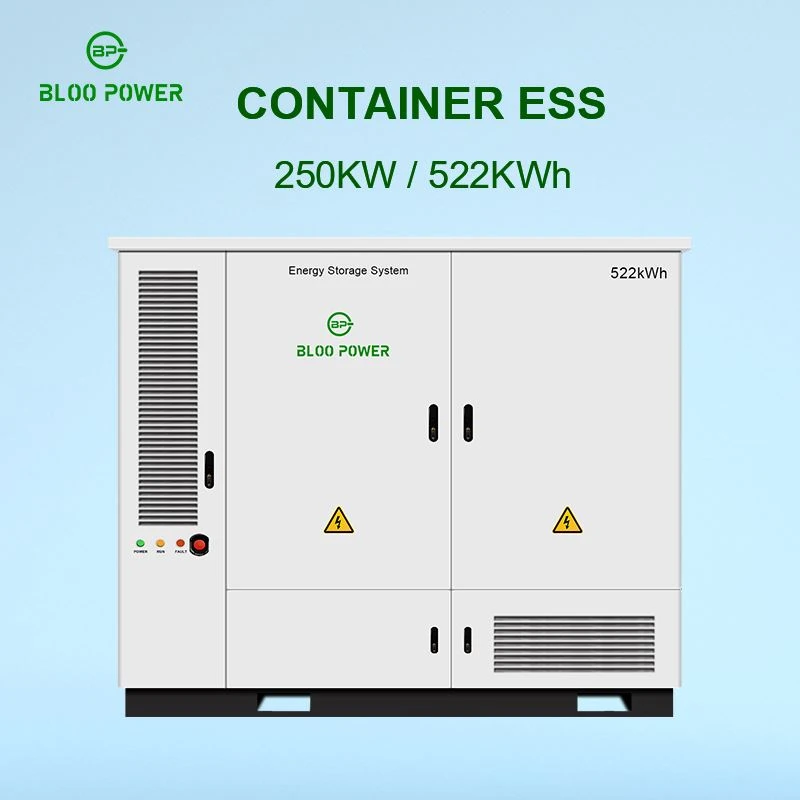
Where a fixed installation is genuinely preferable, BLOO POWER offers complementary lines: 15kWh / 30kWh stacked LFP home storage batteries, a 314Ah 16kWh rack-mount unit, a 16kWh floor-standing unit, a 6kW/16kWh integrated system, and C&I battery energy storage systems at 125kW/261kWh and 250kW/522kWh.
The real temperature window: −10 to 55 °C discharge, 0 to 55 °C charge
Temperature is the parameter most frequently flattered in sales literature and most frequently the cause of field failures. BLOO POWER states the series plainly: charge 0–55 °C, discharge −10 to 55 °C, storage 0–55 °C, with a note that operation below −10 °C / 14 °F is not recommended. For LFP that is a standard window; what matters is why it cannot be exceeded.
The 0 °C charge floor is a hard chemical constraint. Charged below freezing, intercalation kinetics at the graphite anode slow down, lithium ions cannot enter the layered structure in time, and metallic lithium plates onto the anode surface as dendrites - irreversible capacity loss, and over time a separator puncture risk. The discharge floor is more forgiving: at −10 °C the battery is usable, but available capacity and internal resistance both deteriorate, and delivered energy may be only 70–80% of the warm-condition figure.
This is where the wheeled format offers something a fixed system cannot. An installed pack relies on electric heating that draws energy from the pack it protects; a wheeled unit can be rolled into a heated space before the cold season, sidestepping the restriction entirely. At the top end, with storage limited to 50 °C and charging to 55 °C, the BMS derating strategy - reducing current to limit temperature rise - is what protects cycle life in hot climates rather than a sign of degraded performance. For inland Australia, the Middle East and parts of Africa where summer ambient reaches 45–55 °C, this is a decisive input to chemistry and siting choice.
Table 2 | Usable energy and runtime of a 30kWh wheeled battery at different AC load levels
|
Load case |
Continuous power |
Energy in 24h |
Runtime on one cycle |
Typical use |
|
Base load |
0.5kW |
12.0kWh |
about 43.2 hours |
Refrigeration, router, lighting, cameras, phone charging |
|
U.S. household average |
1.18kW |
28.4kWh |
about 18.3 hours |
EIA 2024 residential average consumption |
|
Moderate household load |
1.2kW |
28.8kWh |
about 18.0 hours |
Inverter air conditioning, TV, computers, washing machine |
|
Elevated load |
3.0kW |
72.0kWh |
about 7.2 hours |
A/C plus pump plus induction hob, covers a full night |
|
Job site / small three-phase |
5.0kW |
120.0kWh |
about 4.3 hours |
Power tools, lighting and small equipment for one shift |
|
Machine power limit |
10.24kW |
245.8kWh |
about 2.1 hours |
Against the 200A × 51.2V continuous discharge ceiling |
Basis of calculation: usable AC energy 21.6kWh = 28.67kWh nominal × 80% DOD × 94% inverter efficiency. Actual runtime depends on load power factor, simultaneity, ambient temperature and cell ageing; the table is a warm-condition, new-cell theoretical figure, and engineering selection should retain a further 15–20% margin. Sources: BLOO POWER published product parameters; U.S. Energy Information Administration 2024 residential consumption data.

Figure 2 | Runtime against AC load power. The curve decays almost hyperbolically at low load and flattens at high load: below about 3kW the 30kWh model is capacity-limited, above about 5kW it becomes power-limited by the 200A continuous discharge ceiling. Determine where your load sits on this curve before deciding whether to parallel a second module. Sources: BLOO POWER published parameters; EIA 2024 residential baseline.
The certification evidence chain: UN 38.3 to UL 1973 and UL 9540A
Certification is where storage buyers most often confuse two distinctions: transport testing versus product safety certification, and component listing versus system listing. Get either wrong and a project can ship, install, then stall at acceptance or underwriting. BLOO POWER's corporate site states CE, FCC, MSDS and UN 38.3, and separately lists UL 1973 and IEC 62619, with factory certification to ISO 9001 / ISO 14001 / ISO 45001. Here is what each mark does and does not prove.
- UN 38.3 is a test in Section 38.3 of the UN Manual of Tests and Criteria - a transport safety test, not a product certification. It simulates low pressure, thermal cycling, vibration, shock, external short circuit, impact, overcharge and forced discharge. Without it, no carrier will accept a lithium shipment.
- IEC 62619 is the safety standard for industrial secondary lithium cells and batteries, covering external short circuit, thermal abuse, overcharge and drop, with propagation requirements added in later editions. It is the baseline for EU and Asia-Pacific industrial buyers, and it is not IEC 62620 (performance) nor a substitute for IEC 62477-1 or IEC 62109 (power conversion).
- UL 1973 covers the battery system itself for stationary, vehicle-auxiliary and light-rail use, and is the usual North American minimum - but it does not, alone, approve a complete storage system.
- UL 9540 certifies an integrated system (battery plus PCS plus EMS) as one unit. UL 9540A is different again: not a pass/fail certificate but a test report documenting thermal runaway propagation behaviour, which authorities having jurisdiction and insurers use to set separation distances, sprinkler demand and adjacency permissions. Two vendors may both "have 9540A" and receive opposite rulings, because the underlying data differ. UL published the 6th Edition on 13 March 2026, adding large-scale fire testing in which a complete unit is ignited with suppression disabled; NFPA 855's 2026 edition requires that testing be laboratory-witnessed and adds thermal runaway propagation prevention provisions and a mandatory hazard mitigation analysis. Anyone requesting a UL 9540A thermal runaway propagation test report should ask which edition and which test levels were actually completed.
- CE is the manufacturer's declaration of conformity, typically covering the Low Voltage and EMC Directives; RoHS restricts specified substances. Regulation (EU) 2023/1542 layers on further obligations: a carbon footprint declaration applies to EV batteries from 18 February 2025 and to rechargeable industrial batteries above 2kWh from 18 February 2026, and a digital battery passport becomes mandatory for industrial batteries above 2kWh, EV batteries and light means of transport batteries from 18 February 2027. For most residential products, the industrial-battery category is the one that applies - which means the lithium battery pack for home energy solar storage system placed on the EU market must carry a compliant declaration and, from 2027, a passport.
- GB/T 36276-2023 is China's lithium-ion standard for electric energy storage (in force 1 July 2024), required for grid-side and distributed tenders in that market. GB/T 46266-2025, covering mobile energy storage supplies for household and similar use, took effect on 1 March 2026 - the first national standard aimed directly at the mobile/wheeled category.
Table 3 | Certification checklist: marks publicly stated by BLOO POWER vs documents the buyer must request separately
|
Mark / standard |
Scope |
Market |
Publicly stated |
Documentation to request |
|
UN 38.3 |
Cell and pack transport safety |
Global (mandatory for transport) |
Yes |
Test summary shipped with goods; report number |
|
CE |
EMC / low voltage / applicable directives |
European Union |
Yes |
Declaration of conformity naming the directives applied |
|
FCC |
Electromagnetic interference |
United States |
Yes |
Separate radio certification if a wireless module is fitted |
|
MSDS |
Chemical safety data sheet |
Global (transport / customs) |
Yes |
Version number mapped to the specific battery model |
|
IEC 62619 |
Industrial secondary lithium safety |
EU / APAC / Middle East |
Yes |
Report number, issuing body, whether propagation clauses are covered |
|
UL 1973 |
Stationary battery system safety |
North America |
Yes |
Whether issued in the manufacturer's name and covering this configuration |
|
UL 9540 |
Complete storage system (battery + PCS + EMS) |
North American grid-tied projects |
Not stated publicly |
System-level certification must be confirmed separately |
|
UL 9540A |
Thermal runaway propagation test report |
North America |
Not stated publicly |
Requested by fire authorities for cabinet and container projects |
|
NFPA 855 |
Installation standard; LSFT and TRPP requirements |
United States |
Not stated publicly |
Hazard mitigation analysis and test data for the AHJ |
|
GB/T 36276-2023 |
Lithium-ion battery for electric energy storage |
China |
Not stated publicly |
Required for Chinese storage tenders |
|
GB/T 46266-2025 |
Mobile energy storage supply, household use |
China |
Not stated publicly |
In force 1 March 2026; applies to the mobile storage category |
|
(EU) 2023/1542 |
Carbon footprint declaration, recycled content, battery passport |
European Union |
Not stated publicly |
Confirm which phase applies to your product and placing-on-market date |
|
ISO 9001 / 14001 / 45001 |
Quality / environmental / OH&S systems |
Global |
Yes |
Certificate validity and accreditation body verifiability |
What "not stated publicly" means: the mark was not found stated on BLOO POWER's public pages. It does not mean the manufacturer does not hold it - storage certifications are frequently applied for per order configuration. The correct approach is to request the certificate list and report numbers for the destination market in writing at quotation stage, and to write into the contract that certificates must be issued in the manufacturer's name and cover the configuration being purchased. Sources: BLOO POWER published certification statements; scope descriptions per UL Standards & Engagement, IEC, Regulation (EU) 2023/1542 and the GB/T series.
Deployment without civil works: the site economics of a two-hour install
A fixed 30kWh installation follows a long sequence: site survey, floor loading assessment, electrical room confirmation, wall bracket or rack installation, cable tray routing, earthing and insulation testing, fire and grid-connection approvals, then commissioning. Where structure or fire strategy must change, that sequence is measured in months. A wheeled unit compresses it to: unload, roll into position, connect to the hybrid inverter, power up and complete protocol commissioning. Two further items drop out on this series - the published table states maintenance free, and the four-wheel base removes both foundations and wall mounting. Published experience with modular mobile storage units in the 30kWh to 800kWh range puts commissioning at roughly two hours once the unit is on site.
Four cost lines disappear with the civil works:
- Structural and civil scope. A fixed design may need floor reinforcement, a masonry electrical room and fire compartmentation; the wheeled design needs none.
- Approvals and schedule risk. Anything touching structure or fire strategy needs permitting, and schedule uncertainty is itself a cost.
- Site suitability. Leased, temporary and seasonal premises frequently prohibit permanent modification - here a wheeled system is not cheaper, it is the only configuration that can be installed at all.
- Decommissioning and residual value. A fixed battery is normally scrapped when a site closes; a wheeled unit moves intact to the next site.
The contrast is sharper against diesel. A genset requires a concrete pad, a fuel tank with a spill bund, an exhaust stack routed to code, acoustic treatment, plus scheduled no-load testing, oil changes and battery maintenance even in years when it never runs. In the coal-mine case published by People's Daily, the operator calculated that a conventional diesel generator "requires periodic test runs, oil changes and battery maintenance even if it is never used, with annual maintenance costs exceeding ¥100,000 (about US$14,000)", whereas the storage replacement "runs intelligently day to day, faults are warned in real time, annual maintenance is about 2% of investment, and it stays in hot standby continuously".
Application map, from off-grid homes to vehicular duty
The application coverage of this capacity class is wider than it appears, because 21.6kWh of usable AC energy is enough both to house people and to do work:
- Off-grid and remote housing. Island holiday homes, mountain self-builds, end-of-line rural feeders. At a 0.5–1.2kW base load, 21.6kWh delivers 18–43 hours of uninterrupted supply for refrigeration, lighting, routers, cameras and phone charging.
- Construction sites and temporary work points. At 5kW the runtime is about 4.3 hours, close to a working shift, and the wheeled format lets the unit advance with the works.
- Agriculture and livestock. Irrigation pumps, electric fencing, milking equipment and barn lighting are seasonal and mobile loads - exactly the case the wheeled format was built for.
- Telecom sites and emergency response. Base stations without reliable grid supply need a backup unit that can be exchanged easily, and published scenario analyses group mobile storage into emergency response, event power for stadiums and concerts, and grid ancillary services.
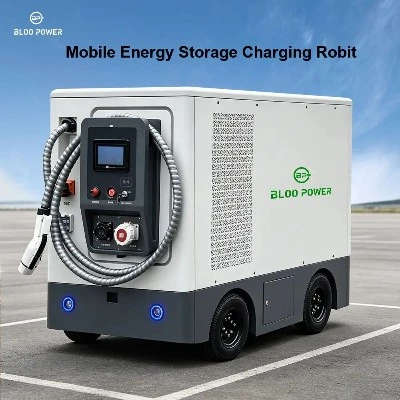
- Mining, ports and mobile recharging. In enclosed operations, a mobile unit can recharge electric haul trucks while simultaneously solving the charging infrastructure problem.
Vehicular and mobile duty: rechargeable lithium battery energy storage systems for vehicular applications
The line between portable storage and rechargeable lithium battery energy storage systems for vehicular applications is thinner than most procurement teams assume. The same 51.2V module that powers a house can supply auxiliary and traction-support duty in electric work vehicles, material-handling equipment and marine craft - and the regulatory framing already treats them together: Regulation (EU) 2023/1542 covers traction batteries, industrial batteries above 2kWh and light means of transport batteries in one framework, placing material-handling equipment such as forklifts and AGVs inside the industrial-battery category.
Three configurations recur: fixed auxiliary packs on electric utility vehicles, where a 48V lithium battery pack for electric utility vehicles replaces lead-acid traction strings at roughly one-third the mass; swappable depot packs in material-handling fleets, where the wheeled enclosure doubles as the handling aid; and mobile recharge skids at mine faces and ports, where the pack is vehicle-mounted rather than vehicle-integrated. In all three the governing requirement is identical to the stationary case: accurate state-of-charge reporting over a documented protocol.
Behind the scenario list sits a compounding market. Fortune Business Insights sizes global portable energy storage at US$5.03 billion in 2025, US$6.40 billion in 2026 and US$32.07 billion by 2034, a 22.34% compound annual growth rate, with North America holding 36.58% of the 2025 market. On supply, the IEA places more than 4TWh of global nameplate capacity at the end of 2025, over 80% of it in China - the structural reason European and North American integrators source this product class from Chinese factories.

Note: values after 2027 are derived from the published 22.34% CAGR applied to the 2026 base, to show trajectory rather than to forecast.
Figure 3 | Global portable energy storage market, 2025–2034. Source: Fortune Business Insights, Portable Energy Storage Market Size, Share & Industry Analysis, 2026–2034. One caveat matters for this article: the "portable energy storage" statistical definition is dominated by consumer products. A 30kWh wheeled battery sits in the gap between consumer and commercial scale, and is driven by growth from both sides of that gap.
Grid services: where a 30kWh unit fits in the energy storage lithium batteries for frequency regulation market
Battery storage in competitive markets earns most of its money from ancillary services before energy, and that market is maturing fast. Modo Energy's PJM benchmark shows batteries earning the bulk of revenue from Regulation, with November 2025 clearing prices averaging US$61/MW-h against an energy market 36% lower, after October 2025 spikes near US$1,800/MW-h. In CAISO, by contrast, revenue compressed as capacity grew: ancillary services earnings fell from US$13,279 to US$6,659 per MW-year between 2023 and 2024, and resource adequacy contracts of US$90,000–120,000/MW-year now form the floor rather than the merchant upside. Because published BESS frequency regulation revenue per MW varies by a factor of five between markets, any business case must be built on local clearing history rather than a headline figure.
The lesson for anyone weighing the energy storage lithium batteries for frequency regulation market is that frequency regulation is real and well paid, but it is one service. Revenue stacking is what makes a project bankable:
- Time-of-use arbitrage. On a published Chinese benchmark, the average peak-to-valley spread across 32 regions in January–July 2025 was ¥0.618/kWh (about US$0.09/kWh), down 9.1% year on year; 18 regions exceeded ¥0.6/kWh, with Guangdong's Pearl River Delta at ¥1.297/kWh, Hainan at ¥1.053/kWh and Hunan at ¥0.957/kWh. On a 22.94kWh cycle that is about ¥14.2 per cycle at the national average and about ¥29.8 in the Pearl River Delta.
- Demand-charge management. Under a two-part tariff, peak shaving reduces billed maximum demand. A published case describes a 300kW system in Zhejiang cutting demand charges by about ¥14,400 (US$2,030) per month - usually the largest and most predictable line item behind the meter.
- Demand response and aggregation. Curtailing load or exporting stored energy during system stress earns compensation; published Chinese programmes pay up to ¥1.5/kWh for flexible peak avoidance, and aggregated assets can reach further markets through a virtual power plant.
The realistic positioning for this class is therefore self-consumption plus backup plus arbitrage, not pure arbitrage. Where spreads are thin and no demand-charge reduction is available, the honest framing is that a lithium battery pack for home energy solar storage system is a resilience purchase with an energy-bill discount attached, not an investment product. Note also that market revenue per MW is not a constant: published guidance suggests energy arbitrage revenues could decline 20–40% over a decade as storage deployment grows.
Replacing the diesel genset: cost, emissions and maintenance
Diesel gensets held the off-grid and backup market for one reason - low capital cost. Their running cost, emissions and maintenance burden now look indefensible next to a chemistry whose pack price has fallen 93% since 2010.
The strongest published evidence comes from a coal-mine emergency-power retrofit covered by People's Daily: a 1,250kW diesel generator cost roughly ¥2,000 (US$280) per hour to run with about 900kg of CO₂ per hour, while the storage replacement ran at about ¥400 (US$56) per hour with zero operational emissions, also removing the leakage risk of fuel transport and storage. Four dimensions separate the two:
- Running cost. Diesel is five times storage in that case (¥2,000/h against ¥400/h). Published Indian comparisons point the same way: diesel at roughly ₹25–30 per unit against battery storage at ₹2.80–8.00.
- Changeover speed. A diesel set takes 10–30 seconds from start to load acceptance, during which PLCs, CNC controllers, imaging systems and recording servers reset. Lithium storage changes over in milliseconds, with vendors quoting below 5ms to 20ms, producing no perceptible interruption.
- Noise and emissions. A genset runs at 75–85dB and needs heavy acoustic enclosure; a storage system typically runs below 55–75dB and can go indoors or on a roof. Using U.S. EPA eGRID methodology, each MWh of diesel displaced corresponds to roughly 0.76 tonnes CO₂e avoided.
- Fuel logistics. Diesel needs a tank, a bund, an exhaust route and scheduled delivery. At mine faces, on islands and at remote telecom sites, fuel logistics are the least reliable part of the system. A battery charged from PV or grid has no supply chain to interrupt.

Source: measured figures published by People's Daily, China Energy News, 20 July 2026. Currency converted at an indicative ¥7.1 per US$1
Figure 4 | Diesel generator versus storage, per hour of operation. The two panels use independent scales: the cost panel runs to ¥2,200 per hour and the emissions panel to 1,000kg CO₂ per hour. The storage emissions bar retains a 3-pixel marker to represent zero. These are single-case measured figures from one published retrofit and will vary with genset model, load factor and local fuel price.
Boundaries and counterexamples: when a 30kWh wheeled energy storage battery is not optimal
A selection document that only endorses is not worth reading. These six conditions are cases where a 30kWh wheeled energy storage battery is either the wrong answer or needs additional provisions.
Sustained high-power output with no opportunity to recharge
Maximum continuous output is about 10.24kW: roughly 4.3 hours at 5kW and about 2.1 hours at full power. Where a site needs more than 5kW continuously for eight hours or longer with no PV or grid input, the correct choice is a genset, a two-to-four-unit parallel bank, or a larger rack or cabinet system. In the very-long-duration, no-recharge case, diesel retains an advantage no chemistry currently matches, because the energy density of fuel is an order of magnitude higher.
Insufficient floor loading capacity
230kg distributed over a 740 × 450mm footprint is a concentrated load of roughly 690 kg/m² (141 lb/ft²), well above the 200 kg/m² (41 lb/ft²) uniform live load normally assumed for residential floors. A ground-floor concrete slab, basement or garage floor is normally fine; timber floors, precast slabs and intermediate floors in high-rise buildings need a structural check first, with load spread by steel plate and positioned away from mid-span. The same judgement applies to transport - 230kg in an older building without a lift needs a ramp or stair route, and corridor width, gradient and turning radius should be assessed beforehand.
Long-term low temperature with no heating available
The 0 °C charge floor is chemical and no brand can bypass it. If a unit must remain outdoors below −10 °C with no heating package and no way to move it indoors, the BMS will inhibit charging for extended periods: the battery can discharge but not recharge, which off-grid amounts to single use.
North American grid-tied or financed projects needing system-level certification
UL 1973, as stated on BLOO POWER's public pages, is a battery-system-level certification. Where a project requires UL 9540 system certification, or a fire authority demands a fire hazard assessment of lithium ion battery energy storage systems supported by a UL 9540A thermal runaway propagation test report, this must be confirmed separately at quotation stage. Do not assume that holding UL 1973 implies system compliance.
Thin arbitrage spreads with no other revenue channel
If the local peak-to-valley spread is below roughly ¥0.6/kWh and demand-charge reduction, demand response or aggregation are unavailable, pure arbitrage payback may exceed the warranty period. Justify the purchase on resilience instead.
Multi-day autonomy requirements
Runtime is about 18 hours at a 1.2kW load and about 7 hours at 3kW. Where a site must keep running through three consecutive overcast days with no PV yield, one unit is insufficient; parallel expansion or a genset backstop is required.
|
Conclusion: the optimal window for this product class can be stated in one line - daily consumption of 8–25kWh, one to two days of autonomy, peak load below 10kW, and a site that cannot or may not accept a fixed installation. Inside that window it is superior on mass, installation, expansion and levelised cost. Outside it, choose another format honestly. |
Eight clauses to write into your specification
Turning the thirteen points above into contract language means translating them into verifiable, attributable clauses. Whether you are specifying for your own site or buying wholesale lithium ion batteries solar energy storage for onward distribution, these eight clauses belong in the technical specification verbatim. Clause 1 is also where volume pricing belongs: ask for the wholesale LiFePO4 solar battery price per kWh at each tier you expect to order, rather than accepting a single reference figure.
Accept against usable AC energy, not nameplate capacity. Require the full chain - nominal energy × depth of discharge × inverter efficiency - and runtime sized against the actual site load profile. Acceptance testing should measure delivered energy at the agreed temperature.
Lock down the cycle-life test conditions. "6,500 cycles" carries no information alone. Require depth of discharge (e.g. 80% DOD), ambient temperature (25 °C or 45 °C), charge and discharge C-rate, and the end-of-test criterion (80% or 70% retention). Under GB/T 36276-2023 terms, state whether testing was at 45 °C.
Demand a year-by-year capacity retention table. Not "10 years" but the capacity floor per year or per thousand cycles, with the annual cycle cap, average operating temperature and rest state of charge the guarantee assumes - and whether degradation itself is covered.
Verify cell traceability and the factory's claims. Request the cell brand and model, batch traceability records and outgoing test reports covering capacity, internal resistance and K-value. Ask the lithium battery energy storage factory for its declared LiFePO4 battery factory annual production capacity, plant address and a recent audit or ISO certificate, then reconcile that against order volume and quoted lead time.
Specify the BMS protocol and inverter compatibility list. Require brand, model and firmware version for every supported inverter, plus agreed commissioning support, response times and remote diagnostics.
Check certification scope and the issuing entity. Certificates must be issued in the manufacturer's name and cover the configuration purchased. For North American grid-tied projects, confirm UL 9540 and the UL 9540A report separately; for the EU, confirm which phase of the carbon footprint and battery passport obligations applies to your placing-on-market date; for mobile storage entering China, confirm GB/T 46266-2025 conformity.
Confirm temperature limits and heating provisions in writing. State the charge temperature floor, the low-temperature protection strategy and whether heating is offered. Write "no charging below 0 °C" into both the manual and the user disclosure - the highest-frequency field failure and the easiest item to skip at acceptance.
Define parallel-expansion conditions and warranty continuity. Require identical model, batch and firmware; supply parallel wiring diagrams, cable specifications and BMS address-setting instructions; state whether existing warranties survive expansion and how degradation is apportioned.
The BLOO POWER wheeled product line
BLOO POWER has been engaged in battery technology and production for more than 17 years, with a declared LiFePO4 battery factory annual production capacity of 2GWh, a 15,000 m² production base, more than 90,000 customers served worldwide and ISO 9001 / ISO 14001 / ISO 45001 certification. The lithium battery energy storage factory behind these products supplies 12V / 24V / 48V / 96V low-voltage and 220V / 360V / 400V / 512V high-voltage LFP home storage batteries, plus portable storage from 200Wh to 5,000Wh. The 30kWh wheeled battery is the model built specifically for the large-capacity, mobile corner of that range.
30kWh Wheeled Energy Storage Battery
BP-HR-30KWH-B
A 560Ah LFP pack in a four-wheel floor-standing envelope, rated for a 12kW hybrid inverter, and the best balance of capacity and mobility in the series.
Nominal energy 28.67kWh
Nominal voltage 51.2V
Nominal capacity 560Ah
Cycle life 6,500 @ 80% DOD
Max continuous discharge 200A
(approx. 10.24kW)
Net weight 230kg / 507lb
Max parallel 16 units
(approx. 458.7kWh)
25kWh Wheeled Energy Storage Battery
BP-HR-25KWH-B
Same 51.2V / 16S2P architecture. At 190kg it suits frequent relocation or floor-loading-restricted sites, and can be paralleled with the 30kWh model.
Nominal energy 23.35kWh
Nominal voltage 51.2V
Nominal capacity 456Ah
Cycle life 6,500 @ 80% DOD
Max continuous discharge 200A
Net weight 190kg / 419lb
Max parallel 16 units
15kWh / 30kWh Stacked
LFP Home Storage Battery
Where the site permits a fixed installation and mobility is not required, the stacked format delivers more capacity per unit of floor area. It complements the wheeled range rather than replacing it.
Format Stacked floor / rack
mount
Capacity classes 15kWh / 30kWh
Cells LiFePO4 (314Ah
prismatic optional)
Cycle life 8,000+ cycles (per
corporate site)
Warranty 10 years
Applications Solar self-
consumption, peak
shaving, backup
Companion products 6kW/16kWh
integrated unit;
125kW/261kWh
and 250kW/522kWh
C&I BESS
For project-specific capacity calculations and parallel topologies, the BLOO POWER application engineering team issues a configuration proposal against the site load profile. Resellers buying wholesale lithium ion batteries solar energy storage can request OEM/ODM customisation and sample orders, with EXW, CIF, DDP and DDU trade terms available. Ask for the wholesale LiFePO4 solar battery price per kWh at the volume tier you intend to order - unit price steps down sharply between sample, LCL and full-container quantities.
Send Inquiry