












What Are The Main Types Of Residential Energy Storage Batteries?
Aug 25, 2026
Leave a message

What are Residential Energy Storage Batteries? Let's start with the classification of "battery types"
Residential energy storage batteries are not simply a single type of battery, but a comprehensive product category covering electrochemical systems, capacity, voltage, structural forms, installation methods, and system architecture. Home energy storage typically stores surplus electricity generated by solar photovoltaic systems during the day and releases it at night, during cloudy or rainy weather, or when the grid experiences a power outage, thereby increasing the self-consumption rate of home solar power and providing backup power.
NREL, in its analysis of residential energy storage technology, points out that current residential battery energy storage cost and performance models mainly use lithium-ion batteries, including two chemical systems: NMC and LFP. It specifically notes that LFP has become a major mainstream chemical system for stationary energy storage. Therefore, determining "what types of residential energy storage batteries are available" cannot be based solely on the appearance of the battery casing; it is also necessary to distinguish between the cell chemical system and product structure. For example, wall-mounted, rack-mounted, and stacked batteries belong to installation and structural types, while LiFePO4, NMC, lead-acid, and sodium-ion batteries belong to electrochemical systems.
● Classification by battery chemistry: LFP, NMC, lead-acid, sodium-ion, LTO, etc.
● Classification by structure: wall-mounted, rack-mounted, stacked, integrated, floor-standing.
● Classification by system voltage: 12V/24V, 48V/51.2V low-voltage systems, high-voltage energy storage systems.
● Classification by application: grid-connected energy storage, off-grid energy storage, hybrid energy storage, backup power.

First Type: Lithium Iron Phosphate (LiFePO4/LFP) Batteries – Currently the Most Promising Mainstream Type for Residential Energy Storage
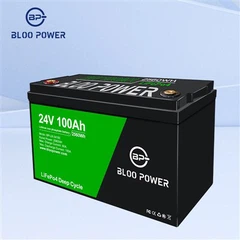
Lithium iron phosphate (LiFePO4) batteries, also known as LFP, are one of the most important battery types in the residential solar energy storage field. Their cathode material is lithium iron phosphate. Compared to some lithium-ion batteries containing nickel or cobalt, LFP has better thermal stability, cycle performance, and cost advantages, making it very suitable for stationary energy storage scenarios requiring long-term charge-discharge cycles. NREL's residential energy storage analysis clearly indicates that in 2024, residential battery energy storage technology models mainly adopted the NMC and LFP systems from lithium-ion batteries, and points out that LFP has become the main chemical system in stationary energy storage since 2021. For household users, the greatest value of LFP is not just its "large capacity," but its ability to maintain good long-term performance even with daily charge-discharge cycles.
BLOO POWER's current residential energy storage products are also based on LiFePO4, including wall-mounted, rack-mounted, and stacked products. For example, its 51.2V 10.24kWh, 15kWh, and 16kWh wall-mounted batteries all use lithium iron phosphate cells and are equipped with a smart BMS.
● Advantages: Good thermal stability, long cycle life, suitable for high-frequency charging and discharging.
● Suitable scenarios: Residential photovoltaic energy storage, peak-valley electricity price arbitrage, backup power, off-grid systems.
● Typical voltage: 51.2V low-voltage energy storage systems are very common.
● BLOO POWER products: 5kWh, 10kWh, 15kWh, 16kWh, 20kWh, and other LiFePO4 energy storage solutions.
The Second Type: Ternary Lithium-ion Batteries (NMC) – High Energy Density Residential Energy Storage Solution
NMC, or lithium nickel manganese cobalt oxide, is another typical lithium-ion battery system. Its main characteristic is its high energy density, giving it a significant advantage in devices where size and weight are critical. From a technical perspective, NMC can store more energy in a smaller volume, meaning it can provide higher energy storage capacity per unit volume in homes with limited space. However, for home energy storage systems permanently installed in garages, basements, storage rooms, or outdoor equipment rooms, users often consider not only energy density but also cycle life, thermal stability, cost, and long-term safety management. Therefore, LFP is increasingly important in stationary energy storage.
NREL data lists both NMC and LFP as important chemical systems for lithium-ion energy storage, noting that LFP has become the dominant chemical system for stationary energy storage. Therefore, NMC is not "unsuitable for home energy storage," but rather requires a comprehensive assessment based on space, power demand, temperature environment, cost, and safety design.
● Main advantages: High energy density, good volume utilization.
● Key considerations: High requirements for thermal management and safety design.
● Suitable users: Energy storage projects with limited space and sensitivity to volume and weight.
● Difference from LFP: Currently, LFP is more prominently used in residential stationary energy storage.
The Third Type: Lead-Acid Batteries – Traditional Residential Energy Storage Still Exists, But Market Positioning Has Changed
Lead-acid batteries are one of the most traditional rechargeable energy storage technologies, with a long history of application in off-grid solar systems, UPS, and communication backup power supplies. Their advantages include mature technology, a well-established supply chain, relatively easy-to-understand initial purchase costs, and a large number of standardized products on the market. However, compared to modern LiFePO4 batteries, lead-acid batteries are typically heavier and larger, and often have disadvantages in terms of deep cycle life and effective usable capacity. The U.S. Department of Energy still lists lead-acid batteries as one of the electrochemical energy storage technologies in its long-term energy storage technology data, indicating that the technology still has practical application value, but this does not mean that it is the best choice for all residential energy storage scenarios.
For households that charge and discharge solar power daily, lead-acid may be attractive if only the initial purchase price is compared; however, when considering installation space, maintenance, cycle life, usable capacity, and long-term replacement costs, LiFePO4 is often more worthy of further evaluation.
● Advantages: Mature technology, high product penetration, and relatively easy-to-control initial costs.
● Disadvantages: Heavy weight, large size, and relatively limited deep-cycle performance.
● Suitable scenarios: Projects with low-frequency backup, limited budgets, or existing lead-acid systems.
● Replacement trend: Many new residential energy storage projects are gradually adopting LiFePO4 to replace traditional lead-acid systems.
Fourth Type: Sodium-ion Batteries – An Emerging Residential Energy Storage Technology Worthy of Future Attention
Sodium-ion batteries are a new electrochemical energy storage technology that has attracted attention in the energy storage industry in recent years. While similar in working principle to lithium-ion batteries, they use sodium as the primary current-carrying ion, thus offering potential advantages in resource supply, material systems, and low-temperature performance. The U.S. Department of Energy's inclusion of sodium batteries in its long-term energy storage technology research scope indicates that they have become one of the important technological directions for new electrochemical energy storage.
However, considering the current commercial maturity of residential energy storage, sodium-ion batteries cannot be simply interpreted as having completely replaced lithium-ion batteries (LFPs). For ordinary households, in addition to focusing on the battery materials themselves, they also need to pay attention to the supply chain, certification, inverter compatibility, after-sales service, cycle life, and total life cycle cost. Therefore, sodium-ion batteries are more suitable as a future energy storage technology trend, while LFPs still have a very significant maturity advantage in current large-scale residential photovoltaic energy storage projects.
● Potential Advantages: Abundant sodium resources, cost potential in material routes.
● Technological Direction: Suitable for scenarios such as energy storage where energy density requirements are not as extreme as for electric vehicles.
● Current Status: Commercialization is progressing, but product maturity varies.
● Selection Recommendation: Before purchasing, focus on verifying certifications, cycle life, and inverter compatibility.
Fifth Type: Lithium Titanate Battery (LTO) – A Special Energy Storage Option with High Rate and Long Cycle Duration
Lithium titanate batteries belong to a special chemical system of lithium-ion batteries. NREL's data on solar energy and energy storage technologies lists various lithium-ion battery types, including LFP, NMC, NCA, LMO, and LTO. The biggest technical advantages of LTO are usually excellent rate performance, high cycle life, and good low-temperature performance, making it attractive in scenarios requiring frequent charging and discharging, rapid charging and discharging, or operation in special environments. However, it also has limitations in energy density and cost, so for ordinary households, "higher parameters are not always better."
If a household's primary use is solar charging during the day and slow discharging at night, then LFP can already meet the needs well. If the project has extremely high-frequency charging and discharging, extreme environments, or special power requirements, then LTO can be further explored. In other words, LTO is more geared towards professional, specialized energy storage, rather than being the first choice for current household energy storage.
● Key Features: High rate performance, long cycle life, good low-temperature performance.
● Disadvantages: May not be advantageous in terms of cost and size.
● Suitable scenarios: High-frequency charging and discharging, special industrial or extreme environments.
● Recommendation for home use: Ordinary residences do not need to blindly pursue LTO.
Sixth Type: Flow Batteries – Mature Technology, but Usually Not the First Choice for Ordinary Households
The biggest difference between flow batteries and traditional lithium batteries is that their energy storage medium is primarily located in an external electrolyte tank. The electrolyte is circulated through the stack by a pump to complete charging and discharging. The U.S. Department of Energy classifies flow batteries as a long-term energy storage technology and categorizes them as an electrochemical energy storage system. The biggest advantage of flow batteries is that their power and capacity can be configured relatively independently at the system design level, making them valuable for research and application in long-term energy storage and large-scale renewable energy storage applications.
However, for ordinary residences, factors such as home space, system complexity, auxiliary equipment, installation costs, and maintenance requirements need to be considered comprehensively. Therefore, they are generally less convenient than a compact LiFePO4 battery. The core demand for residential energy storage is generally modular products with capacities of 5kWh, 10kWh, 15kWh, 20kWh, or even higher, which is the main application direction for LFP products like BLOO POWER.
● Features: Capacity and power design have a certain degree of independence.
● Advantages: Suitable for long-term energy storage.
● Disadvantages: System complexity is typically higher than that of household lithium batteries.
● Typical applications: Large-scale energy storage, renewable energy, and long-term energy storage projects.
Seventh Type: Wall-Mounted Energy Storage Batteries – One of the Best Product Forms for Homes with Limited Space
Strictly speaking, wall-mounted energy storage batteries are not a new electrochemical system, but rather a product structure. They typically use LFP cells, integrating the battery module, BMS, circuit breaker protection, and communication interface into a thin enclosure, reducing floor space occupation through wall mounting. For ordinary homes, villas, garages, and small energy storage rooms, the biggest advantage of wall-mounted solutions is space saving, along with a relatively intuitive installation method.
BLOO POWER's publicly available wall-mounted products include 5.12kWh, 6.91kWh, 10.24kWh, and higher capacity models. Some products use a 51.2V system and support CAN/RS485 communication and multi-unit parallel expansion. Some of their wall-mounted products also feature IP65/IP66 rated enclosures; specific protection levels should be checked against the corresponding model's datasheet and certification documents. For homes that need to install batteries in garages, against walls, or in technical rooms, wall-mounted batteries are often a very straightforward solution.
● Advantages: Saves floor space, simple appearance, flexible installation.
● Typical capacities: 5kWh, 10kWh, 15kWh, 16kWh, etc.
● Suitable scenarios: Villas, ordinary residences, garages, home solar power.
● BLOO POWER: 51.2V wall-mounted LiFePO4 products covering multiple capacity levels.
Type 8: Rack-Mounted Energy Storage Batteries – Suitable for Standardized, Modular, and Large-Capacity Home Energy Storage
Rack-mounted energy storage batteries are generally designed using a 19-inch rack or similar standard structure, mounting multiple battery modules in a storage rack or battery cabinet. This structure is particularly suitable for projects requiring parallel operation of multiple batteries, future capacity expansion, and centralized maintenance. Compared to wall-mounted products, rack-mounted batteries may not be as "applied" to home space utilization, but they have significant advantages in energy storage rooms, equipment rooms, and larger villas.
BLOO POWER's publicly available information on rack-mounted LiFePO4 products includes specifications such as 5.12kWh and 10.24kWh, equipped with LCD monitoring, CAN/RS485/RS232 communication interfaces, and a BMS; their data indicates that some rack-mounted products have a cycle life of 6500 cycles. For homes requiring multiple batteries to form a 30kWh, 50kWh, or even higher capacity system, the rack-mount design allows for centralized battery installation and facilitates future maintenance, capacity expansion, and system management.
● Advantages: High degree of modularity and convenient centralized management.
● Suitable scenarios: Large villas, energy storage rooms, off-grid residences.
● Typical capacity: Approximately 5kWh, 10kWh and above per module.
● BLOO POWER products: 5.12kWh and 10.24kWh rack-mounted LiFePO4 series.
Ninth Type: Stacked Energy Storage Batteries – A Modular Solution Balancing Capacity Expansion, Installation, and Aesthetics
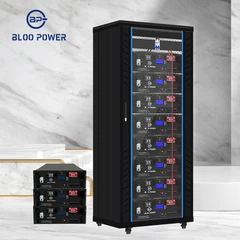
Stacked energy storage batteries have gained increasing attention in the residential energy storage market in recent years. They typically involve stacking multiple battery modules vertically, connecting them modularly to form a complete energy storage system. Users can then gradually increase the number of batteries according to their actual needs. Compared to traditional large battery cabinets, stacked products can break down a large energy storage system into multiple smaller modules, thus reducing the difficulty of handling and installation.
BLOO POWER's publicly available information shows that its BP-HB-LV-15KWH stacked LiFePO4 battery has a rated voltage of 51.2V and a capacity of 15.36kWh. A 20.48kWh product is also available. It features an LCD display, CAN/RS485/RS232 communication, and a BMS. Some models in its publicly available information claim a cycle life of 6500 cycles. For families needing to start with 15kWh and gradually expand to 30kWh or even higher capacities, the stacked solution offers good flexibility.
● Key Advantages: Modular design, easy capacity expansion, and clean appearance.
● Suitable for: Families whose capacity needs will gradually increase.
● Installation features: Multiple battery modules can be vertically combined.
● BLOO POWER: Stacked LiFePO4 products such as 15.36kWh and 20.48kWh.
Type 10: All-In-One Residential Energy Storage System – High Integration of Battery, Inverter, and Control System
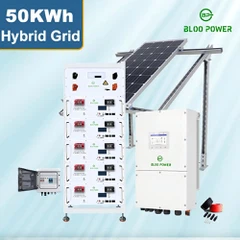
An All-in-one energy storage system is a product form that integrates the battery, inverter, BMS, and some power distribution and control functions into a single device. Compared to systems where the battery and inverter are completely separate, the biggest advantage of an integrated system is its more compact structure. Users do not need to select multiple devices separately and complete complex matching work, making it ideal for families who want quick installation and use. For ordinary users, the key to an integrated system is not "the more integrated, the better," but rather ensuring that the photovoltaic input, battery capacity, inverter output power, household load, grid system, and backup circuit are compatible.
BLOO POWER also offers residential energy storage product forms such as All-in-One ESS, and lists various residential energy storage designs, including wall-mounted, rack-mounted, stacked, All-in-One ESS, and floor-standing units, in its official FAQ. Therefore, for families with limited installation space who want to reduce on-site wiring and the number of devices, integrated energy storage is worth considering.
● Core Feature: High integration of battery and power electronics.
● Advantages: Easy installation and small footprint.
● Precautions: Inverter output and battery capacity must be verified.
● Suitable scenarios: New solar-powered homes, backup power supplies, and small off-grid systems.
Eleventh Type: Low-Voltage Residential Energy Storage Batteries – 51.2V Systems are Currently a Common Home Energy Storage Route
Based on system voltage, residential energy storage can be further divided into low-voltage and high-voltage systems. 51.2V is a very common rated voltage in residential LiFePO4 energy storage, as 16 LFP cells with a nominal voltage of 3.2V connected in series can form a battery system of approximately 51.2V. For ordinary households, low-voltage systems are characterized by high maturity, abundant product offerings, multiple installation options, and compatibility with a large number of hybrid inverters.
BLOO POWER's publicly disclosed wall-mounted, rack-mounted, and stacked products all use a nominal voltage of 51.2V. For example, its 10.24kWh wall-mounted battery uses a 51.2V/200Ah configuration, and its 16kWh product uses a 51.2V/314Ah configuration, and provides CAN/RS485 communication. However, it's important to note that "low voltage" does not mean it can be installed arbitrarily. The battery's maximum charge/discharge current, inverter voltage range, communication protocol, cable specifications, protection devices, and the number of parallel connections must all be carefully considered in the system design.
● Typical voltages: 48V, 51.2V, etc.
● Main advantages: Mature and widely compatible products.
● Typical applications: Residential energy storage systems of approximately 5kWh to 50kWh.
● BLOO POWER: Numerous wall-mounted, rack-mounted, and stacked 51.2V LFP products.
Thirteenth and twelfth type: High-voltage residential energy storage batteries – suitable for large-capacity and high-power residential systems
High-voltage energy storage systems typically increase the number of battery modules connected in series, allowing the entire battery pack to operate within a higher DC voltage range. Compared to low-voltage systems, at the same output power, increasing the voltage reduces the required current, thus helping to reduce current and cable losses on the DC side and meeting the design requirements of some high-power hybrid inverters.
BLOO POWER has also disclosed high-voltage stacked LiFePO4 products; for example, some of its stacked systems use a rated voltage of 204.8V and a rated energy of 20.48kWh, and achieve system management through a modular structure and BMS. However, high voltage does not necessarily mean better than low voltage. High-voltage systems involve higher DC voltages, placing higher demands on insulation, protection, contactors, pre-charging, BMS, installer qualifications, and system safety design. Therefore, when choosing a high-voltage system, residential users should prioritize the inverter manufacturer's battery voltage window and official compatibility list, rather than solely relying on the claim of "high voltage, high efficiency."
● Key feature: Higher system DC voltage.
● Advantages: Suitable for high-power and high-capacity systems.
● Applicable Scenarios: Large villas, high-power home energy storage.
● Precautions: Pay close attention to high-voltage safety and inverter compatibility.
How to Choose Different Types of Residential Energy Storage Batteries?
In reality, no single battery type is suitable for every household. When choosing a residential energy storage battery, you should first determine your household's daily electricity needs, then determine the battery capacity and power, and subsequently consider the battery chemistry, installation method, voltage platform, and expansion requirements. For example, if an average household's primary goal is to increase its solar self-consumption rate, a 10kWh LFP wall-mounted system might be a good first choice. If the household has higher electricity consumption, or wants to maintain critical loads such as refrigerators, air conditioners, and water pumps during power outages, a 15kWh, 20kWh, or even larger system might be necessary.
NREL's residential energy storage technology model uses a 5kW/12.5kWh system as a representative residential energy storage system. This helps to understand that "power" and "capacity" are two different indicators in residential energy storage: 12.5kWh represents how much electricity can be stored, while 5kW represents the system's output power.
● Step 1: Calculate your household's actual daily electricity consumption.
● Step 2: Determine how many hours or days of backup power are needed.
● Step 3: Select the battery and inverter based on the load power.
● Step 4: Confirm the installation method, communication protocol, certification, and expansion capabilities.
Comparison of Major Residential Energy Storage Battery Chemistry Systems
|
Battery Type |
Energy density |
Recycling characteristics |
Safety/thermal stability |
Residential energy storage applicability |
Typical positioning |
|
LiFePO4/LFP |
medium |
excellent |
better |
★★★★★ |
Current mainstream |
|
NMC |
higher |
better |
Thermal management needs to be improved. |
★★★★ |
High energy density |
|
lead-acid batteries |
lower |
Medium/Low |
Mature |
★★★ |
Traditional backup |
|
Sodium ions |
Medium |
Depends on the product |
Technological development continues |
★★★ |
Emerging technologies |
|
LTO |
lower |
Very high |
better |
★★★ |
Special high-frequency scenarios |
|
Flow battery |
Low to medium |
Long-term energy storage advantages |
Different technical approaches |
★★ |
Large-scale/long-term energy storage |
Note: The table is a summary of the technical route level. Different manufacturers, different battery cells and system designs will lead to significant differences in actual performance. The U.S. Department of Energy lists lithium-ion, lead-acid, liquid flow, and sodium batteries as electrochemical energy storage technology routes; NREL focuses on tracking lithium-ion systems such as LFP and NMC.
Comparison of Common Residential Energy Storage Product Structures
|
Product Form |
Space usage |
Expansion Capacity |
Ease of installation |
Recommended for families |
|
Wall-mounted |
★★★★★save |
★★★★ |
★★★★★ |
Ordinary residential/villa |
|
rack-mounted |
★★★ |
★★★★★ |
★★★★ |
Large-capacity families |
|
Stacked |
★★★★ |
★★★★★ |
★★★★★ |
Gradual expansion is needed |
|
All-in-one |
★★★★★ |
★★★ |
★★★★★ |
New energy storage system |
|
floor-standing |
★★★ |
★★★★ |
★★★★ |
Large-capacity families |
|
High-voltage modular |
★★★★ |
★★★★★ |
★★★ |
high power residential |
Why is LiFePO4 Increasingly Suitable for Modern Home Energy Storage?
From the perspective of the overall development trend of the residential energy storage industry, the reason why LiFePO4 is gaining attention is not because it is absolutely superior in every performance indicator, but because it has achieved a good comprehensive balance between safety, lifespan, cost, cycle performance, and adaptability to stationary energy storage. Home energy storage typically requires daily charging and discharging, and may even operate for hundreds of cycles a year. Therefore, "cycle life" is more important than simply peak energy density. NREL has already incorporated LFP into its mainstream stationary energy storage system in its residential energy storage technology model, and pointed out that LFP has become an important mainstream chemistry system for stationary energy storage.
BLOO POWER currently also uses LFP as its core battery technology for residential energy storage, and offers different product forms such as wall-mounted, rack-mounted, and stacked. For ordinary households, unless there are special requirements for extreme low temperatures, high rates, or ultra-high energy density, a well-designed, well-developed BMS, and fully certified LFP system is usually a priority.
● Safety and Stability: LFP has good thermal stability.
● Long-term use: Suitable for home photovoltaic energy storage with frequent charging and discharging.
● Product maturity: The market supply chain and inverter supporting system are relatively complete.
● BLOO POWER positioning: Covering multiple residential energy storage product forms with LiFePO4.
When choosing residential energy storage batteries, don't just look at the "capacity in kWh".
Many consumers only ask "how much does a 10kWh battery cost?" or "how much does a 15kWh battery cost?" when choosing energy storage batteries, but this is far from sufficient. Capacity only indicates how much energy the battery can theoretically store; it doesn't directly indicate whether the system can power high-power devices such as air conditioners, induction cookers, and water pumps. For example, two 10kWh batteries, one allowing a higher continuous discharge current while the other has a lower discharge power, will have completely different capabilities to power household loads.
Therefore, when purchasing residential energy storage batteries, in addition to kWh, you should also focus on rated voltage, continuous charge/discharge current, maximum output power, DoD, cycle life, BMS, operating temperature, IP protection rating, communication protocol, number of parallel connections, and certification status. BLOO POWER's publicly available product data lists parameters such as capacity, voltage, charge/discharge current, cycle life, BMS, CAN/RS485, and IP rating. These indicators should be considered together, not just compared individually.
● Capacity in kWh: Determines how much electricity can be stored.
● Power (kW): Determines the maximum load that can be driven simultaneously.
● DoD (Theoretical Capacity): Determines how much of the theoretical capacity can actually be used.
● Cycle Life: Determines the long-term value of the product.
When purchasing residential energy storage batteries, it is also essential to pay attention to BMS and inverter compatibility.
BMS, or Battery Management System, is a crucial component of modern lithium-ion battery energy storage systems. It monitors cell voltage, temperature, current, and system status, and provides protection against overcharging, over-discharging, overcurrent, short circuits, and temperature fluctuations according to pre-defined strategies. NREL clearly states in its solar and energy storage technology materials that lithium-ion battery systems typically require a battery management system, and energy storage battery packs are often integrated with inverters and protection systems.
Furthermore, residential energy storage batteries cannot be simply understood as "being able to connect to any inverter as long as the voltage is the same." Actual systems also involve CAN and RS485 communication protocols, battery voltage range, maximum charge/discharge current, SOC reading, BMS control logic, and fault protection. While some BLOO POWER products feature CAN+RS485 communication interfaces and claim compatibility with various off-grid/hybrid inverters, specific project compatibility should still be confirmed based on the corresponding battery model and inverter brand.
● Check BMS functions: overcharge, over-discharge, overcurrent, temperature, etc. protection.
● Check communication protocols: CAN, RS485, etc.
● Check inverter compatibility: do not judge solely based on rated voltage.
● Check certification documents: requirements may vary by country and region.
Summary: What are the main types of residential energy storage batteries?
In summary, residential energy storage batteries can be understood from two dimensions: first, "what's inside the battery," which refers to electrochemical systems such as LFP, NMC, lead-acid, sodium-ion, and LTO; second, "what does the battery look like and how is it installed," which refers to structures such as wall-mounted, rack-mounted, stacked, integrated, and floor-standing. For the vast majority of current residential solar energy storage projects, LiFePO4 has become a very important mainstream choice.
NREL's residential energy storage technology data also shows that LFP has become an important mainstream chemical system for stationary energy storage. If home space is limited, BLOO POWER's wall-mounted LFP should be considered; if centralized installation and continuous capacity expansion are needed, rack-mounted systems can be considered; if a more modular installation and gradual capacity increases according to family needs are desired, stacked systems can be considered. BLOO POWER's currently publicly available residential energy storage products cover capacities of 5kWh, 10kWh, 15kWh, and 20kWh, as well as various installation methods, providing a relatively complete product roadmap for different family energy storage needs.
● Preferred choice for ordinary households: LiFePO4/LFP.
● Limited space: Wall-mounted LiFePO4.
● Need for large capacity and expansion: Rack-mounted or stacked.
● Seeking high integration: Integrated ESS (Energy Storage System).
● Special needs: Evaluate NMC, LTO, sodium ion, or other technologies based on conditions such as low temperature, high rate, and long-term energy storage.
Conclusion
For the vast majority of modern residential solar energy storage projects, "LiFePO4 + suitable capacity + suitable voltage + smart BMS + compatible inverter + correct installation" is more important than simply pursuing a so-called "top-of-the-line" battery. When choosing residential energy storage products such as BLOO POWER, it is recommended to consider factors such as daily household electricity consumption, photovoltaic installed capacity, power outage backup time, maximum load power, installation space, local climate, and future expansion plans before deciding on a storage system with a capacity of 5kWh, 10kWh, 15kWh, 20kWh, or larger.
Send Inquiry