



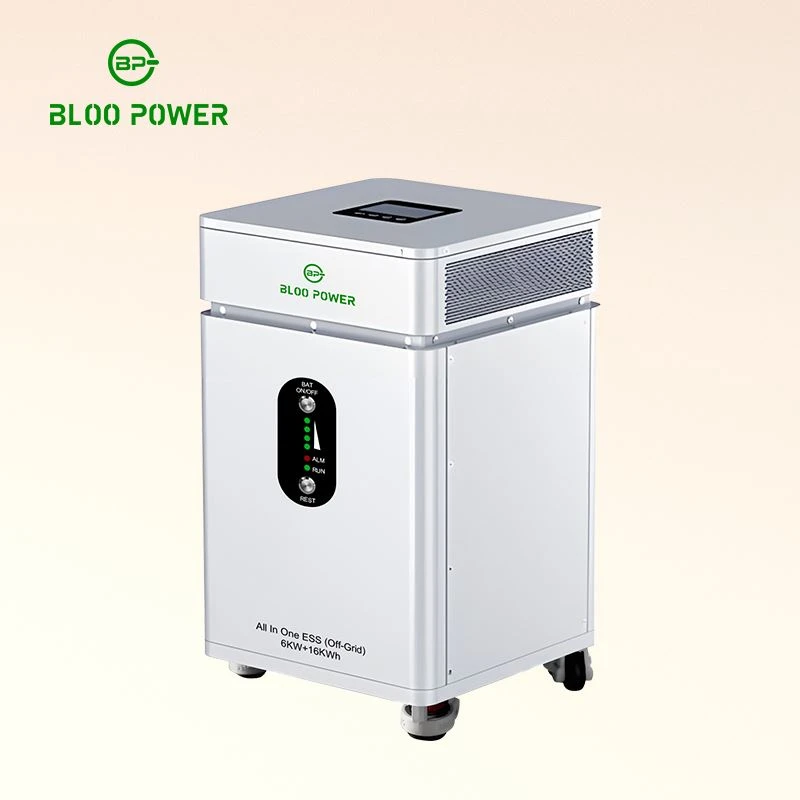


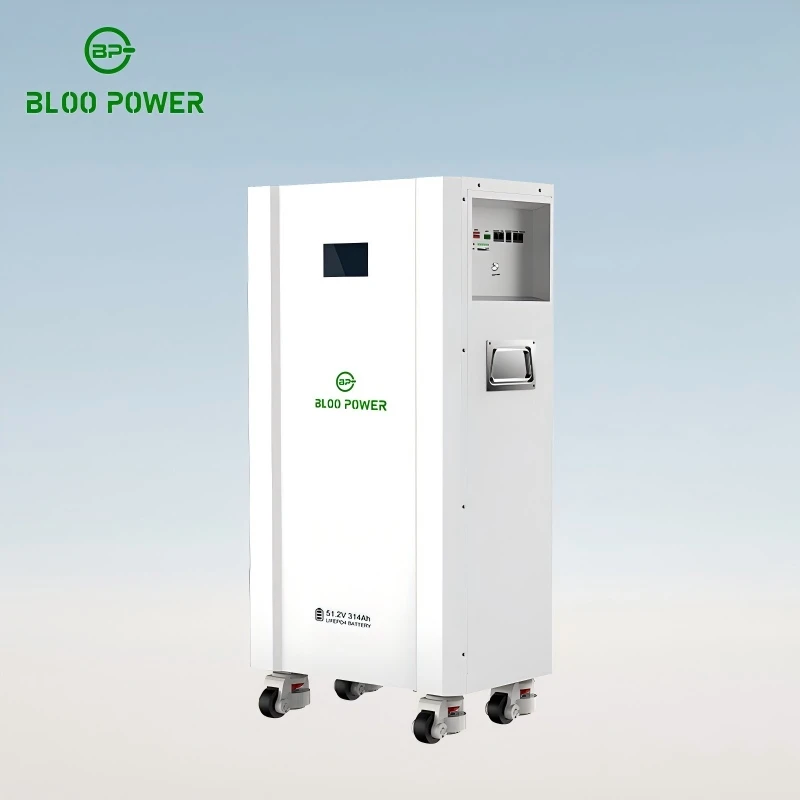















What Communication Scenarios Are Suitable for a 48V 100Ah Base Station Battery?
Sep 24, 2026
Leave a message

What this guide answers
01.Which site types a 5.12 kWh module actually suits-
02.How to size it without guessing.
03.Why 100Ah is the right block size
04.What changes when you replace VRLA.
05.The procurement questions that separate vendors.
Why the 48V 100Ah block became telecom's building brick
Telecom power economics are unusually unforgiving, and the numbers explain why operators have been so aggressive about redesigning site energy. Energy costs now represent somewhere between 20% and 40% of network operating expenditure depending on market and year, according to GSMA research - and 3GPP's own energy study cites a figure of roughly 23% of total operator cost. Around 73–76% of network energy is consumed in the radio access network, and within a base station the radios themselves account for more than 65% of consumption. Nokia has put the emissions picture even more bluntly: 93% of telecom network CO2 comes from operating equipment, and 80% of network energy consumption is attributable to base station sites.
The scale of the installed base makes this a physical, not an abstract, problem. In the United States alone there are 447,605 operational cell sites, of which 166,264 - about 37% - are small cells, according to CTIA's 2025 Annual Wireless Industry Survey. Every one of those sites needs backup. Roughly 1.5 million telco sites worldwide are still powered entirely by diesel generators, at an estimated industry-wide diesel spend above US$19 billion a year.
Against that backdrop, the 48V 100Ah lithium-iron-phosphate block has become the default unit of account for a simple reason: it lands exactly on the intersection of three constraints that are non-negotiable at a cell site. It matches the legacy DC plant voltage window, it is light enough for two people to install, and it is small enough to fit inside equipment that was specified before anyone had heard of Massive MIMO.

20–40%
Share of network OPEX consumed by energy (GSMA)
73–76%
Share of network energy used by the RAN
447,605
Operational US cell sites, incl. 166,264 small cells
5.12kWh
Nameplate energy in a 51.2V × 100Ah module
The voltage match is the first constraint. Base station DC plants have been standardised on a 48V nominal bus for decades: AC mains enters through the distribution panel, a rectifier converts it to 48V DC, and that bus feeds the baseband unit, the radio units and the battery string in parallel. A LiFePO4 cell has a nominal 3.2V, so a 16-cell series string yields 51.2V nominal with an operating window of roughly 40V to 58.4V - landing inside the rectifier's existing output range. In most brownfield retrofits that means the battery can be swapped without touching the power architecture at all.
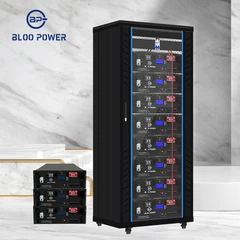
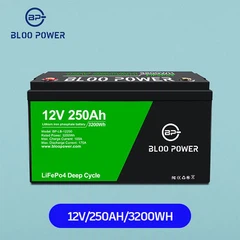
The second and third constraints are physical. A 48V 100Ah class module typically weighs around 40 kg (88 lb) and occupies roughly 2U to 3U of rack height - for BLOO POWER's BP-BSB base station series, that is 130 mm (about 5.1 in) of vertical space in a standard 19-inch rack. That combination is the difference between a site that can be upgraded by a two-person crew in a single truck roll and a site that needs a crane, a structural survey and a landlord conversation.
48V 100Ah telecom battery modules and adjacent models: specification comparison
BLOO POWER rack-mount LiFePO4 range. All units support parallel connection of up to 16 modules.
|
Specification |
BP-HP-5KWH-2U |
BP-HP-5KWH-3U |
BP-BSB-5KWH-3U |
BP-BSB-10KWH-3U |
|
Nominal voltage |
48V / 51.2V |
51.2V |
48V / 51.2V |
48V / 51.2V |
|
Cell configuration |
16S |
16S |
15S / 16S |
15S / 16S |
|
Rated capacity |
100Ah |
100Ah |
100Ah |
200Ah |
|
Nameplate energy |
5.12 kWh |
5.12 kWh |
5 kWh |
10 kWh |
|
Operating window |
40–58.4V |
40–58.4V |
40–58.4V |
40–58.4V |
|
Charge profile |
CC / CV |
CC / CV |
CC / CV / CP |
CC / CV / CP |
|
Max continuous charge |
80A |
80A |
100A |
200A |
|
Max continuous discharge |
100A |
100A |
100A |
200A |
|
Cycle life |
8,000 @ 80% DOD |
6,500 @ 80% DOD |
2,000 / 4,000 / 8,000 |
2,000 / 4,000 / 8,000 |
|
Weight |
40 kg / 88 lb |
60 kg / 132 lb |
40 kg / 88 lb |
65 kg / 143 lb |
|
Dimensions (L×W×H) |
480 × 450 × 88 mm |
550 × 442 × 131 mm |
440 × 400 × 130 mm |
500 × 442 × 130 mm |
|
Operating temperature |
Charge 0–55°C (32–131°F) |
Charge 0–55°C (32–131°F) |
−20 to 65°C |
−20 to 65°C |
|
Communications |
CAN / RS485 |
CAN / RS485 |
RS485 / CAN |
RS485 / CAN |
|
Monitoring |
Smart BMS, local LCD |
Smart BMS, local LCD |
BMS with SNMP support, remote monitoring and management |
BMS with SNMP support, remote monitoring and management |
|
Max parallel modules |
16 |
16 |
16 |
16 |
|
Cell chemistry |
LiFePO4, grade-A prismatic cells · maintenance free |
|||
The engineering case for 100Ah - and where it stops making sense
Why build a site out of 100Ah blocks rather than ordering one large string? Because modularity converts a single irreversible capacity decision into a series of small, revisable ones - and it changes what happens on the day a battery fails.
Consider a 5G macro site that needs roughly 20 kWh of backup. As a single string, that is a bespoke product: long lead time, one part number, and if a cell group degrades you replace the whole assembly. Built from four 5.12 kWh modules in parallel, the same capacity arrives as a standard SKU that ships from stock, can be staged across two truck rolls if needed, and loses only a quarter of its capacity if one module drops out. Field replacement becomes a lift-and-swap operation rather than a project.
Modularity also lets capacity track the load. A site that starts as 4G with a single radio can add a module when a second radio is commissioned and a third when the site is densified - instead of paying up front for capacity that sits idle for three years. BLOO POWER modules support connection of up to 16 units in parallel, which stretches a single standard part number from 5 kWh to more than 80 kWh of nameplate capacity.
That said, the 100Ah block is not always the right answer, and it is worth being precise about where it stops being one:
- Very long autonomy requirements. If a site genuinely needs 24 hours of autonomy at 3 kW - around 72 kWh - you are looking at 14+ modules in parallel, and a purpose-built high-voltage containerised system with a single BMS becomes simpler to commission and monitor. Module count is not free: every parallel string adds interconnect, fuse coordination and monitoring points.
- High-voltage DC architectures. Some new edge data centre and C-RAN designs are moving to 400V DC distribution. A 51.2V block is the wrong building unit there.
- Extreme discharge rates. A 100Ah module at 1C delivers 100A, or roughly 5 kW. Sites with short, very high inrush requirements - large motor loads, some legacy transmission equipment - may need a higher-rate cell or a hybrid approach.
Sizing rule of thumb. Multiply the site's critical DC load in kW by the required autonomy in hours, divide by 4.6 kWh (usable energy per module at 90% depth of discharge), and round up. Add one module of margin for sites above 40°C ambient or below 0°C, where the BMS will derate the charge window.
Doing the runtime math before you buy
The number that matters on a specification sheet is not nameplate capacity - it is usable energy at the depth of discharge you are actually willing to run. A 48V 100Ah module stores 5.12 kWh. Discharging to 90% leaves 4.6 kWh available; discharging to 80% leaves 4.1 kWh and buys noticeably more cycle life. Dividing that figure by the site's average DC load gives runtime in hours.
The chart below plots that relationship for one, two and four modules. Two reference points are worth noting because they bracket most real deployments: a single module carrying a 1,500 W load delivers about 3.1 hours, which covers a small-cell or DAS head-end requirement comfortably; four modules carrying a 2,300 W idle 5G macro load deliver about 8 hours, which puts a rural site well inside an overnight repair window.
Backup runtime vs. site load for 48V 100Ah modules in parallel
Assumes 4.6 kWh usable per module (90% depth of discharge), 25°C ambient, new cells

Calculated from published module capacity. Real-world runtime is shorter - apply a 0.9 temperature correction below 0°C, and derate in line with state-of-health as the string ages. A string at 80% SOH delivers roughly 80% of the runtimes shown.
13 telecom sites where a 48V 100Ah battery earns its place
The scenarios below are ordered roughly from the site types with the largest installed base to the most specialised. In each case, the question being answered is the same: what is it about this site that makes a 5.12 kWh LiFePO4 module the right unit of capacity?
1 Rooftop macro sites with structural or space limits
Urban rooftop macro sites are where battery selection gets decided by a structural engineer rather than an electrical one. These sites typically sit in a few square metres of a commercial building's plant room, on a slab designed for a fraction of the load a legacy VRLA string imposes. The arithmetic is unforgiving: a 48V/300Ah VRLA bank occupies roughly 1.7 times the floor area of an equivalent lithium bank and weighs about 2.9 times as much under the same installation method. On a rooftop, that difference can trigger a structural survey, a landlord negotiation and a construction programme - weeks of delay for a battery replacement. A 48V 100Ah module in the 40 kg class changes the category of the job entirely. Two technicians can carry it through a standard passenger lift, and its 3U rack height means it drops into the existing cabinet footprint rather than requiring a new one. For brownfield rooftop upgrades, this weight and volume advantage is usually the deciding factor, ahead of cycle life or cost. It also matters that these sites are frequently unstaffed and without HVAC, so a maintenance-free chemistry with a wide operating window removes a recurring service visit from the maintenance schedule.
Specification note
For rooftop and plant-room sites, check three things before anything else: the module's weight per rack position, the cabinet's existing U-space, and whether the BMS can report to the site's DCIM or network management system so that capacity checks stop requiring a site visit.
2 New 5G macro builds and capacity upgrades
The move from 4G to 5G is the single largest driver of backup capacity expansion in telecom power. A 5G site can consume up to four times the energy of a 4G site, and a typical 5G site needs up to 70% more power than a site running a mix of 2G, 3G and 4G radios[8]. Published vendor measurements of a three-sector macro site put a fully loaded 5G configuration near 3.85 kW against roughly 1.04 kW for the equivalent 4G site, with idle consumption around 2.3 kW against 0.84 kW. Idle power is the part operators consistently underestimate: a 5G radio keeps broadcasting synchronisation and broadcast channels even with no user traffic, so a site's baseline never approaches zero.
When backup capacity is sized against peak load, the required bank roughly doubles against the 4G generation. A 100Ah module makes that increase incremental rather than binary. A standard 5G macro site lands at three to four modules in parallel; a site with heavy auxiliary loads - air conditioning, transmission equipment, site security - pushes toward four or five. Because the modules are a standard part, capacity can be staged: commission with two, add the third when the second carrier is switched on, add the fourth when the site is densified. Each stage is a routine truck roll rather than a procurement project, and the operator never pays for capacity that is sitting idle waiting for a radio that has not shipped yet.
3 Distributed antenna systems and indoor coverage head-ends
Distributed antenna systems invert almost every assumption that applies to a macro site. Loads are small - tens to hundreds of watts at a remote node - but the site count is enormous, and the locations are the worst possible places for a battery: mall service corridors, stadium risers, basement electrical rooms, airport plant areas. Nobody who works there knows what a VRLA string is, and no one is going to check its terminal voltage quarterly.
What DAS nodes need is not long autonomy but a long service interval and honest remote telemetry. LiFePO4 self-discharge sits under 1% per month, several times better than lead-acid, so a stored or float-charged module holds its state of charge through long idle periods. Discharge capacity is also far less sensitive to discharge rate than VRLA, which means a smaller nominal capacity can meet the same load requirement - useful when a remote node has to be installed inside a ceiling void. A 48V 100Ah module is over-specified for a single remote node and correctly sized for a head-end or a zone hub feeding several sectors, which is exactly where operators deploy it: at the point where the fibre and the power come in, not at every antenna.
4 Outdoor cabinets and pole-mounted enclosures
The outdoor cabinet is the fastest-growing site form factor and the harshest environment a battery will see. A sealed cabinet in direct summer sun can hold internal temperatures well above ambient, with nothing but fans or a small heat exchanger to manage it. This is where lead-acid's temperature behaviour becomes a real problem: a rule of thumb widely used in telecom power design is that VRLA service life halves for every 10°C rise in operating temperature, which historically forced operators either to keep cabinets aggressively cooled or to fit insulated enclosures around the batteries. LiFePO4 tolerates sustained high temperature far better - the electrolyte chemistry is more thermally stable and the failure mode is less energetic - which means the cabinet's thermostat can be set higher, cutting cooling energy and extending the life of unrelated electronics at the same time.
For this scenario, the operating window is the specification line that matters most. BLOO POWER's BP-BSB telecom series is rated from −20°C to 65°C (−4°F to 149°F) with a full metal enclosure and a maintenance-free design - numbers chosen for exactly this duty cycle, where the battery sees desert heat in August and a hard freeze in January without anyone opening the door in between.
5 Rural and remote sites on weak or unreliable grids
Grid reliability, not load, sets the autonomy requirement. Utilities and operators typically work to a risk-based classification: urban sites with dependable supply are sized for a few hours, remote sites on long rural feeders or single-source supplies are sized for overnight or longer, and sites feeding transport rings or emergency services get extended further still. On a poor-grid site, the battery is not a rare-event insurance policy - it is a routine participant in the site's daily operation.
That changes the economics. A lead-acid battery on a site that cycles twice a week will be replaced long before its calendar life suggests, because cyclic service at depth is what kills VRLA. A LiFePO4 module rated at thousands of cycles at a defined depth of discharge is being asked to do precisely what it was designed for. The practical configuration at these sites is four to six modules for an 8–10 hour window at 1–2 kW, expandable module by module as outage patterns become clear. This is also the scenario where the modular approach beats a single large string most decisively - because the eventual requirement is unknown at design time, and the operator can only learn it by watching the site.
6 Extreme-climate sites: cold, altitude and desert heat
Telecom networks operate across climate ranges that consumer energy storage never encounters. In cold regions, VRLA loses a substantial share of usable capacity at low temperature and must be housed in an insulated or heated enclosure - in the most severe cases buried below the frost line, which makes maintenance extremely difficult[7]. LiFePO4 discharge performance holds up better across the same range, and the wider envelope removes the enclosure requirement on many sites.
At the other extreme, high-temperature sites now allow a power-saving change that lead-acid actively blocked: raising the cabinet or shelter setpoint. Because LiFePO4 tolerates sustained 55°C operation without the proportional life penalty VRLA suffers, operators can raise the thermostat and reduce cooling energy - a change that compounds with the already-reduced cooling load from a maintenance-free battery that does not need watering or ventilation.
One caveat deserves to be stated plainly, because it is the most common surprise in cold deployments: lithium cells accept charge poorly below 0°C, and most telecom modules - including the ones in Table 1 - specify a charge window starting at 0°C even where the discharge window extends to −10°C or lower. On a site that can be called into deep discharge at −25°C, the battery may be able to run the load but unable to accept a recharge from the rectifier until it warms. Any cold-climate specification must include either a low-temperature charge cut-off with a heating element, or acceptance of a delayed recharge while a generator or solar array supplies the load.
7 Off-grid islands, border posts and solar-plus-storage microgrids
Where there is no grid to connect to, the battery stops being a backup component and becomes the central element of the site's energy architecture. These installations - island relays, border and coastal sites, remote mountain installations, submarine cable landing stations - typically run a photovoltaic array, sometimes a small wind turbine, a battery bank and a diesel generator as the last resort. The battery here performs two jobs simultaneously: it buffers the daily solar cycle, and it carries the site through consecutive cloudy days.
Daily cycling is the key difference. A battery in this role completes a full charge–discharge cycle every day, which is the single most demanding duty a lead-acid cell can be given; VRLA service life under daily deep cycling is measured in a small number of years. A module rated for thousands of cycles at 80% depth of discharge is doing routine work. The BP-BSB series, for example, is specified at 2,000 cycles at 100% DOD, 4,000 at 80% and 8,000 at 50% - and because autonomy is usually sized generously against consecutive no-sun days, the bank typically runs shallower than 50% DOD in normal operation, which is where cycle life is longest.
Because these sites use 48V DC distribution as standard and often have no capacity escalation path other than adding more storage, parallel expansion to 8–16 modules per site is common. Wide compatibility with off-grid and hybrid inverters and charge controllers means the same module works whether the site is a fresh build or a retrofit onto existing controls.
8 Highway, rail, tunnel and bridge coverage
Linear infrastructure presents a specific operational problem: sites are spread along hundreds of kilometres, they are maintained by crews making multi-site runs, and the load-bearing sites are the ones nobody can reach quickly. Rail corridors are the most demanding case, because signalling and train-control traffic has effectively zero tolerance for interruption, and many segments run through cuttings and tunnels where grid supply is difficult or impossible to bring in.
Three requirements follow from this. The battery has to tolerate the temperature swing of a roadside cabinet. It has to be maintainable in the minimum number of visits. And critically, its condition has to be visible from a control centre, because sending a crew to physically inspect forty sites along a corridor is the dominant cost in the region's battery programme. This is where the network interface becomes the specification's most valuable line: BLOO POWER's telecom modules expose state of charge, state of health, cell voltages and temperature over RS485/CAN, with the BP-BSB line supporting SNMP for direct integration into a remote monitoring and management platform. Along a linear corridor, that turns periodic physical inspection into continuous exception reporting - and a spare module in the service vehicle means a degraded unit is simply swapped out and taken back for evaluation, rather than triggering a return visit.
9 Small cells, smart poles and edge compute nodes
The densification layer is where space is tightest and growth is fastest. Small cells already account for roughly 37% of all US cell sites and are growing faster than macro sites, reflecting the physics of high-band 5G: coverage comes from tower height, but capacity comes from density. Alongside them sit edge compute installations that place server-class hardware in a street cabinet, plus the 5G RedCap and 5G-Advanced nodes now being deployed to serve IoT and low-latency applications.
The design constraint at these sites is vertical inches. A smart pole's internal cavity may allow a single 19-inch rack position; a pavement cabinet may allow three. The 2U variant of BLOO POWER's 100Ah rack-mount module is 88 mm (3.5 in) tall and weighs 40 kg, which fits that envelope where a 3U module at 60 kg often does not. Capacity growth here is genuinely staged: an edge node commissioned with one module for initial services can add a second and third as compute load ramps, so the power infrastructure follows the business case rather than front-running it. The one thing to watch is thermal - a pole-mounted module in full sun needs the enclosure to shed heat, and no cell chemistry is indifferent to being cooked.
10 Emergency response, portable sites and disaster recovery
Disaster response is the harshest duty cycle in telecom because everything that normally supports a site has failed at once: the grid is down, the roads may be impassable, and the site has to be operational within hours of arrival. Cells on wheels, cells on light trucks and portable quick-deploy kits all share the same power problem - generator runtime is limited by fuel, and the battery has to carry the load during generator-off periods.
A 5.12 kWh LiFePO4 module suits this role for three reasons. First, energy per kilogram: at roughly 40 kg for 5.12 kWh, two people can move a module into position where an equivalent lead-acid bank would need mechanical handling. Second, charge acceptance: lithium accepts high charge current without the progressive sulfation damage that cycling does to VRLA, so the battery can be brought back to service quickly during the limited generator-running window, increasing how often the asset can be redeployed. Third, safety in occupied spaces: LiFePO4 has a comparatively high thermal runaway onset temperature and a less energetic failure mode than other lithium chemistries, which matters when the equipment is standing next to a temporary command post or a shelter full of people. Grade-A prismatic cells with cell-level overcharge, over-discharge, over-current, short-circuit and over-temperature protection are the baseline expectation here, not an upgrade.
11 Turning backup into revenue: peak shaving and demand response
The most consequential change in telecom power over the last several years is conceptual rather than technical. A battery string that sits at float voltage for 99% of its life is a stranded asset. Run it against a time-of-use tariff and it becomes a revenue-generating device: charge when energy is cheap, discharge when it is expensive, and reserve only the capacity the site genuinely needs for backup.
The published results are large enough to justify the redesign. In a one-year deployment on Zhejiang Tower sites using AI-driven peak-shaving control, average savings reached 17.1% of site electricity cost - roughly ¥1,784 (about US$250) per site per year - with no site outages attributed to the strategy. A Chinese coastal province operator applying the same principle to a demonstration site reported daily savings of about 22% against local time-of-use rates. The mechanism is straightforward: charge during off-peak hours, discharge during peak hours to offset grid draw, and let the control system decide how much capacity it can safely borrow.
What makes modular 100Ah blocks well suited to this is that the reserve can be partitioned cleanly. Of four modules installed, two might be permanently reserved as backup and two made available for daily cycling. As the site load changes or the string ages, that partition is revised in software. The enabling requirement is data quality: an algorithm that shaves peaks without risking the backup floor needs accurate state of charge, per-cell voltage and temperature, which is exactly what the BMS telemetry in these modules reports.
How backup capacity becomes a peak-shaving asset (simplified 24-hour model)
Shaded area: time-of-use energy price band. Dashed line: net grid draw from the site once the battery is dispatched.

Illustrative model, not a specific tariff. Measured results: 17.1% of site electricity cost saved at ¥1,784 (≈US$250) per site per year in a one-year deployment; approximately 22% daily savings reported at a demonstration site under provincial time-of-use rates.
12 Legacy VRLA replacement programmes
For most operators, the largest lithium opportunity is not new construction - it is the installed base of lead-acid batteries reaching end of life on sites that will otherwise be re-equipped with more lead-acid by default. Fibre and cellular infrastructure in mature markets has largely been built, so the market's centre of gravity has shifted from new-build volume toward replacement, upgrade and site energy management. That is a predictable, budgetable programme rather than a speculative one, and it is where standardisation pays off most.
The 48V 100Ah format was chosen by the industry partly because it makes that swap cheap. The voltage window matches the legacy 48V bus, so rectifiers and distribution do not change. The rack format matches the existing cabinet. The capacity can be matched module-by-module to the old string's rating, or upgraded where the original was undersized for current load. And the monitoring interface can be tied into the same network management system that already polls the site. In practice, the constraint on these programmes is rarely technical - it is the cost of truck rolls and the disruption of taking sites offline, both of which favour a module that one crew can install in a single visit.
13 Emerging markets: diesel-hybrid and off-grid telecom
Outside mature markets, a much larger share of sites run with no reliable grid at all. Roughly 1.5 million telco sites worldwide are powered entirely by diesel generators, at an industry-wide fuel cost estimated above US$19 billion per year[6]. Diesel is expensive, logistically painful, frequently stolen and heavily carbon-intensive - which is why the standard solution has shifted to solar plus battery storage with the generator retained only as a last resort. In that architecture, the battery does the daily work and the generator covers extended bad weather.
The selection criteria in these markets differ from domestic ones in ways that matter. Ambient temperatures are higher and less predictable, so the operating window carries more weight than peak power. Grid quality is worse and outages are more frequent, so cycle life under repeated deep discharge drives lifecycle cost more than the purchase price. Maintenance reach is poor, so remote monitoring is not a convenience feature but a substitute for site visits. And power available for charging may be intermittent and low - PV-driven rather than rectifier-driven - which places a premium on charge efficiency and a wide charge acceptance range. Vendors supporting these projects need international transport and safety certification plus field service capability; BLOO POWER's product range carries UN38.3, CE, FCC and RoHS certification, with OEM/ODM support and remote technical assistance.

Send us the DC load, required autonomy hours and ambient temperature range. We will return a module count, rack layout and a runtime curve for your exact conditions.
Sizing table: site type to module count
The table below converts the scenarios above into a first-pass configuration. It is deliberately conservative on depth of discharge and does not assume any derating for temperature or state of health - both of which should be applied for sites outside 10–30°C ambient.
First-pass sizing: 5.12 kWh modules per site type
Based on 4.6 kWh usable per module (90% DOD) at 25°C. Confirm against actual site load profile and SOH.
|
Site type |
Typical critical DC load |
Target autonomy |
Modules in parallel |
Total nameplate |
|
DAS remote node |
200–500 W |
2–4 h |
1 |
≈5.1 kWh |
|
Small cell / smart pole / edge node |
500–1,000 W |
3–4 h |
1 |
≈5.1 kWh |
|
Urban macro, 4G-dominated |
1,000–1,800 W |
3–5 h |
2 |
≈10.2 kWh |
|
5G macro, standard configuration |
2,000–3,000 W |
3–4 h |
3–4 |
15.4–20.5 kWh |
|
5G macro, full load incl. auxiliary |
3,800 W + |
4 h + |
4–5 |
20.5–25.6 kWh |
|
Remote or poor-grid site |
1,000–2,000 W |
8–10 h |
4–6 |
20.5–30.7 kWh |
|
Off-grid island / solar microgrid |
500–1,500 W |
Daily cycle design |
4–16 |
20.5–82 kWh |
|
Transport / core ring node |
2,000–4,000 W |
12–24 h |
8–16 |
41–82 kWh |
Configuration guidance reflects common telecom engineering practice for risk-based autonomy classification. Upper limits assume the manufacturer's maximum of 16 parallel modules. Applied conservatively, an 80% SOH string and a 0°C ambient each reduce delivered runtime by roughly 10–20%.
LiFePO4 vs VRLA: the numbers behind the swap
The case for replacing lead-acid in telecom is not a single headline number - it is four numbers that compound. Lithium iron phosphate stores roughly three to five times more energy per kilogram (200–260 Wh/kg against 50–70 Wh/kg for lead-acid) and takes about 30% less volume for the same capacity. Its cycle life is an order of magnitude longer: the relevant telecom standard for VRLA calls for a cyclic endurance of only 400 cycles, while the LiFePO4 telecom standard requires at least 1,000, and commercial products routinely claim several thousand at a defined depth of discharge. And its self-discharge is several times lower, which matters on sites that sit at float for months at a time.
The financial consequence is a lifecycle cost roughly one third that of lead-acid over a comparable service period, even though the purchase price of the lithium system is higher. Across a ten-year site life, a VRLA bank is typically replaced at least once and often twice; a lithium bank is generally sized to serve the whole period. That difference is large enough that evaluation on sticker price alone is now difficult to defend in a procurement review.
Footprint, weight and 10-year lifecycle cost: VRLA indexed to 100
Comparable 48V/300Ah banks under the same installation method

Index values derived from published comparisons of equivalent 48V/300Ah banks under the same installation method. Lifecycle cost assumes two VRLA replacements against a single lithium installation over ten years.
LiFePO₄ vs VRLA for telecom backup: what each difference actually changes on site
| Dimension | LiFePO₄ (48V/51.2V, 100Ah) | VRLA lead-acid | Operational consequence |
| Gravimetric energy density | ≈200–260 Wh/kg | ≈50–70 Wh/kg | Rooftop and pole sites avoid structural surveys; installation no longer needs mechanical handling |
| Footprint | ≈30% smaller volume for equal capacity; 59% of VRLA floor area at 48V/300Ah | Index 100 | Capacity can be added inside existing cabinets, avoiding new civil works |
| Cycle life | Telecom standard requires ≥1,000; commercial products 6,500–8,000 @ 80% DOD | Telecom standard requires ≥400; typical service 300–600 | One installation covers a 10-year site life; VRLA needs at least one full replacement |
| 10-year lifecycle cost | ≈33% of VRLA | Index 100 | Justifies evaluation on total cost of ownership rather than purchase price |
| Temperature response | Wide operating window; BP-BSB rated −20 to 65°C | Life roughly halves per 10°C rise; outdoor sites need insulating enclosures | Allows higher cabinet setpoints, cutting cooling energy as well as battery cost |
| Cold charging | Charge typically restricted below 0°C - a real design constraint | Charges at low temperature but with reduced capacity | Cold sites need heating, or must accept delayed recharge during deep cold |
| Self-discharge | <1% per month | Materially higher | Better charge retention on sites that float for months without cycling |
| Monitoring | BMS with RS485/CAN; SNMP support on BP-BSB | Often monitored but rarely controlled | Transforms scheduled physical inspection into continuous exception reporting |
| Peak-shaving capability | Accepts high-rate charge/discharge; deep cycling with limited life penalty | Deep cycling rapidly shortens life | Converts a stranded backup asset into a bill-reducing one |
Sources as cited. Regulatory certification is separate from performance: confirm UN38.3 for transport and the safety certification required by your market - UL 1973 or UL 9540A in North America, IEC 62619 or IEC 62620 in the EU - before finalising a specification.
What to put in your specification
Most telecom battery problems are traceable to a specification that described capacity but not behaviour. Eight lines worth insisting on:
- Cycle life with the depth of discharge stated. "6,500 cycles" is meaningless without the DOD attached - the same cell may be rated 2,000 cycles at 100% DOD and 8,000 at 50%. The telecom use case cycles shallowly, so the 80% and 50% figures are the ones that apply.
- Charge window at low temperature. State the minimum charge temperature explicitly, and state what the BMS does when it is exceeded. This is the single most common cause of winter deployment failures.
- Operating temperature range for the enclosure as installed, not the bare cell. A cabinet-mounted module sees a different profile from a rack-mounted one.
- Monitoring protocol and data points. Confirm RS485 or CAN, and confirm whether SNMP or Modbus TCP is available if the module has to report into an existing network management platform. Ask which values are exposed - at minimum SOC, SOH, cell voltages and temperature.
- Parallel limits and derating behaviour. How many modules in parallel, and how does the BMS coordinate them? Whether a single module can be isolated for service without shutting down the string determines maintenance cost for the next decade.
- Certification for the destination market. UN38.3 for transport plus the safety standard your regulator expects. Certificates should be provided for the exact model, not the cell.
- Protection scope. Overcharge, over-discharge, over-current, short circuit and over-temperature protection at cell level, plus cell balancing.
- Mechanical envelope and weight. Weight per rack position and vertical height, matched against the actual cabinet. This determines whether the deployment is a truck roll or a construction project.
Send Inquiry