












Residential Energy Storage is Entering Its second wave of Explosive GrowthW
Jun 12, 2026
Leave a message

This year, when discussing energy storage, many people's first reaction is "large-scale energy storage system."
It typically appears alongside new energy power plants or in grid-side projects, involving large scale, heavy investment, and long decision-making chains. For ordinary households and small and medium-sized commercial and industrial users, energy storage has always seemed somewhat distant: it's more like infrastructure within the power grid system than an energy device that can be directly used in their homes, factories, or stores.
But this perception may be changing.
A recent research report by HSBC, a top international investment bank, titled "China Energy Storage: Residential Energy Storage Is About to Explode," makes an important judgment: global energy storage installations will continue to grow rapidly, but the more easily underestimated incremental growth may come from off-meter storage, or BTM (Base-to-Meter) storage. HSBC expects global energy storage system installations to grow at a CAGR of approximately 23% from 2025 to 2030, with the BTM (Building Management and Utilization) segment, which includes residential energy storage, potentially growing at 30%. The share of BTM in global new energy storage installations is also expected to increase from approximately 17% in 2024 to 25% in 2030.
This means that the story of residential energy storage may not just be a "short-term demand following the European energy crisis," but rather the beginning of a longer-term industry transition.

I. Energy storage is shifting from a "grid asset" to a "user asset".
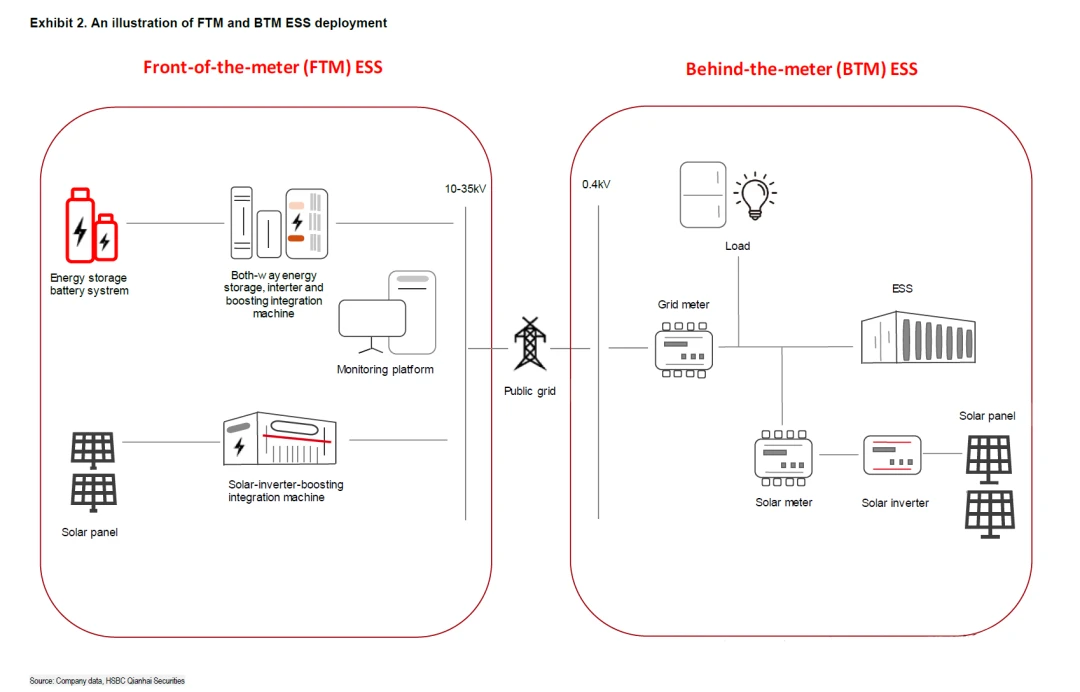
To understand residential energy storage, it's crucial to distinguish between two concepts: Front-of-the-meter (FTM) and Back-of-the-meter (BTM).
FTM, or Front-of-the-meter, is generally understood as "energy storage before the meter." It serves the power grid, power plants, and large-scale power systems, primarily for peak shaving, ancillary services, and enhancing the integration of renewable energy. BTM, or Behind-the-meter, is installed after the electricity meter, serving end-users such as households, businesses, and factories. Residential energy storage is a significant component of BTM.
This distinction fundamentally determines their completely different business models.
Front-of-the-meter energy storage is more like infrastructure engineering. Customers are concerned with whether the supplier has experience with large-scale projects, its financing capabilities, and its long-term operation and maintenance capabilities. Back-of-the-meter energy storage, on the other hand, is closer to distributed energy products. Users are concerned with ease of installation, reasonable payback periods, reliable after-sales service, and whether the system can truly reduce electricity costs.
In other words, the core question for FTM is "what does the grid need?", while the core question for BTM becomes "why would users be willing to buy it?"
II. From large-scale savings to household savings: the growth logic is shifting.
This isn't the first time residential energy storage has seen such a surge. It was quickly brought to the forefront during the last major fluctuation in European energy prices. Many households installed solar panels and batteries to enhance their energy security in the face of soaring electricity prices and unstable power supply.
However, today, the driving factors for residential storage are no longer just "emergency" needs. HSBC points out that Base-to-Trend (BTM) energy storage has several noteworthy features compared to Ground-to-Trend (FTM): it is closer to the user, can be integrated with distributed solar power, and reduces long-distance transmission losses; it is more sensitive to electricity price fluctuations, and when the peak-valley price difference widens, the payback period for user-side energy storage will be significantly shortened; it is also more likely to benefit from policy changes in emerging markets, as many countries, after increasing solar penetration, gradually shift their policy focus from "encouraging solar installation" to "encouraging energy storage."
There is a very real background to this. Over the past decade, distributed solar power has rapidly spread globally, and many regions are increasingly reliant on solar power for daytime electricity supply. However, the problems with solar power are also obvious: more is generated at noon, and more is consumed at night. If the grid does not have sufficient regulation capacity, phenomena such as daytime curtailment, evening power shortages, and widening peak-valley price differences will occur. Residential energy storage perfectly fills this gap: it stores electricity during the day and discharges it at night; it charges at low prices and uses it at higher prices; and it can serve as a backup power source during power outages.
From another perspective, the most interesting aspect of residential energy storage lies here. It's not a standalone device, but rather the result of the combined effects of photovoltaic penetration, electricity pricing mechanisms, grid pressure, and user electricity consumption habits. So the question arises: is this change accidental?
III. a surge in household savings deposits often begins with a policy shift.
Many people worry that residential energy storage relies too heavily on policy. This concern is indeed valid. Without subsidies, peak-valley pricing, and a clear grid connection and settlement mechanism, users are unlikely to proactively bear the initial investment in an energy storage system. However, HSBC offers a more explanatory framework: energy storage policies typically don't change randomly, but rather progress through different stages as the penetration rate of new energy sources increases.
In the first stage, the policy focus is on encouraging photovoltaic (PV) installations. The government uses feed-in tariffs, net metering, and subsidies to encourage users to install PV systems first. In this stage, energy storage isn't necessarily economically viable because the electricity generated by PV can be sold to the grid relatively smoothly, making batteries an additional cost.
In the second stage, policies begin to encourage energy storage installations. As the proportion of PV and wind power increases, the pressure on the grid to absorb the power increases. Traditional net metering policies may gradually shift to net settlement, reducing the revenue from PV grid connection and increasing the value of self-consumption by users. At this point, energy storage transforms from an "optional" option into an important tool for increasing PV revenue.
In the third stage, the policy focus shifts to the use of energy storage. Energy storage is no longer just a battery for home use, but can be connected to virtual power plants, participate in electricity market regulation, and even provide flexibility services to the grid by aggregating a large number of distributed energy storage resources.

Germany serves as a prime example. From 2018 to 2025, Germany's compound annual growth rate (CAGR) for energy storage installations reached 53%, exceeding the growth rate of photovoltaic installations during the same period. This growth was driven by a combination of factors, including rising residential electricity prices, declining energy storage costs, and policy incentives. More importantly, as Germany gradually enters its third phase, household energy storage is shifting from a "power-saving tool" to an "arbitrage asset": users are not only concerned with their own consumption but also with how to obtain higher returns through time-of-use pricing, virtual power plants, and electricity market mechanisms.
This is also the difference between the second wave of household energy storage growth and the first.
The first wave was more like defensive demand driven by the energy crisis; if a second wave occurs, it is more likely to stem from the restructuring of the power system itself.
IV. Household savings opportunities are diverging from Europe to emerging markets.
Assessing the potential of residential energy storage in a country or region cannot be based solely on solar irradiance or household income. The two more crucial variables are: electricity prices and energy storage penetration rates.
HSBC has constructed a four-quadrant framework based on these two variables: regions with high electricity prices and low energy storage penetration rates represent high-potential markets; regions with high electricity prices and high energy storage penetration rates resemble mature markets; regions with low electricity prices and low energy storage penetration rates are often policy-driven markets; and regions with low electricity prices and high energy storage penetration rates have relatively limited growth potential.
This framework is well-suited for analyzing global residential energy storage market opportunities.
In European markets such as Germany and Italy, where residential electricity prices are high and energy storage penetration rates are already relatively high, the future focus may not be on explosive growth in installed capacity, but rather on system quality, intelligent dispatch, virtual power plants, and operation and maintenance services. Markets like Australia and Brazil are more like high-potential regions: electricity prices are not low, but there is still room for improvement in energy storage penetration rates. As for many emerging markets, their residential electricity prices may not be high enough, and electricity cost savings alone may not be enough to drive large-scale installations. However, new demand may be generated due to grid instability, power supply security, and policy support.

The chart above categorizes different countries into four quadrants based on electricity prices and energy storage penetration rates, making it easier to understand why residential energy storage hasn't seen a simultaneous boom in all markets. Researching residential energy storage shouldn't focus on just one country. Europe's logic is high electricity prices and virtual power plants, Australia's logic is subsidies for energy storage after the widespread adoption of solar PV, and emerging markets' logic might be grid reliability and energy security. Superficially, it's all about "buying a battery," but the underlying drivers are quite different.
V. Household savings are crossing a critical point.
Whether users will ultimately install energy storage depends on a cost-benefit analysis: how much will it cost, how many years will it take to recoup the investment, and can it operate stably?
HSBC breaks down the factors affecting the payback period into detailed categories: on one hand, there's revenue, primarily from peak-valley price differences and electricity arbitrage; on the other hand, there are costs, including batteries, inverters, installation, grid connection, and operation and maintenance. As long as revenue increases and costs decrease, the economic viability of residential energy storage will be re-evaluated.
Let's look at the revenue side first.
With the increased proportion of renewable energy, the intraday fluctuations in the power system will become larger. During the day, higher solar power generation may lead to lower electricity prices; at night, peak electricity demand may cause prices to rise again. Taking Europe as an example, the intraday peak-to-trough price spread in Germany, France, and Spain had widened significantly in March 2026 compared to 2021. Specifically, the spread in Germany widened from €56/MWh to €214/MWh, in France from €40/MWh to €159/MWh, and in Spain from €40/MWh to €223/MWh.


Let's look at the cost side.
Installation costs are an easily underestimated aspect of the economics of residential energy storage. In mature markets like Europe and Australia, electrical engineering, certification, installation, and grid connection costs are not low. HSBC points out that in these regions, installation costs can account for around 20% of the total deployment cost of residential energy storage. Low-voltage energy storage solutions have the potential to reduce overall deployment costs because of their relatively lower installation requirements, easier expansion, and greater flexibility in terms of certain battery specifications. According to HSBC estimates, low-voltage solutions can reduce deployment costs by 20%-40% compared to high-voltage solutions; if the energy storage capacity is increased from 5kWh to 10kWh, the deployment cost per kWh could also decrease by 10%-20%.


The table above shows the differences in payback periods across different countries, capacities, and voltage schemes.
The widespread adoption of many technologies is not due to a sudden breakthrough in a single performance aspect, but rather to the simultaneous improvement of multiple small variables. A steeper electricity price curve, lower installation costs, longer battery life, and smarter software scheduling-all these factors combined transform a payback period from "seemingly unprofitable" to "something to seriously consider."
Residential energy storage is approaching this tipping point.
VI. AI is transforming home energy storage from a "backup power source" into an "energy manager".
Viewing residential energy storage merely as a battery might underestimate its future potential.
In the new electricity market environment, the real value lies not in the "battery itself," but in when to charge and discharge it, how to protect its lifespan, and how to participate in electricity trading. This problem is difficult to solve with fixed rules because user load, electricity prices, weather, and solar power generation are all constantly changing. The role of AI is to find optimal solutions among these variables.
HSBC mentions that AI can enhance the value of energy storage in several ways: improving arbitrage profits by predicting electricity prices and usage behavior; extending battery life by optimizing battery health; reducing unplanned downtime and maintenance costs through anomaly detection; and reducing after-sales costs through more user-friendly interactive systems. Quantitative impacts include: AI-driven dispatching is expected to increase arbitrage profits by 15%-20%, and maintenance costs may decrease by 10%-40%.
This is why future competition in residential energy storage won't be limited to hardware prices.
When residential energy storage is connected to a virtual power plant, becoming a dispatchable, tradable, and aggregated distributed energy node, its value will no longer be just about "whether the lights will stay on during a power outage," but rather "whether it can continuously generate profits or save money in a complex electricity pricing environment."
Past residential energy storage was like a backup power source; future residential energy storage will be more like a mini-electricity trader in your home.
VII. Behind the surge in household energy storage lies a restructuring of the energy system.
Connecting the dots reveals that the logic behind residential energy storage is not complex.
Increasing photovoltaic penetration puts pressure on the grid to absorb the energy; electricity pricing mechanisms are shifting from fixed subsidies to more market-based settlements; widening peak-valley price differences increase the arbitrage value of user-side energy storage; optimized low-voltage solutions, system integration, and installation processes reduce deployment costs; and AI and virtual power plants further improve the operational efficiency of energy storage assets.
These changes combined mean that energy storage is no longer just a grid-side accessory, but is beginning to become an energy asset that households, factories, and businesses can actively configure.
Of course, residential energy storage won't explode in all markets simultaneously. It remains constrained by policy pace, electricity pricing mechanisms, installation costs, product safety, grid connection rules, and after-sales service capabilities. Some emerging markets still require policy "ignition," while mature markets face greater challenges in system quality and long-term operational capabilities. Furthermore, while the base-to-market (BTM) sector has higher growth potential, it is highly sensitive to policy changes, raw material costs, and the competitive landscape.
However, the direction is becoming clear. The first wave of residential energy storage explosions often stemmed from the need for security during the energy crisis; the second wave, if it does occur, will be driven by a more systemic approach: it will come from grid pressure following the high penetration of renewable energy, from users' proactive management of electricity price fluctuations, and from new rules governing the participation of distributed energy assets in the electricity market.
The next stage of residential energy storage may not just be about selling more batteries, but about redefining "how ordinary users participate in the energy system." When a battery is installed in a home, it connects not only to solar panels and meters, but also to a reconstructed electricity world.
Send Inquiry