




















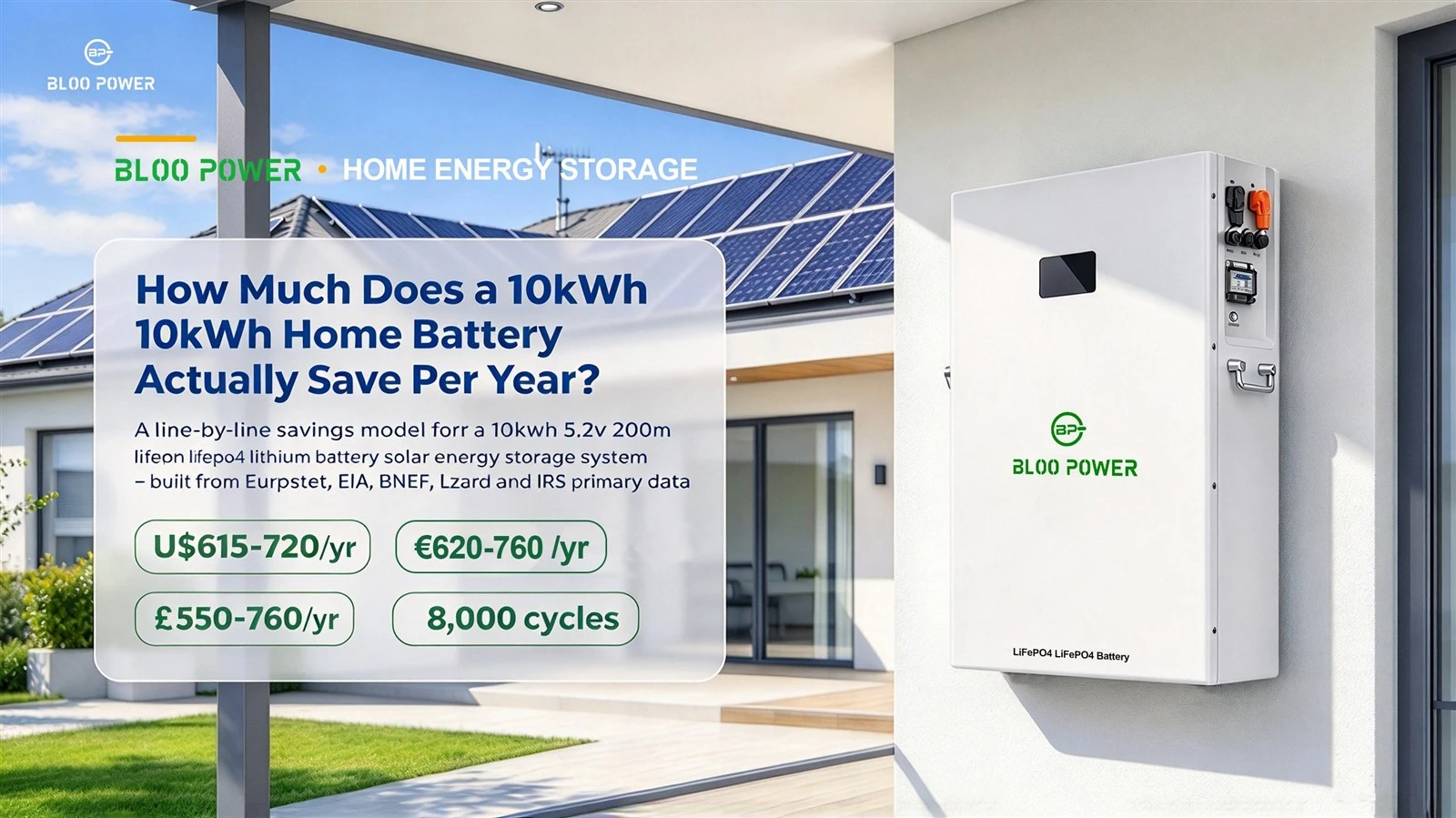
How Much Does a 10kWh Home Battery Actually Save Per Year?
Oct 09, 2026
Leave a message

|
What this guide answers
|
A homeowner in Munich, Manchester or Modesto who types "how much can a 10kWh home battery save per year" is asking a question the industry almost never answers with a defensible number. What they get instead is a marketing range - "save up to 90% of your electricity bill" - that is true only inside an imaginary house that has no winter, no clouds, no standing load and no efficiency losses. This article does it the other way round: it starts with a firm price anchor from a statistics office, subtracts a measured efficiency loss, and reports what is left.
The unit we model is the most widely shipped residential format in the world: a low-voltage wall-mount pack built as 16 series LiFePO4 cells at 51.2 V nominal, 200 Ah, 10.24 kWh nameplate, 80% depth of discharge and a 8,000-cycle rating at 25 °C. That specification is not arbitrary - it is what BLOO POWER ships as the BP-HP-10KWH-A, and it is close to what almost every tier-one residential ESS enclosure in Europe and North America contains. Sizing the battery smaller makes the savings negligible; sizing it larger usually leaves you with capacity you never cycle.
Two conventions before we start. All currency figures are in the currency of the market being described, converted once and never mixed inside a table. Second, we separate cash savings (money that does not leave your bank account) from non-cash benefits (backup power, carbon, comfort). Many articles merge them; doing so is how a battery that pays back in 14 years is presented as one that pays back in four.
01 - THE MARKET
Why 10 kWh became the default size for lithium batteries for home energy storage
Three data points explain why a ~10 kWh pack, rather than a 5 kWh or a 20 kWh one, is the module most households settle on when they first specify lithium batteries for home energy storage.
Cost has collapsed to the point where the battery is no longer the expensive part of the decision. BloombergNEF's 2025 Lithium-Ion Battery Price Survey put the global volume-weighted average lithium-ion pack price at US$108/kWh, down 8% year on year and roughly 93% below 2010 in real terms. The number that matters for this article, though, is the stationary-storage line: packs for stationary applications averaged US$70/kWh, down 45% in a single year, with the lowest observed LFP pack at US$50/kWh and the lowest LFP cell at US$36/kWh. Stationary storage became the cheapest battery segment in the world for the first time. When the cells cost this little, the enclosure, the BMS, the inverter interface and the installer's labour dominate the invoice - which is exactly why the industry standardised on one or two enclosure formats instead of a long tail of sizes.
Chemistry standardised on LFP. Roughly 80% of new stationary storage deployments now use lithium iron phosphate rather than nickel-manganese-cobalt. BNEF's 2025 survey puts average LFP pack prices at US$81/kWh against US$128/kWh for NMC. LFP gives up energy density - around 180 Wh/kg against NMC's 240 Wh/kg - and in exchange delivers better thermal stability, a materially longer cycle life and no exposure to cobalt price shocks. For a wall-mounted box in a garage, energy density is irrelevant; cycle life and thermal behaviour are everything. That single trade-off is why LFP rather than NMC is now the default choice for lithium batteries for home energy storage almost everywhere outside the far north.
The tariff environment moved in the battery's favour on both sides of the Atlantic. In the EU, Eurostat's household electricity price series shows an EU average of €28.96 per 100 kWh (€0.2896/kWh) in the second half of 2025, with Ireland highest at €40.42 and Germany at €38.69 per 100 kWh - and taxes and levies now making up 28.9% of the bill, so the pre-tax price decline never reaches the consumer. In the US, the EIA's Electric Power Monthly puts the national average residential price at 17.30 ¢/kWh for 2025, rising to 18.19 ¢/kWh for the year to date in 2026, with individual states far above that. High and rising retail prices are the fuel; the battery only needs a spread to burn.
The upshot is a market where a 10 kWh enclosure is a commodity and the differentiator has moved to engineering. That is why a serious buyer evaluating lithium batteries for home energy storage now spends more time on the BMS specification, the certification stack and the low-temperature charge window than on the cell chemistry, which is essentially settled.
02 - THE SPEC
What "10 kWh" actually means: nameplate versus usable energy
The single most common source of disappointment in a home battery installation is the assumption that a 10 kWh battery delivers 10 kWh. It does not, and the gap between the label and the meter is where a large part of the payback calculation is lost. Everything in this section applies unchanged to any 10kwh 51.2v 200ah lifepo4 lithium battery solar energy storage system, whichever enclosure it arrives in. Three numbers sit between nameplate energy and energy actually delivered to your house: depth of discharge, round-trip efficiency, and the auxiliary draw of the battery management system and inverter.
Table 1 converts specifications into actual usable energy, using the BLOO POWER BP-HP-10KWH-A wall-mounted battery as an example. All data in the right-hand column are derived directly from the manufacturer's specifications and have not been calculated or estimated.
Table 1 - Decoding the nameplate: BP-HP-10KWH-A wall-mount battery
|
Parameter |
Published value |
Effect on usable energy |
|
Cell chemistry & configuration |
LiFePO4, 16 cells in series (16S) |
- |
|
Rated voltage |
51.2 V nominal |
- |
|
Rated capacity |
200 Ah |
- |
|
Rated (nameplate) energy |
10.24 kWh |
10.24 kWh |
|
Operating voltage window |
40 – 58.4 V |
Full range available |
|
Depth of discharge (DOD) |
80% |
8.19 kWh daily cycling window |
|
Round-trip efficiency (RTE) |
≈95% typical for an LFP pack + hybrid inverter |
Charging cost 8.62 kWh to refill 8.19 |
|
Cycle life |
8,000 cycles at 80% DOD, 25 °C |
53 MWh lifetime throughput |
|
Continuous charge / discharge |
40 A / 40 A nominal; 160 A / 200 A max |
2.0 kW nominal, 8.2 kW peak |
|
Charge temperature window |
0 – 55 °C |
No charging below 0 °C |
|
Discharge temperature window |
−10 – 55 °C |
Full window in operation |
|
Net energy delivered per daily cycle |
After DOD and RTE |
≈7.78 kWh to the load |
Source: BLOO POWER product datasheet for BP-HP-10KWH-A (51.2 V / 200 Ah / 10.24 kWh wall-mount). RTE of 95% is the mid-range assumption for an LFP pack paired with a modern hybrid inverter; the datasheet does not publish an RTE figure, so treat it as a modelling input, not a vendor claim. Lifetime throughput = 8.19 kWh × 8,000 cycles.
Usable energy = Nameplate × DOD = 10.24 kWh × 0.80 = 8.19 kWh
Grid-side charge cost = 8.19 ÷ RTE = 8.19 ÷ 0.95 = 8.62 kWh
Energy lost per cycle = 8.62 − 8.19 = 0.43 kWh (5.0%)
Annual cycles at 350 days = 350 → annual discharge 2,867 kWh
Two things follow from this. The first is that the 5% round-trip loss is not free. Over 350 cycles it burns 150 kWh of energy that you paid for and never used - at an EU average household rate of €0.29/kWh that is about €44 a year, and it must be subtracted from the gross arbitrage gain before you compare anything. Any savings model that quotes a raw discharge total without mentioning this is overstating the case by roughly 5%.
The second is that 8,000 cycles is a genuinely large number, and it changes the ownership question. At 350 full cycles a year, the pack is rated for roughly 18.5 years of daily cycling before reaching its end-of-life capacity threshold. Real households rarely cycle the full window every single day, so in practice the calendar life of the electronics - and the inverter, which typically needs replacing at 10–15 years - tends to end the story before the cells do. The practical read: a correctly specified LFP pack of this class will outlive the payback period of almost any realistic residential installation, and residual value for second-life use is a genuine, if unquantified, asset.
|
The cold-weather constraint most quotes omit
The BLOO POWER wall-mount datasheet specifies a charge window of 0 – 55 °C and a discharge window of −10 – 55 °C. That asymmetry is deliberate and it is not a quirk of this vendor: charging a lithium cell below 0 °C causes lithium plating on the anode, which permanently reduces capacity and creates a genuine safety risk. If you intend to install any battery in an unheated garage in a market with real winters - the Nordics, Canada, much of the northern US - the specification must include either a heated enclosure, a BMS that gates charging on cell temperature, or a self-heating film. A brochure that says "−10 °C operating temperature" without distinguishing charge from discharge is describing the discharge window only. |
03 - THE FRAMEWORK
Six Key Value Streams: The Real-World Benefits of Lithium-Ion Battery Energy Storage
It is unfortunate that the benefits of residential lithium-ion battery energy storage systems are often reduced to the single slogan of "electricity bill savings." In reality, their value stems from six distinct streams, each with unique economic characteristics. The ability to accurately distinguish between these value streams determines whether a proposed solution stands up to scrutiny.
Cash-Generating Benefits of Lithium-Ion Battery Energy Storage
The first three categories represent cash-generating benefits. Time-of-use arbitrage involves charging the battery when grid electricity prices are low and discharging it when prices are high; this model does not require a solar PV system and can be implemented simply by utilizing a rate structure with price differentials. Increasing self-consumption involves capturing solar energy-which would otherwise be exported to the grid at a low or near-zero price-and using it within the home; this model requires a solar PV system, and in all the markets we have modeled, the financial returns from this stream far exceed those of the other two. Peak and demand-charge avoidance applies to scenarios where utility rates include capacity charges or impose very high fees during specific evening hours-a situation becoming increasingly common as grid operators adjust pricing strategies for the 4 PM to 9 PM window.
Non-Cash Benefits of Lithium-Ion Battery Energy Storage
The remaining three categories offer real value but do not translate directly into cash flow. Backup power and resiliency provide "insurance value"; homeowners often value this more highly than its actuarial worth, yet there is currently no objective method to price it. Consequently, we list this benefit separately and exclude it from total revenue figures. Revenue from grid services and Virtual Power Plants (VPPs) can generate cash income in a limited number of markets, but in most markets, the return is zero. The value derived from carbon emissions reduction and compliance represents a form of reporting asset rather than direct savings on electricity costs; however, for any enterprise or entity required to disclose Scope 2 emissions data, its business significance is becoming increasingly apparent.
Table 2 - The six value streams, ranked by cash contribution for a 10 kWh home battery
|
Value stream |
Requires |
US (CA, NEM 3.0) |
Germany |
UK |
Cash? |
|
1. Self-consumption uplift Export credit converted into avoided peak purchase |
Solar + battery |
$525–590 |
€560–640 |
£430–500 |
Yes |
|
2. Time-of-use arbitrage Off-peak charge, peak discharge, no PV needed |
TOU tariff |
$90–130 |
€60–120 |
£120–260 |
Yes |
|
3. Peak / demand charge avoidance Capacity-based or punitive evening blocks |
Specific tariffs |
$0–400 |
€0 |
£0 |
Yes |
|
4. Backup & resiliency Outage ride-through, storm protection |
Critical-load panel |
Not cash |
Not cash |
Not cash |
No |
|
5. VPP / grid service revenue Aggregated demand response |
Qualified program |
$0–180 |
€0–150 |
£0–120 |
Market-dependent |
|
6. Carbon & compliance Scope 2 reporting, embodied-carbon labelling |
Disclosure need |
~350 kg CO₂e/yr |
~230 kg CO₂e/yr |
~210 kg CO₂e/yr |
No |
|
Defensible cash total |
$615–720 |
€620–760 |
£550–760 |
- |
|
Source and method: modelled by BLOO POWER from Eurostat household electricity prices (H2 2025), EIA Electric Power Monthly (2025–2026), the German EEG feed-in tariff schedule published by the Bundesnetzagentur (7.70 ct/kWh partial feed-in, ≤10 kWp, from 1 August 2026) and the UK Smart Export Guarantee rate table (standalone rates 3–6 p/kWh, bundled 12–16 p/kWh, August–September 2026). Carbon figures use Ember's 2025 global average grid intensity of 458 g CO₂e/kWh and EPA eGRID 2023 national average of 767 lb CO₂/MWh (≈0.35 kg/kWh). Streams 1–3 are additive, and the stream-2 column deliberately models only the residual grid arbitrage left over in a solar household - section 4 models the battery-only case separately, where the battery grid-arbitrages all year and stream 2 alone rises to roughly $200–400 / €250–420 / £300–430. Streams 4–6 are excluded from the total. Ranges reflect a 2,000–2,900 kWh annual discharge window rather than a single point estimate.
The table already tells the story that the rest of this article spends 15 sections proving. Stream 1 dominates, and it dominates by a factor of four or five. A battery earns its money in a solar household primarily by rescuing self-consumption - by intercepting kilowatt-hours that the export tariff was about to price at 4–8 pence or cents and delivering them instead to a load that would otherwise have been bought at 26–39 cents. Every other stream is a rounding error next to that one, and any market where the export credit is generous and the retail price is low will produce a battery that does not pay back, no matter how good the hardware is.
Part 2 continues with the arbitrage arithmetic, the self-consumption model, the export-rate collapse now under way in California, Germany and the UK, and the three non-cash streams.
04 - STREAM 1
Time-of-use arbitrage, worked through to the cent
Arbitrage is the simplest of the six streams to explain and the easiest to overstate. You charge the battery when grid electricity is cheap and discharge it when grid electricity is expensive, and the difference is your gross gain. What makes it worth doing carefully rather than assuming is that three of the four inputs - the size of the spread, how many days a year you can actually cycle, the efficiency of the round trip, and the price you paid for the hardware - vary by a factor of three between markets.
Figure 1 shows an illustrative European time-of-use structure of the kind now offered in Germany, the Netherlands, Belgium and by most UK suppliers that have a smart-meter tariff. The shape is consistent across markets even when the numbers are not: a long cheap overnight block, a moderate daytime shoulder, and a short, very expensive evening peak between roughly 17:00 and 20:00, which is precisely when a household's own solar output has already gone.

Figure 1. A battery earns its arbitrage margin in the vertical gap between the peak band and the off-peak band, not in the average price. Note that the evening peak in most European and North American residential tariffs now runs to 20:00 or 21:00 - deliberately later than the afternoon solar peak, which is what makes storage necessary for anyone who wants to offset evening consumption. Tariff shape is illustrative; substitute your own supplier's published bands.
Daily arbitrage gain = (usable kWh × peak price) − (usable kWh ÷ RTE × off-peak price)
Annual gain = daily gain × effective cycling days
Run it in three markets, using published 2026 tariff levels and the 8.19 kWh usable window derived in Table 1.
Germany. A household on a fixed time-of-use contract with an off-peak rate near €0.22/kWh and an evening peak near €0.35/kWh - both plausible against the Eurostat H2 2025 German average of €0.3869/kWh - earns 8.19 × 0.35 − 8.62 × 0.22 = €0.97 per full cycle. At 300 effective days a year that is €291. The spread, not the price level, is doing all the work here: German prices are the second-highest in the EU, but the time-of-use differential on offer from most suppliers is only 12–14 cents, which caps the arbitrage.
United Kingdom. Avoided self-consumption is worth around 26.11 p/kWh against a flat export rate of 3–6 p/kWh under the Smart Export Guarantee, and a time-of-use import tariff can push the overnight charge rate down to roughly 12 p/kWh. That gives 8.19 × 0.2611 − 8.62 × 0.12 = £1.10 per cycle, or £364 a year at 330 cycles. The UK is the most attractive of the three for pure battery-only arbitrage, because the gap between a 12 p overnight import and a 26 p avoided evening purchase is unusually wide - and because SEG export rates collapsed through 2026, so the alternative to storing is being paid almost nothing.
California. The state has the highest retail prices in the continental US, but the standard residential time-of-use differential is narrower than homeowners expect: a typical investor-owned utility rate sets the 16:00–21:00 peak at roughly 49 ¢ against an off-peak of roughly 38 ¢, a spread of only about 11 ¢. That yields 8.19 × 0.49 − 8.62 × 0.38 = $0.74 per cycle, or about $220 a year. Electric-vehicle tariffs with a genuine super-off-peak window do materially better; flat-rate customers do nothing at all.
Taken together, these three cases also explain why the cash benefits of using lithium ion batteries for energy storage systems are so much larger in a solar household than in a battery-only one.
Which brings us to the honest conclusion about stream one. For a battery-only installation, time-of-use arbitrage is the entire business case, and the payback period under a reasonable $8,000–10,000 installed cost for a 10 kWh battery is 20 to 35 years - longer than the pack. If you are weighing a 10kwh battery payback period with time-of-use tariff arbitrage alone, and you do not already have solar, the honest answer in most markets is that the numbers only work if you are also buying something else with the money: outage protection, or a tariff structure your utility has not yet repriced. Section 5 is where the economics actually turn.
05 - STREAM 2
Solar self-consumption uplift - where the money really is
In a house with solar panels, the battery's job changes completely. It stops being an arbitrage machine and becomes a self-consumption device: it intercepts generation that the export tariff was about to price at almost nothing and delivers it to a load that would otherwise have been bought at full retail. The gain is not the price of electricity; it is the spread between the export credit and the retail price, multiplied by every kilowatt-hour the battery rescues.
Figure 2 shows the mechanism directly. A solar-only household with a conventional load profile self-consumes a minority of its generation and exports the rest - a ratio that has been getting worse everywhere as evening peaks move later and household consumption shifts away from the middle of the day. Adding a battery inverts the ratio.
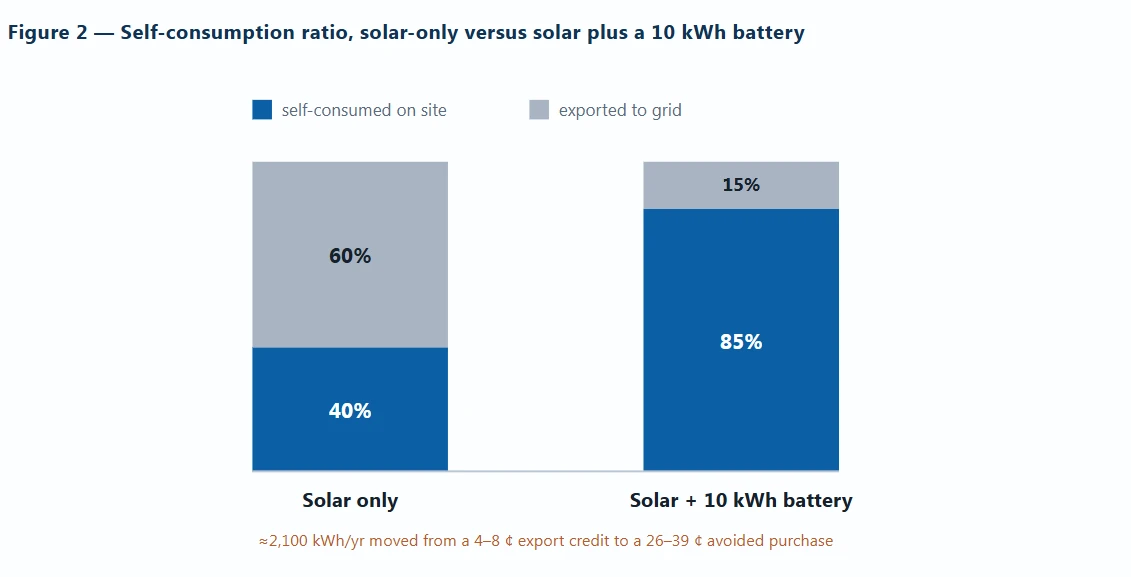
Figure 2. The 40% / 60% split is representative of an unmetered daytime-absent household on a standard load profile; the 85% / 15% split is what a correctly sized 10 kWh battery achieves against a typical European or North American load curve. The shift is worth four to six times more per kilowatt-hour than the export credit it replaces, which is the entire economic argument for residential storage.
How large the gain is depends almost entirely on the size of that spread, so it is worth anchoring on real published prices rather than estimates. Figure 3 plots the Eurostat household electricity price series for the second half of 2025 - the most recent release - for five reference points, because it shows both the size of the retail price the battery is avoiding and the extraordinary dispersion between EU member states.

Figure 3. Source: Eurostat, household electricity prices, second half of 2025. The EU average stood at €28.96 per 100 kWh, with taxes and levies making up 28.9% of the final bill - so the pre-tax decline recorded in the same release never reached consumers. The 3.7× gap between Ireland and Hungary is the single clearest illustration that a storage business case is a function of local prices, not of the hardware.
Put the two figures together and the German case falls out. A 6 kWp rooftop array in southern Germany generates roughly 5,700 kWh a year; a household consuming 4,000 kWh self-consumes perhaps 35% of that without storage and around 75% with a 10 kWh battery. Roughly 2,000 kWh a year therefore moves from the feed-in tariff - 7.70 ct/kWh for systems up to 10 kWp commissioned on or after 1 August 2026, per the Bundesnetzagentur schedule - to an avoided purchase at the Eurostat German household price of 38.69 ct/kWh. That is a gain of 30.99 cents per kilowatt-hour, or about €620 a year. Subtract the 5% round-trip penalty on the stored energy, roughly €30, and the German net figure lands at €590–640, which is the number in Table 2.
Two things about the German policy environment make this case stronger than the raw arithmetic suggests. The Solarspitzengesetz that took effect in February 2025 removed feed-in support entirely during quarter-hours of negative wholesale prices; generation in those windows is now worth zero, which raises the value of self-consuming it. §9 EEG caps feed-in at 60% of installed capacity unless a smart meter and a controllable device are fitted - a cap that applies to export, not to generation, and therefore does not penalise self-consumption at all. Both changes point the same way: German policy has been quietly transferring value from export to self-consumption since 2025, and storage is the instrument that captures it.
This is also why the question of which is the best LiFePO4 battery for solar self-consumption in Europe has a slightly counter-intuitive answer. What matters is not peak power - a household load almost never needs more than 3 kW - but the usable energy window and the round-trip efficiency, because the entire gain is the difference between two prices that are only ~30 cents apart. A pack with 95% round-trip efficiency captures 5% more of that spread than one at 90%, worth €30–50 a year in the German case and considerably more in a market with a wider spread. Capacity claims in the brochure are far less important than consistency between the datasheet and what the BMS actually delivers. It is also the reason lithium batteries for home energy storage should be specified on measured cycle data rather than on a nameplate capacity figure.
06 - STREAM 3
The export-rate collapse: why the battery got more valuable without changing
The clearest structural driver of residential storage economics over the past three years has nothing to do with batteries. It is that the three largest Western solar markets have each independently cut the value of exporting electricity, and in every case the cut has been large.
California's NEM 3.0 - formally the Net Billing Tariff - replaced retail-rate net metering with avoided-cost export credits for systems applying after April 2015 2023. In practice the average export credit fell to roughly 5–8 ¢/kWh, with peak windows reaching 10–20 ¢ and midday hours as low as 2–5 ¢, against retail rates of 28–55 ¢. That is a reduction of roughly 75% in the value of an exported kilowatt-hour. For a solar-only household the bill impact was immediate and large; for a household with a battery it was an opportunity, because the same kilowatt-hour, stored and used on site, still offsets the full retail rate. Independent modelling cited by installers puts the battery's share of the value recovered at roughly 60–70% of what NEM 3.0 removed, and Lawrence Berkeley National Laboratory's 2025 analysis puts solar-plus-battery payback in California at 9–12 years.
Germany's Solarspitzengesetz, in force since 25 February 2025, forfeits feed-in remuneration during any quarter-hour in which the exchange price is negative, with the lost period added to the end of the support term at half rate for solar. Combined with a feed-in tariff that has degressed to 7.70 ct/kWh for partial feed-in on systems up to 10 kWp, the practical effect is that surplus generation in the middle of a sunny day is worth very little - and worth nothing at all in the hours when the grid is most oversupplied.
The UK's Smart Export Guarantee has moved furthest of the three. Rates open to any household without switching import supplier sat at 3–6 p/kWh through the autumn of 2026 - Scottish Power and E.ON Next at 6 p, So Energy at 4.5 p, Octopus at 4.1 p - and the bundled rates that reach 12–16 p all require taking the same supplier for import. Meanwhile avoided self-consumption is worth about 26.11 p/kWh. The ratio is now roughly four to one against exporting, which is the widest spread in any market we model.
Table 3 - What an exported kilowatt-hour is now worth, versus what a self-consumed one saves
|
Market |
Export credit |
Avoided purchase |
Spread |
Ratio |
|
UK - Smart Export Guarantee Standalone rate, no import switch |
3–6 p/kWh |
≈26.1 p/kWh |
20.1–23.1 p |
4.4–8.7× |
|
Germany - EEG partial feed-in ≤10 kWp, from 1 Aug 2026 |
7.70 ct/kWh |
38.69 ct/kWh |
30.99 ct |
5.0× |
|
California - NEM 3.0 Avoided-cost export credit, average all hours |
5–8 ¢/kWh |
33–49 ¢/kWh |
25–44 ¢ |
4.1–9.8× |
|
Full-retail net metering e.g. Florida, North Carolina, many municipal utilities |
Retail rate |
Retail rate |
0 |
1.0× |
Sources: UK Smart Export Guarantee supplier rate tables (August–September 2026) and the avoided-cost figure of 26.11 p/kWh published by UK solar tariff analysis; Bundesnetzagentur EEG feed-in schedule and Eurostat household price for Germany (H2 2025); California Public Utilities Commission Net Billing Tariff avoided-cost export rates as reported by multiple installer analyses; full-retail net metering as it operates in states that have not adopted avoided-cost export. The last row is the one that decides whether a battery is worth buying where you live.
Table 3 makes the boundary condition unambiguous. In a market where export earns full retail, the spread is zero, and the battery's energy value is zero - the kilowatt-hour was going to offset the same retail price whether you exported it or used it later. That is not an argument against installing storage in Florida or North Carolina; it is an argument for being honest that what you are buying there is backup power and outage resilience at an energy cost of approximately nothing, and should be priced accordingly. Buyers who ignore that distinction are the ones who end up disappointed by lithium batteries for home energy storage in low-spread markets. The same hardware in Greater Manchester or Bavaria is a financial instrument. Nothing changed except a line in a tariff schedule.
Where tariffs include a capacity or demand component - increasingly common for commercial customers, and creeping into residential rates in parts of the US - the battery gains a third cash channel. Reducing the highest 15-minute average draw in a billing month can be worth several hundred dollars a year for a small business, and it is one of the few storage use cases where a modest battery produces a disproportionate return, because the value is set by a peak rather than by energy volume.
07 - STREAMS 4 & 5
Backup power and grid services - real value, but not cash
The remaining three streams need to be understood precisely because they are the ones that get inflated in sales conversations. They are also the parts of the proposition that homeowners value most highly even when the cash benefits of using lithium ion batteries for energy storage systems are marginal - which is exactly why they belong in a separate discussion rather than inside a bill-saving headline.
Backup and resiliency
A 10 kWh battery with 8.19 kWh usable, discharged at a household's critical-load-only draw - fridge, freezer, boiler controls, Wi-Fi, router, lighting, a few sockets - will typically carry a home for 12 to 24 hours. That is a genuine, measurable service, and in markets with frequent outages it is the reason people buy. But it is not a bill saving, and it is not additive to the arbitrage arithmetic: to deliver backup, a battery must hold reserve capacity that cannot be cycled for arbitrage, so the two uses compete for the same kilowatt-hours.
The specification detail that decides whether backup works is the critical-load panel. A battery wired to the whole house through the main board will, on most installations, fail to energise anything during an outage unless the inverter supports islanding with a dedicated backed-up circuit. Retrofitting one after the fact costs more than specifying it at the outset. Ask for a drawing that shows exactly which circuits are backed up, and confirm that the changeover is automatic and within a stated time in milliseconds - not "seamless" in a brochure.
Grid services and virtual power plants
Aggregated residential storage is now a real revenue stream in a handful of markets and a marketing promise in most others. Where it works - parts of Australia, Texas, New England, California, and a growing number of European flexibility markets - an enrolled battery can earn anything from €50 to €300 a year for allowing a third party to dispatch it during grid stress events. Where it does not, "VPP-ready" means only that the inverter has a Modbus register someone could one day write to. Three questions separate the two: whether the program pays for availability or only for dispatch, how many events a year are contractually permitted, and who owns the warranty risk on the extra cycles. A contractual promise to cycle the battery 40 extra times a year is a real cost if the warranty is cycle-limited.
Two practical points about grid-service revenue. First, availability payments and dispatch payments are not the same thing, and programmes that pay only for dispatch routinely deliver a fraction of the headline figure in a mild year. Second, and more important for anyone modelling a business case: enrolled capacity is capacity you cannot simultaneously use for your own arbitrage. If a dispatch event lands inside your evening peak, the revenue you earned and the saving you gave up can cancel out. Model the two together, never separately.
08 - STREAM 6
Carbon, compliance and a regulation that turns a claim into a document
The carbon arithmetic is straightforward and worth stating precisely, and it is one of the least discussed benefits of using lithium ion batteries for energy storage systems. Ember's 2026 Global Electricity Review puts the global average carbon intensity of electricity at 458 g CO₂e/kWh in 2025, down 2.7% from 471 g in 2024 and the largest annual decline in two decades. In the United States, the EPA's eGRID 2023 dataset puts the national average at 767 lb CO₂/MWh (≈0.35 kg/kWh), with a range from roughly 0.1 kg in hydro-dominated regions to over 0.7 kg in coal-heavy ones. A battery that shifts 2,867 kWh a year from grid supply to self-consumption therefore avoids roughly:
Global average grid = 2,867 kWh × 0.458 kg/kWh = 1,313 kg CO₂e / yr
US national average = 2,867 kWh × 0.350 kg/kWh = 1,003 kg CO₂e / yr
Displaced: the pack carries roughly 700–800 kg CO₂e embodied
Payback on embodied carbon = under one year
Two caveats keep this honest. That in a low-carbon grid - France, Norway, or a US region dominated by hydro and nuclear - the avoided emissions are far smaller, and the embodied-carbon payback stretches out. And that embodied carbon is now a regulated number rather than an estimate. Under the EU Battery Regulation (EU) 2023/1542, carbon-footprint declarations became mandatory for rechargeable industrial batteries above 2 kWh on 18 February 2026, carbon-footprint performance classes apply from 18 August 2026, and the digital battery passport becomes mandatory on 18 February 2027 for industrial batteries above 2 kWh. A residential ESS enclosure is caught by the industrial-battery definition once it exceeds 2 kWh, so from 2027 onward, the carbon content of the battery you install in Europe is a document, not a claim - and a supplier who cannot produce the underlying primary data will not be able to sell into the EU at all. That requirement now shapes procurement for lithium batteries for home energy storage across the whole European market, not just for industrial buyers.
|
Why this matters to a buyer, not just a compliance officer The Battery Regulation's data requirements flow upstream. A manufacturer that cannot obtain verified carbon-footprint data from its cell supplier cannot issue a conforming declaration, and customs authorities can hold non-compliant shipments at the border. When you are evaluating a wholesale China LiFePO4 battery supplier for residential ESS, asking whether they can support a 2027 battery passport is now a commercial question about delivery risk, not an environmental one. |
Part 3 continues with the honest subtractions, the five LCOS metrics that decide whether a quote is real, the chemistry comparison, and the certification stack.
09 - THE SUBTRACTIONS
The honest subtractions: efficiency, standby, degradation and cold
Every savings model published by a battery vendor contains one or more of the following omissions. Each is individually small; together they can turn a €620 headline into a €480 reality, and a 12-year payback into a 16-year one.
Subtraction 1 - Round-trip efficiency, charged on the meter side
An LFP pack paired with a modern hybrid inverter loses roughly 5% of the energy that passes through it, and a further 1–2% in the inverter's own conversion. The correct way to account for this is to compute the charge energy as usable ÷ RTE, which Table 1 did: 8.62 kWh in for 8.19 kWh out. In a market with a 31-cent spread, that 0.43 kWh is worth about 13 cents per cycle, or €46 a year at 350 cycles. It is not a reason to avoid storage; it is a reason to insist on an efficiency figure rather than accepting silence.
01
Subtraction 2 - Standby and parasitic load
This is the one almost nobody mentions. A hybrid inverter with an active BMS and a communications stack draws power continuously - typically 10 to 30 W in idle, more when the display, the Wi-Fi module and the contactors are all live. At 20 W, that is 175 kWh a year of consumption that appears on no datasheet's "energy" line. At the EU average household price of €0.2896/kWh that is €51 a year, and at the German price of €0.3869/kWh it is €68. For a battery-only installation with a €291 arbitrage gross, standby alone consumes 18–23% of the gain. When you are comparing quotes, ask for the inverter's no-load or standby consumption in watts, and multiply it by 8,760 before you compare prices.
02
Subtraction 3 - Capacity degradation and the warranty's throughput cap
A 6,500-cycle rating does not mean the pack delivers its original capacity on cycle 6,500. It means the pack reaches the end-of-life threshold - conventionally 70% or 80% of nameplate - at that point. In practice a well-managed LFP pack loses roughly 2–3% of capacity a year in the first decade, so the energy you actually cycle in year eight is materially less than in year one. The compounding effect on a levelised calculation is modest but real, and it is why a warranty expressed purely in years (a "15-year warranty") is far less informative than one expressed as years and remaining capacity or as a total throughput in MWh. A 10.24 kWh pack with 8.19 kWh usable and 6,500 cycles has a rated lifetime throughput of about 53 MWh; a warranty that does not reference a number in that ballpark is a marketing document.
03
Subtraction 4 - Temperature, in both directions
Two separate temperature effects get conflated. The first is the charge gate: the BLOO POWER wall-mount specification permits charging only between 0 °C and 55 °C and discharging between −10 °C and 55 °C, which is the standard, safety-driven asymmetry across the industry. In an unheated garage in a cold climate, the BMS will refuse charge for part of the winter, and the household silently reverts to grid import - no fault, no alarm, just a smaller saving. The second is derating: usable capacity falls with temperature even inside the permitted window, and some systems spend additional energy heating themselves. Adding a heater to a cold-climate installation can cost a further 50–150 kWh a year, which belongs in the model.
04
Subtraction 5 - The battery competing with itself
A battery cannot simultaneously hold a backup reserve, participate in an evening VPP dispatch event, and cycle its full window for arbitrage. Whatever fraction of usable capacity is reserved for backup is not earning anything. If your installer promises both a 20-hour backup window and full daily arbitrage from the same 8.19 kWh, at least one of those claims is wrong.
05
Gross German gain (Table 2, stream 1) = €620
− round-trip penalty = −€46
− standby at 20 W = −€68
− winter charge-gate shortfall = −€40
Net year-one cash saving = ≈€466
That final number is the one worth putting in a spreadsheet. It is 25% below the gross figure that a marketing page would quote, and it is still a genuinely good outcome - which is precisely the point. A model that only works when the losses are hidden is not a model; it is an advertisement. Everything from here on uses the net figure.
10 - THE METRIC
LCOS: the five metrics that decide whether a quote is real
he only defensible way to compare a 10 kWh battery against a 15 kWh battery, or a cheap low-voltage rack against an integrated all-in-one, is the levelised cost of storage: total lifetime cost divided by total lifetime energy discharged. It is also the only way to compare two vendors who each advertise a ce certification lithium-ion battery for solar energy storage claim without disclosing which standard the claim rests on. It is the residential analogue of the levelised cost of electricity, and it is the number the industry's own benchmarks use.
Lazard's Levelized Cost of Storage analysis, version 10.0 published in 2025, modelled utility-scale standalone storage at 100 MW / 4 hours at US$115/MWh unsubsidised and US$83/MWh with the investment tax credit, with behind-the-meter commercial systems far higher and residential standalone higher again. The 2026 edition (v11.0) revised the utility-scale four-hour range upward to roughly $210–292/MWh and stopped publishing a separate residential line altogether - a useful reminder that these modelled ranges move, and that a residential battery should be modelled from its own installed cost, tariff and cycle count rather than scaled down from a utility project.
Five inputs decide the answer. Get all five and you can compute a defensible LCOS for a 10kwh 51.2v 200ah lifepo4 lithium battery solar energy storage system, or for any competing quote, in about two minutes.
A "$399/kWh" banner price means $399 ÷ 0.80 DOD = $499 per usable kWh before efficiency. Always divide by depth of discharge first - and then ask what the price excludes.
"6,000 cycles" without a DOD, a temperature and a capacity-retention threshold is not a specification. The BLOO POWER figure - 8,000 cycles at 80% DOD and 25 °C - is the format to demand.
The difference between a 90% and a 96% round trip is 6% of your stored energy, every day, for fifteen years. On 2,867 kWh a year that is 172 kWh annually - roughly €50 at EU average prices.
A residential battery system fully installed in the United States runs roughly $700–1,300 per kWh of nameplate capacity, against a pack price of $70–108/kWh. The difference is the inverter, the mounting, the DC and AC wiring, the critical-load panel, the permits, the labour and the installer's margin. That list is identical whether you buy a branded unit or commission an odm lithium ion battery for solar energy storage build; only the enclosure and the logo change.
A hybrid inverter is typically replaced at 10–15 years, and that is a real line item. A model that assumes 20 years of service from a 12-year inverter is understating lifetime cost.
Figure 4 shows why input four matters more than any other. It plots the cost of a kilowatt-hour of storage capacity at each stage from a Chinese LFP cell to a fully installed American residential system, using BNEF's 2025 price survey, NREL's benchmark and published installed-cost data.

Figure 4. Sources: BloombergNEF 2025 Lithium-Ion Battery Price Survey (cell, pack, stationary pack, turnkey project); NREL 2025 utility-scale storage benchmark (US four-hour system); EnergySage and published installer data (US residential, fully installed). Read the bottom bar against the top one. An installed residential system costs roughly 18 to 34 times the cell it contains. Almost none of that multiple is the battery - it is conversion, control, enclosure, installation and margin - which is why a cheap battery in an expensive system is not a cheap system, and why a well-engineered pack with a long cycle life is the smallest lever you have.
The practical application of LCOS is as a filter. When a quote arrives, compute cost per usable kWh, cycle life at a stated DOD, round-trip efficiency, all-in installed cost, and the inverter replacement year. Any quote that cannot supply all five numbers is not ready to be signed. And when a vendor's headline price looks dramatically better than everyone else's, the missing input is almost always number four - the excluded items between the pallet and the wall.
11 - THE CHEMISTRY
LFP versus NMC versus lead-acid: what you are actually buying
Lithium iron phosphate has won the residential storage argument, and it is worth being precise about why, because the reasons are not the ones usually given. LFP is not the cheapest per kilowatt-hour of nameplate capacity in every comparison, and it is not the most energy-dense by a wide margin. What it has is a combination that is almost ideally suited to a stationary application: a long cycle life, an unusually stable thermal profile, and no exposure to the cobalt supply volatility that made NMC prices unpredictable through 2024 and 2025.
BloombergNEF's 2025 survey quantifies the price side: average LFP packs across all segments cost US$81/kWh against US$128/kWh for NMC, and LFP now accounts for roughly 80% of new stationary storage deployments. The performance side is in the datasheets, and it is dominated by cycle life.
Table 4 - Chemistry comparison for stationary residential storage
|
Attribute |
LiFePO4 (LFP) |
NMC |
Lead-acid (AGM / gel) |
|
Average pack price, 2025 |
$81/kWh |
$128/kWh |
$150–250/kWh |
|
Practical depth of discharge |
80–100% |
80–90% |
50% |
|
Cycle life to end-of-life threshold |
8,000–10,000 8,000 published for BP-HP-10KWH-A |
2,000–4,000 |
500–1,200 |
|
Lifetime throughput per kWh of nameplate |
≈5,200 kWh |
≈3,000 kWh |
≈400 kWh |
|
Effective levelised cost of storage |
Lowest |
~2× LFP |
~8–13× LFP |
|
Thermal runaway onset (typical literature values) |
~270 °C, no oxygen release |
~210 °C, oxygen-releasing |
Not applicable |
|
Charging at or below 0 °C |
Not permitted without heating |
Permitted with derating to ≈−20 °C |
Permitted, capacity falls sharply |
|
Typical residential role |
Default choice |
Cold-climate, weight-constrained |
Legacy, lowest-capex only |
Sources and method. Pack prices from BloombergNEF's 2025 Lithium-Ion Battery Price Survey (LFP $81/kWh, NMC $128/kWh, volume-weighted across all segments). Cycle life and DOD are the ranges across mainstream residential cells, with the published BLOO POWER figure shown explicitly. Thermal-runaway onset temperatures are typical literature values for each cathode chemistry and vary with cell design, state of charge and form factor - they are not a vendor specification and should not be treated as a safety guarantee. Levelised-cost ratios are computed from the preceding rows without capex or installation, so they isolate the chemistry effect.
he row that decides real-world outcomes is the fourth one. A kilowatt-hour of nameplate LFP capacity delivers roughly thirteen times the lifetime energy of a kilowatt-hour of lead-acid nameplate, because it can cycle more often and deeper. That is why lead-acid remains cheaper on the invoice and dramatically more expensive on the meter - the classic comparison in which the cheaper product costs more. For lithium batteries for home energy storage, the practical conclusion since roughly 2020 has been that LFP is the only chemistry that produces positive economics, and the falling pack price has made even the capex advantage of lead-acid disappear.
Where the chemistry choice still matters is the cold. NMC's tolerance of sub-zero charging without a heater is a genuine advantage in northern Scandinavia, Canada and the northern United States - and it is the one situation in which accepting a shorter cycle life is rational, provided the tariff spread is wide enough to compensate. Everywhere else, heating the enclosure and staying with LFP is the better engineering trade.
12 - THE PAPERWORK
Certification: what a "ce certification lithium-ion battery for solar energy storage" claim actually proves
Certification is the part of a battery purchase where buyers are most often misled, almost always without dishonesty: the standards system is genuinely confusing, and the vocabulary is used loosely by everyone including some resellers. The confusion stems from a single fact - a certified component is not a certified system, and a CE mark is not a fire test.
The standards stack has four levels, and each level needs its own certificate - which is the first thing to understand before you can evaluate a ce certification lithium-ion battery for solar energy storage claim at all.
Level 1 - Cell: IEC 62133-2 and UN 38.3
Cell level. IEC 62133-2 covers portable sealed secondary lithium cells, and UN 38.3 is the UN transport test that any lithium shipment must hold - altitude simulation, thermal cycling, vibration, shock, external short circuit at 55 °C, impact, overcharge and forced discharge. UN 38.3 is mandatory for air, sea and road freight under IATA, IMDG and ADR/RID rules, and it is the one certificate every legitimate supplier will have. Crucially, it is a transport safety test, not a product safety test.
Level 2 - Module and pack: IEC 62619 versus UL 1973
Module and pack level. IEC 62619 is the key standard outside North America. It covers safety requirements for industrial secondary lithium cells and batteries - including stationary energy storage - testing both the cells (external short circuit, impact, drop, thermal abuse, overcharge, forced discharge) and the battery management system's protective functions (overcharge voltage and current protection, overheat protection, and resistance to thermal runaway propagation). In the EU, UK and Australia, IEC 62619 is effectively the baseline. In North America it is not sufficient: UL 1973 evaluates stationary battery packs and racks for electrical, mechanical, environmental and abuse safety, and it is UL 1973 that the authorities having jurisdiction expect to see.
Level 3 - System: UL 9540 and the UL 9540A test method
System level. UL 9540 evaluates a complete energy storage system - battery, BMS, enclosure and power conversion interface - as a unit, and it is what a US residential installation requires in most jurisdictions. UL 9540A is different and frequently confused with it: 9540A is a test method for large-scale fire propagation that produces the data a fire marshal uses to set separation and ventilation requirements. The 9540A report is a document you should ask to see in full, not a badge. On the inverter side, UL 1741 SA/SB covers grid-support functions and IEEE 1547-2018 covers interconnection performance.
Level 4 - Market access: what a ce certification lithium-ion battery for solar energy storage claim does and does not prove
Market access and installation. CE marking in the EU is a declaration of conformity against the Low Voltage Directive (2014/35/EU), the EMC Directive (2014/30/EU) and RoHS - which is to say that a ce certification lithium-ion battery for solar energy storage mark proves electrical safety, electromagnetic compatibility and restricted hazardous substances, and says nothing whatsoever about fire. It is a legal prerequisite to placing a product on the EU market and it says nothing about thermal runaway behaviour. In Germany, VDE-AR-E 2510-50 adds the grid-connection and safety requirements that distribution system operators demand. In the US, NFPA 855 governs installation: spacing, ventilation, fire suppression and maximum quantities per room. And layered on top of all of it since 2024 is the EU Battery Regulation (EU) 2023/1542, which brings its own CE-marking obligations plus, from 18 February 2026, a verified carbon-footprint declaration for rechargeable industrial batteries above 2 kWh, and from 18 February 2027 a mandatory digital battery passport.
Table 5 - The certification matrix: what each standard covers and whether you need it
|
Standard |
Level |
Region |
What it actually covers |
Status |
|
UN 38.3 |
Cell / pack |
Global |
Transport safety: altitude, thermal, vibration, shock, short circuit, impact, overcharge, forced discharge |
Mandatory for any freight movement |
|
IEC 62133-2 |
Cell |
Global |
Portable sealed secondary lithium cell safety |
Baseline for cells |
|
IEC 62619 |
Cell / module / pack + BMS |
EU, UK, AU, global tenders |
Industrial & stationary lithium battery safety, including BMS protection functions and thermal-runaway propagation assessment |
Effectively required in EU/UK and Australia |
|
UL 1973 |
Pack / rack |
US, Canada |
Stationary battery safety: electrical, mechanical, environmental, abuse |
Required - and not satisfied by IEC 62619 |
|
UL 9540 |
Complete system |
US, Canada |
Whole ESS evaluated as a unit with battery, BMS, enclosure and PCS interface |
Required for most US residential installs |
|
UL 9540A |
System - test method |
US, Canada |
Large-scale fire propagation test; generates the separation data AHJs rely on |
Request the full report, not a claim |
|
UL 1741 SA/SB |
Inverter / PCS |
US |
Grid-support functions, anti-islanding, DER interconnection performance |
Required before interconnection |
|
IEC 62933 |
Integrated ESS |
International |
Electrical energy storage system safety |
Increasingly specified in tenders |
|
CE (LVD 2014/35/EU, EMC 2014/30/EU, RoHS) |
Product / system |
EU / EEA |
Electrical safety, EMC, hazardous substances. A ce certification lithium-ion battery for solar energy storage claim is not a fire test |
Mandatory to place on the EU market |
|
VDE-AR-E 2510-50 |
System |
Germany |
Grid connection and safety requirements for stationary storage |
Required by German DSOs |
|
NFPA 855 |
Installation |
US |
Spacing, ventilation, fire suppression, quantity limits per room |
Design standard for permits |
|
EU Battery Reg. 2023/1542 |
Product / documentation |
EU |
CE marking, carbon-footprint declaration, recycled content, digital battery passport |
Phased 2024 → 2027 |
How to read this table. The levels are cumulative and non-substitutable. A supplier that holds IEC 62619 and UN 38.3 has done genuine work - and still cannot sell into a US residential market that expects UL 9540, because IEC 62619 is a cell and module standard while UL 9540 is a system listing. Conversely, a European buyer who is shown a UL 9540 certificate in place of CE marking and IEC 62619 has been shown the wrong paperwork. Ask for the certificate number, verify it in the issuing body's public database, and confirm that the model number on the certificate is the model you are ordering.
|
The three questions that expose an inflated certification claim 1. Which model number is on the certificate? Certificates are issued to a specific model and configuration. A factory that holds IEC 62619 for a 5 kWh rack does not thereby hold it for a 10 kWh wall-mount, and a firmware or BMS change can invalidate a system certificate. 2. Who issued it, and can I look it up? Legitimate certificates come from accredited bodies - UL, TÜV Rheinland, TÜV SÜD, Intertek, SGS, VDE, Bureau Veritas - and every one of them maintains a public database. If the issuing body has no lookup, the document is not a certificate. 3. Is it "certified" or "certification pending"? A product described as having "UL 9540 in process" cannot be shipped compliantly into the United States until the listing is granted. That is a delivery-risk question, not a technicality. |
One further caution belongs in an article aimed at global buyers. Manufacturer-level management-system certificates - ISO 9001 for quality, ISO 14001 for environment, ISO 45001 for occupational health and safety, IATF 16949 for automotive-grade quality - are evidence of a controlled production process, not of product safety. They belong in a supplier evaluation, and they are frequently presented as though they substitute for product certification. They do not. The distinction applies equally to a single unit of lithium batteries for home energy storage bought for one house and to a container-scale order.
|
Where BLOO POWER sits, stated plainly BLOO POWER publishes CE, FCC, MSDS, UN 38.3, and RoHS certification details on its residential product pages. Additionally, its corporate-level certification list includes UL 1973 and IEC 62619, as well as ISO 9001, ISO 14001, and ISO 45001 certifications. In this article, we have intentionally refrained from claiming UL 9540 or UL 9540A certification for any specific residential model; these are system-level certifications issued for specific configurations that must be verified against the UL Product iQ database for each specific project. If your project requires UL 9540 certification or a UL 9540A report, please request the document numbers and covered model details from the sales team before making a decision-and you should request the same information from other potential suppliers. |
Part 4 models a full year, month by month, then sets out the boundary conditions under which a 10 kWh battery is the wrong purchase - and the sourcing and OEM/ODM questions that decide whether the unit you receive matches the unit you specified.
13 - THE YEAR
What a full year actually looks like, month by month
Savings models are usually presented as an annual average, which hides the most important operational fact about residential storage: a battery does two different jobs in two different seasons, and the second one is what stops the winter from being a write-off.
Figure 5 plots monthly solar generation against monthly battery throughput for a representative 5 kWp array in a mid-latitude European climate, against a household with a conventional evening-and-morning load profile.
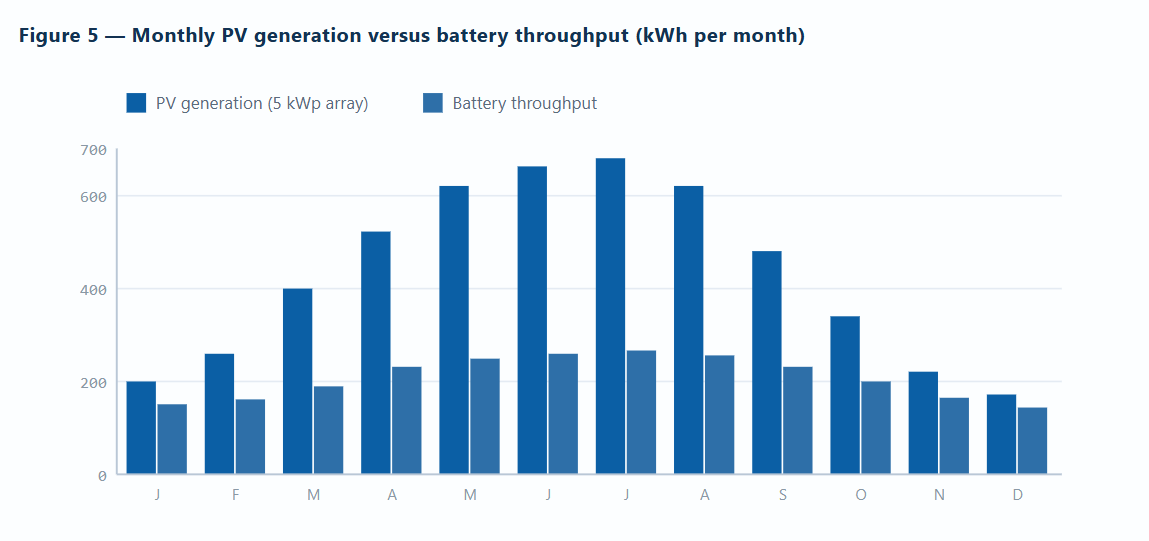
Figure 5. Modelled from a 5 kWp array with a mid-latitude yield profile; annual generation 5,170 kWh, annual battery throughput 2,500 kWh. The shape is the point. PV output varies by a factor of four between July and December; battery throughput varies by less than a factor of two. The reason is that the battery changes job description at the equinox - in summer it stores surplus solar, and in winter it arbitrages the grid instead. A savings model built purely on summer self-consumption will understate winter value in a market with a time-of-use tariff, and overstate it in a market with a flat rate.
The numbers behind the chart matter. Between May and August the battery is almost entirely a solar device: it fills from surplus generation and discharges into the evening peak, and the constraint is the size of the sweet spot between what the array produces and what the house consumes at the time. From November to February the array produces less than the household uses on many days, leaving nothing to store - but the battery is not idle. It charges from the overnight off-peak window and discharges into the evening peak, which is exactly the arbitrage modelled in section 4, and it does so on a much more predictable schedule than solar charging because it does not depend on the weather.
That seasonal switch is also why a 10 kWh battery is not a bad fit for a household with a modest array. A 5 kWp array generating 5,170 kWh a year produces roughly 14 kWh on a good July day and 4–5 kWh on a December day; the battery's 8.19 kWh window is large enough to capture most of a good summer day's surplus and small enough that it does not sit half-empty for six months. Oversizing the battery to 20 kWh would triple the standing capacity without materially increasing annual throughput - the classic mistake that turns a 12-year payback into a 25-year one. It is also why a correctly sized 10kwh 51.2v 200ah lifepo4 lithium battery solar energy storage system outperforms a larger and cheaper pack across a full decade.
The other thing the chart shows is why the "one month of bad weather" objection is weaker than it sounds. A cloudy July still generates materially more than a clear December; what actually dents the model is a bad winter, because that is when the battery depends on the tariff spread rather than on the sun. In a market where the time-of-use differential has been compressed - which is where several European regulators are heading as they re-price network costs - a run of dark, mild winters is the scenario that hurts.
14 - THE BOUNDARIES
Where a 10 kWh battery stops making sense
An article that only endorses is an advertisement. The following conditions are the ones under which we would advise a household not to buy a home battery, or to buy it with different expectations. If none of them applies to you, then the core benefits of using lithium ion batteries for energy storage systems are, in our modelling, real and durable.
You are on full-retail net metering
If your utility credits exported solar at the full retail rate - still the case in Florida, North Carolina, and most municipal utilities in the United States - then the spread that funds the entire business case is zero. An exported kilowatt-hour already offsets a retail kilowatt-hour on your next bill. Adding a battery does not create value; it converts a perfectly good credit into a round-trip loss. Install storage in these markets for resilience, and budget it as you would a generator.
01
Your retail price is low and your spread is thin
The threshold is not a price level but a spread. As a working rule, a battery needs roughly 15 cents per kilowatt-hour of genuine spread - export credit to retail, or off-peak to peak - before the net cash return clears the cost of capital. Below about 10 cents, the arithmetic is negative in most cases. This is why the same hardware produces a 9-year payback in Bavaria and effectively never in a low-tariff US state.
02
Your household consumption is small relative to the pack
A household using 2,500 kWh a year has an average draw of under 300 W and a peak that rarely threatens a 2 kW inverter. A 10 kWh battery is simply too large: it will never cycle its full window, and the capital sits idle. For these households a 5 kWh pack - the same product family, one third the capacity - delivers a better return per dollar. Size the battery to the evening load, not to the annual total. This is the most common sizing error we see in lithium batteries for home energy storage, and it is expensive precisely because the wasted capacity is paid for once and then never earns anything.
03
You have no time-of-use tariff and no solar
Battery-only on a flat rate is the weakest configuration in this entire article, because neither stream 1 nor stream 2 exists. Arbitrage in a market with no cheap window is not arbitrage. If your supplier offers a time-of-use product, switch first and model second.
04
The incentive environment has shifted under you
This is the sharpest boundary for American buyers in 2026. Under the One Big Beautiful Bill Act (Public Law 119-21, enacted 4 July 2025), the Section 25D Residential Clean Energy Credit - which had covered 30% of the cost of residential battery storage with no dollar cap - is not allowed for any expenditure made after 31 December 2025. Because the IRS ties the expenditure to the date the original installation is completed rather than the date of contract, a project that slipped into 2026 lost the credit even if it was signed in 2025. State-administered programs survive: the HOMES and HEAR rebate programmes, California's Self-Generation Incentive Program with its equity tiers, and a patchwork of utility rebates. The effect is that a US residential battery is now priced 30% higher in after-tax terms than it was in 2025, which lengthens payback by roughly four to six years. Contrast the UK, where storage currently benefits from a 0% VAT rate, and Germany, where storage up to 30 kWp is likewise zero-rated - both of which quietly do more for the economics than any grant programme.
05
You are going to move within five years
A battery is not a portable asset in any practical sense, and its contribution to resale value is inconsistent. If your time horizon is under five years, you will not capture the majority of the lifetime value.
06
Cold climate, unheated location, no heater specified
As section 9 set out, a pack that cannot charge below 0 °C will spend part of the winter as an ornament. In a cold climate the specification must include a heated enclosure, a self-heating film or an NMC alternative - and the additional consumption belongs in the model.
07
You expect whole-home backup from 10 kWh
8.19 kWh usable on a critical-load panel gives you 12–24 hours. Whole-home backup, including heating or air conditioning, needs 20–40 kWh and a much larger inverter. Expecting the first from a 10 kWh unit is the most common source of post-installation disappointment we see.
08
Table 6 - Four scenarios, and the verdict that follows from each
|
Scenario |
Tariff regime |
Net cash saving, yr 1 |
Battery-added payback |
Verdict |
|
A. Germany 6 kWp + 10 kWh, 4,000 kWh/yr household |
EEG partial feed-in 7.70 ct; retail €0.3869 |
€466–570 |
11–17 yr |
Buy - strongest self-consumption case |
|
B. United Kingdom 4 kWp + 10 kWh, SEG flat rate |
SEG 3–6 p; avoided purchase ≈26.1 p |
£410–570 |
8–13 yr |
Buy - widest export/retail ratio |
|
C. California 6 kWp + 10 kWh, NEM 3.0 |
Avoided-cost export 5–8 ¢; retail 33–49 ¢ |
$460–540 |
12–18 yr |
Marginal - no federal credit in 2026 |
|
D. Full-retail net metering e.g. Florida, North Carolina |
Export credited at retail rate |
≈$0 |
Never |
Buy only for backup - price as insurance |
Method. Net cash saving is the gross figure from Table 2 after the four subtraction categories in section 9 (round-trip penalty, standby consumption at 20 W, capacity degradation and seasonal charge-gate shortfall). Battery-added payback uses the incremental cost of adding storage to an already-planned solar array - roughly $6,000–9,000 in the US and £4,000–6,000 or €6,000–9,000 in Europe - rather than the full standalone cost, because the inverter and installation are shared. A standalone battery installation, with no solar, has a payback roughly twice as long in every row. All figures are pre-financing and assume the battery is correctly sized to the household's evening load.
15 - THE PURCHASE
How to buy: from china lithium battery energy storage for sale listings to a qualified odm lithium ion battery for solar energy storage partner
The sourcing question is unavoidable, because almost every residential storage product on the Western market contains Chinese cells and most contain Chinese packs. Whether you buy a catalogue unit or commission an odm lithium ion battery for solar energy storage variant, you are almost certainly buying Chinese cells - the only question is who is accountable for them. This is not a compromise; it is a description of the supply chain, and the price data makes the rational sourcing decision obvious.
BloombergNEF's 2025 survey puts average pack prices at $84/kWh in China, against 44% higher in North America and 56% higher in Europe. Chinese production of stationary-storage cells in 2025 is estimated at 557 GWh - more than double global installations in the sector. The consequence is that the price difference between a Chinese pack and a Western-assembled pack is structural, not a temporary discount, and it will not close on its own - which is why a china lithium battery energy storage for sale search will keep returning better unit economics than a domestic catalogue, and why the discipline has to come from the buyer instead.
Reading a china lithium battery energy storage for sale listing, in order
Cell provenance and grade. Ask which tier-one cell manufacturer, which cell part number, and whether the cells are Grade A with intact original QR codes. A supplier who cannot name the cell maker is buying on the spot market, and mixed-grade cells are the single most common cause of premature capacity divergence in a parallel-connected stack - a risk that no china lithium battery energy storage for sale listing will ever disclose, because the listing carries only the finished part number.
BMS architecture. The BMS is where the engineering actually lives. It must provide cell-level (or tight-tolerance cell-group-level) voltage and temperature sensing, active or passive balancing, multi-layer protection covering over-voltage, under-voltage, over-current, short circuit and over-temperature, low-temperature charge gating with a hardware cutoff, and the communication protocols your inverter speaks. On the BLOO POWER wall-mount range that means CAN + RS485 (+ RS232 on some models), which is what a hybrid inverter needs to schedule charge and discharge.
Per-unit ageing test. A serious factory runs every unit through a full charge–discharge cycle before shipment and keeps the record. Ask for the ageing-test certificate that corresponds to your serial numbers, not to the model in general.
Transport documentation in your own name. UN 38.3 must be current and must match the exact model and cell count you are buying, because a BMS change or a change in cell count requires a fresh test. You will also need the MSDS, the freight classification and, depending on the route, a dangerous-goods packing certificate. Shipments held at customs cost far more than the certificate.
OEM, ODM, and what the difference costs
These two terms get used interchangeably and should not be. OEM means a factory builds its existing product with your logo and packaging - no design work, no tooling, the lowest NRE and the fastest route to market. ODM means the factory designs to your specification: enclosure geometry, voltage platform, capacity, discharge rate, communication protocol set, EMS logic, and branding. That is what an odm lithium ion battery for solar energy storage programme actually buys, and it is the only route to a product a competitor cannot simply order from the same catalogue. ODM is what a distributor, an installer group or a regional brand actually needs if it wants a product that no competitor can sell alongside it.
The ODM route has three real costs that buyers routinely underestimate. The first is NRE and tooling, which is sunk and non-refundable. The second is certification re-testing: a new enclosure, a new BMS revision or a different cell configuration invalidates the existing system certificate, so IEC 62619, UL 1973 or UL 9540 must be re-run for the new configuration. The third is the spec freeze - an ODM project without a written, signed and change-controlled specification will drift, and the unit that arrives six months later will differ from the unit that was quoted. Ask for the ODM partner's capability across the full stack - pack design, enclosure design and BMS design in-house rather than outsourced - because a factory that only assembles will produce a different product every batch. An odm lithium ion battery for solar energy storage project that outsources the BMS has outsourced the only part that actually matters.
Commercial terms that matter more than unit price
Incoterms. EXW, CIF, DDP and DDU place very different risk and cost on the buyer, and a DDP quotation that looks 15% more expensive than an EXW quotation is frequently cheaper once freight, duty, dangerous-goods handling and import clearance are counted. For lithium, the freight component is unusually large because of the dangerous-goods classification - it is not a rounding error.
Commercial terms. • MOQ: the ability to take a single sample unit before committing to a container is a genuine qualification signal, and it is standard practice for established exporters. • Lead time: quoted ex-stock times of one to two weeks versus made-to-order times of three to five weeks tell you about inventory depth. • Warranty: a 15-year warranty claim means nothing unless it specifies remaining capacity and a throughput cap; ask for the warranty document, not the warranty sentence. • After-sales: for B2B buyers, ask what happens when a unit fails in the field - remote diagnosis, board-level spares, or on-site engineer support - and get it in writing.
|
Sourcing checklist for a wholesale China LiFePO4 battery supplier for residential ESS ①Named tier-one cell supplier and Grade A documentation - the first line to verify in any china lithium battery energy storage for sale quotation; ② in-house BMS design with low-temperature charge gating; ③ UN 38.3 report matching your exact model; ④ CE, FCC and RoHS on the product, with IEC 62619 or UL 1973 on the pack level where your market requires it - and a ce certification lithium-ion battery for solar energy storage declaration backed by a test report rather than a self-declaration; ⑤ per-unit ageing test records; ⑥ an ISO 9001 / 14001 / 45001 management system; ⑦ a sample-order path before volume commitment; ⑧ a warranty that states remaining capacity and throughput, not just years; ⑨ Incoterms and dangerous-goods documentation agreed in the quotation; ⑩ the ability to support a 2027 EU battery passport if you sell into Europe. |
Read together, these criteria describe a supplier that behaves like a manufacturer rather than a trader. The distinction is testable: a manufacturer will answer the BMS question with a block diagram, a trader will answer it with a datasheet.
Part 5 sets out the three enclosure formats, the eight-line specification to hand to any supplier, and the questions buyers ask most often.
16 - THE HARDWARE
Three form factors, one specification family
The specification derived in Table 1 - 51.2 V, 16 series cells, 200 Ah, 10.24 kWh, 80% DOD, 8,000 cycles - is the reference point, but it is not the only way to buy it. The enclosure decision is driven by three questions: does your inverter already exist, is your installation space wall or floor, and do you expect to expand later. BLOO POWER ships a 10kwh 51.2v 200ah lifepo4 lithium battery solar energy storage system in three configurations to answer those three questions, and the underlying cell, BMS and warranty position is the same across all of them. All three can also be supplied as an odm lithium ion battery for solar energy storage configuration for buyers who need their own enclosure, voltage platform or protocol set.
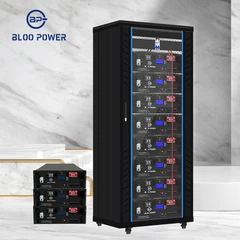
Wall-mount, Battery Only
The reference configuration. A battery-only enclosure with no inverter inside, which is the right answer when you already own a hybrid inverter or want freedom to choose one. Wall-mounting keeps the floor clear and the cable run short.
Rated energy 10.24 kWh
Voltage / capacity 51.2 V / 200 Ah
Cycles @ 80% DOD 8,000
Charge window 0 – 55 °C
Discharge window −10 – 55 °C
Comms CAN / RS485 / RS232
Parallel units up to 16
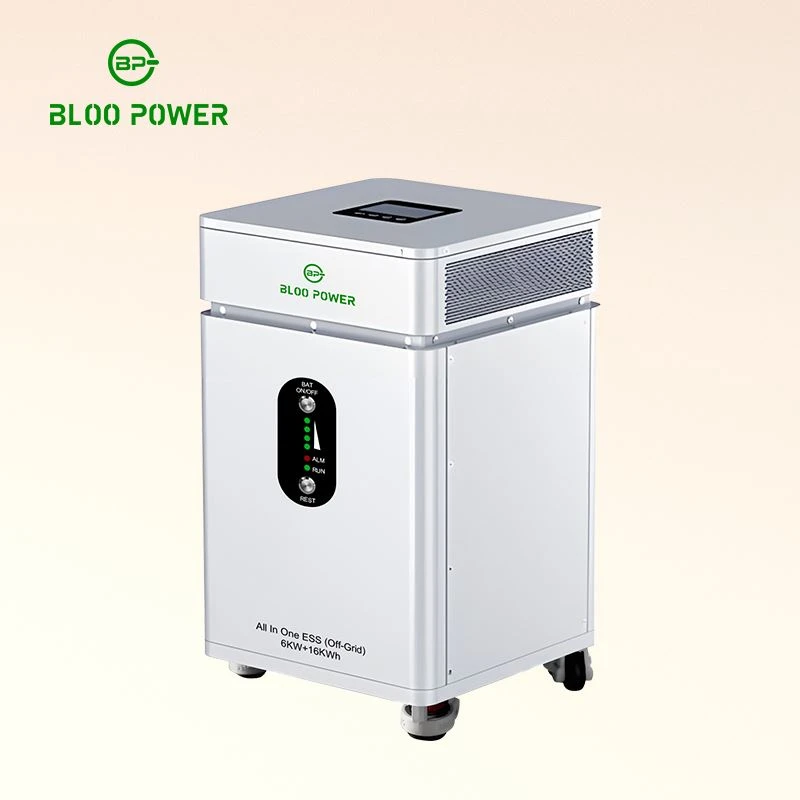
All-in-one ESS
Battery, battery inverter and solar MPPT in a single enclosure on castors. The correct choice when there is no existing inverter and you want a single point of warranty and a single interface rather than two vendors who can blame each other.
Rated energy 10,240 Wh
Voltage / capacity 51.2 V / 200 Ah
Cell arrangement 16S2P
Rated output 5 kW
MPPT range 60 – 180 V DC, 80 A
AC in / out 220 V AC, 50/60 Hz
Comms RS485 / CAN / RS232
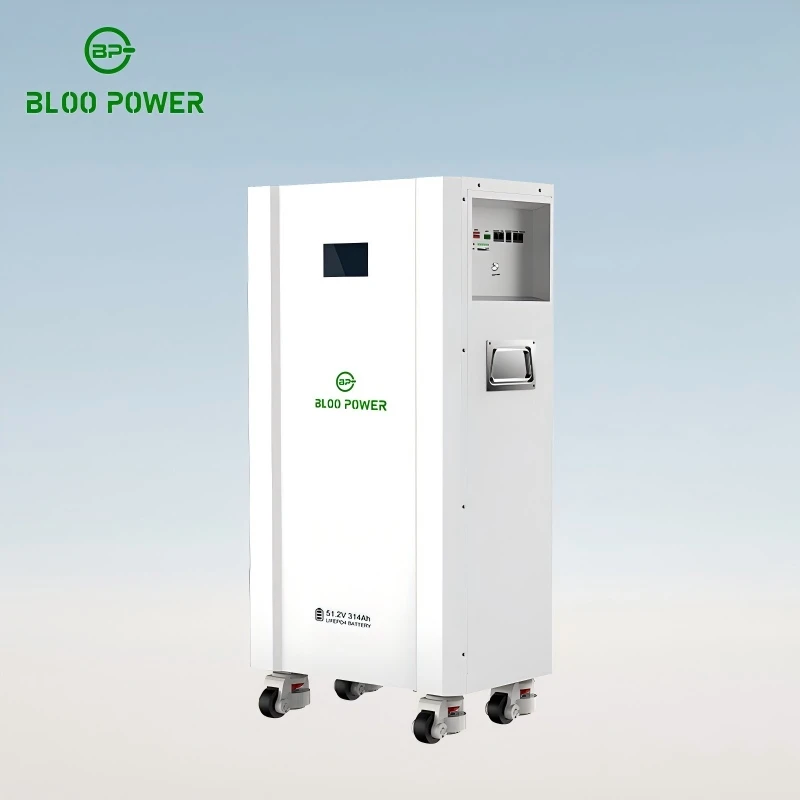
Stackable, Modular
For larger loads, heat pumps and electric-vehicle charging, where 10 kWh is the increment rather than the answer. 5 kWh modules stack in the same footprint, so capacity grows without a new wall or a second enclosure.
Module capacity 5 kWh
Configurations 15 / 30 kWh
Rated cycles 6,500
Chemistry carbon-based LiFePO4
BMS built-in, per module
Display LCD status panel
Certification CE / FCC / UN38.3
A note on the weight and dimension figures, because they are the specification most often taken for granted and most often wrong. Wall-mount units in this class typically run between 78 kg and 120 kg depending on the variant and the enclosure depth - the BLOO POWER range spans both ends - and that matters twice: once for the wall you intend to hang it on, and once for the people who have to lift it up there. Any 10 kWh pack in this class needs a masonry or reinforced stud wall, and the mounting plate should be specified for a static load several times the unit weight. Confirm the exact weight and dimensions against the final datasheet for your specific SKU, and note that variants of the same nominal capacity can differ in both.
Two further engineering points follow from the datasheet. The continuous charge and discharge ratings are modest relative to the capacity - 40 A nominal on the reference wall-mount, giving 2.0 kW, with a peak of 200 A. That is a load-following battery, not a whole-home instantaneous supply, and it is why the all-in-one configuration with its 5 kW rated output exists: a household with an electric shower, an induction hob or an EV charger needs the higher continuous rating. Parallel expansion is a supported configuration, not a workaround: up to 16 units can be paralleled, which takes the family from 10 kWh to a 160 kWh bank using the same BMS and the same enclosure. That is the cleanest upgrade path available in residential storage, and it is worth specifying even if you only intend to install one unit now. For lithium batteries for home energy storage, parallel expansion is what stops a 10 kWh purchase from becoming obsolete the year a heat pump or an electric vehicle arrives.
17 - THE SPECIFICATION
Put this in your specification: eight lines for any supplier
The most useful thing a buyer can do with the preceding sixteen sections is convert them into eight lines of requirements and hand those lines to every supplier being considered. Quotes that answer all eight are comparable; quotes that answer four are not. Run the eight lines against a premium 10kwh 51.2v 200ah lifepo4 lithium battery solar energy storage system and a cheap one, and the difference between them becomes measurable in a single afternoon.
Usable energy, not nameplate energy. State the required usable window - "8 kWh usable at a stated depth of discharge" - and require the supplier to publish both numbers side by side. Add the required continuous power (2 kW for load-following, 5 kW or more for whole-home and EV duty). Require the datasheet of the exact 10kwh 51.2v 200ah lifepo4 lithium battery solar energy storage system you are buying to be attached to the offer, not emailed on request.
01
Cycle life at a named DOD and temperature, plus the lifetime throughput. "6,500 cycles at 80% DOD, 25 °C" is the format. Require the corresponding figure in MWh and require the warranty to reference it.
02
Round-trip efficiency including the inverter. Ask for a measured figure, not a target, and confirm whether it is stated at 25 °C and at 50% state of charge.
03
Charge and discharge temperature windows, stated separately, plus the low-temperature charge strategy. If the installation is in an unheated space below 0 °C, require either a self-heating film, a heated enclosure, or documentary evidence of a BMS hardware charge gate. Do not accept a single "operating temperature" figure.
04
The certification stack, by exact model number. Demand UN 38.3 for the model you are buying, IEC 62619 at pack level for Europe, UL 1973 and UL 9540 for North America, and UL 9540A reports where the authority having jurisdiction requires them. Require the certificate numbers so they can be checked in the issuing body's public database. For European projects that means CE marking plus the test report sitting behind a ce certification lithium-ion battery for solar energy storage claim, not the mark alone.
05
BMS specification in writing. Cell-level or tight-tolerance group-level voltage and temperature sensing, balancing method, all protection functions, and the complete supported protocol list - CAN, RS485, Modbus RTU and whatever your inverter requires. Ask for the block diagram.
06
Standby consumption in watts. One number, and it belongs in the offer. Multiply it by 8,760 before comparing two quotes, because a 35 W inverter against a 12 W inverter is a 200 kWh a year difference.
07
Commercial and lifecycle terms. Incoterms, lead time, per-unit ageing test record, warranty stated as years and remaining capacity and throughput, spares availability, and - for European projects - whether the supplier can support a carbon-footprint declaration and a digital battery passport under EU Regulation 2023/1542 from February 2027. If your quotation originated from a china lithium battery energy storage for sale channel, confirm in writing which party is the certificate holder and which party carries the warranty obligation, because those are frequently not the same company.
08
|
The one-line version If you only remember one thing from this article: the battery's economics are set by the spread between your export credit and your retail price, and its real-world performance is set by four numbers on the datasheet - usable energy, cycle life at a stated DOD, round-trip efficiency and the low-temperature charge window. Everything else is packaging. |
Send Inquiry